Two of Swords Tarot Card Meaning: Upright, Reversed and Symbolism
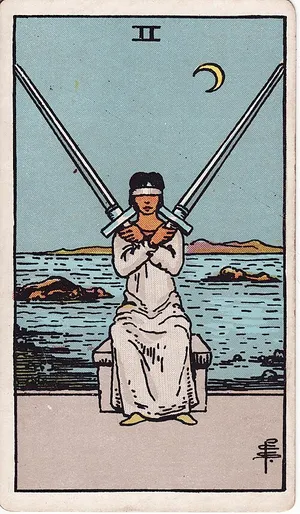

The Two of Swords is the second card of the suit of Swords, one of the four suits that make up the 56 Minor Arcana in the Rider–Waite–Smith tarot, drawn by Pamela Colman Smith and published in London in 1909. It shows a blindfolded woman in white, seated with her back to the sea, her arms crossed over her chest, with a sword in each hand. Upright, it is usually read as a standoff or a decision held in suspense; reversed, as the balance giving way, or the blindfold starting to slip.
Key facts
- Suit: Swords, 14 cards. Readers today commonly associate the suit with thought, speech, decisions and conflict. Today’s common pairing is Air, but schools differ: Papus paired Swords with Earth, and Waite does not specify an element for Swords in this book (see the 1909 Rider–Waite–Smith tarot). It is in this card’s own entry that Waite says “Swords generally are not symbolical of beneficent forces in human affairs”.
- Rank: Two, a numbered card. Like the other numbered cards it has no title, only the Roman numeral II at the top.
- Upright in one line: a stalemate, a truce, a choice not yet made.
- Reversed in one line: the deadlock breaking, information getting through, or the strain of holding it showing.
- Waite’s own key words (1910): conformity, equipoise, courage, friendship, “concord in a state of arms”; reversed, imposture and duplicity.
What the picture shows
A woman sits upright on a low grey stone bench, facing the viewer. She wears a long white robe that falls to the ground, with small yellow shoes showing beneath it, and a white band is tied over her eyes. Her arms are crossed over her chest, and each hand holds the hilt of a sword at the opposite shoulder. The two blades are long and straight, rising outwards in a wide V that reaches almost to the top corners of the card. Waite’s note is brief: “A hoodwinked female figure balances two swords upon her shoulders.” Hoodwinked is the old word for blindfolded.
Behind her, the water stretches to a low line of distant shore in yellow and pink, and dark rocks break the surface on either side. The sky is a pale blue-green, with a thin yellow crescent moon at the upper right. Her bench stands on a flat, pale stone floor in front of the water, so she sits with her back to the sea. Smith’s monogram is at the lower right.
Waite does not explain the moon, the water or the rocks.
Waite’s meanings in 1910
In Part III, §2 of The Pictorial Key to the Tarot, Waite gives the divinatory meanings of the Two of Swords:
“Conformity and the equipoise which it suggests, courage, friendship, concord in a state of arms; another reading gives tenderness, affection, intimacy. The suggestion of harmony and other favourable readings must be considered in a qualified manner, as Swords generally are not symbolical of beneficent forces in human affairs. Reversed: Imposture, falsehood, duplicity, disloyalty.”
His list looks kind at first: courage, friendship, even “tenderness, affection, intimacy”. But he immediately qualifies it. Any harmony here is “concord in a state of arms”, a peace kept with weapons raised, and he warns that the suit as a whole leans away from good fortune. The reversed meaning turns that armed peace into its opposite: deceit and broken loyalty.
In §4, “Some Additional Meanings of the Lesser Arcana”, Waite lists a further set of meanings, which he says are “very often in disagreement with those previously given”. For the Two:
“Gifts for a lady, influential protection for a man in search of help. Reversed: Dealings with rogues.”
These are period fortune-telling formulas, sorted by the sex of the person consulting the cards, and kept here as history. They are not statements about you.
How the card is usually read today
One common modern reading takes the Two of Swords as a mind that has stopped to hold two things in balance. The blindfold shuts out what might tip it one way, and the crossed arms and raised blades keep everything at arm’s length. In that reading the stillness is both a protection and a delay. It is a prompt for reflection, not a forecast.
Upright. Readers often connect it with a decision being put off, two options that seem equally weighted, a truce in a disagreement, or deliberately not looking at something painful. Some see a calm and steady side too: taking time before choosing, rather than rushing.
Reversed. Waite gives “Imposture, falsehood, duplicity, disloyalty”, and some later readers keep that note of deception, including deceiving yourself. More often today the reversed Two is read as the balance becoming hard to hold: new information arriving, the blindfold slipping, a stalemate that can no longer last, or feeling overwhelmed by a choice.
Some questions to sit with:
- What am I choosing not to see, and what does that protect me from?
- If I had to choose today, which way would I lean?
- Is this a pause I have chosen, or one I am stuck in?
Upright and reversed at a glance
| Upright | Reversed | |
|---|---|---|
| Waite, 1910 | Conformity, equipoise, courage, friendship, concord in a state of arms; or tenderness, affection, intimacy | Imposture, falsehood, duplicity, disloyalty |
| Common reading today | A stalemate, a truce, a decision held off | The deadlock breaking; new information; overwhelm |
| A question to ask | What am I keeping out of view? | What is the blindfold no longer hiding? |
The Two of Swords in a spread
Here the card mostly asks what is being held still, and why.
- Three cards (Past, Present, Future). In the Past position, it can point to a choice that was put off and still shapes things. In the Present, it asks where you are holding two sides apart instead of deciding. In the Future position, readers usually take it as an invitation to think about what you would need to know before choosing, not as a fixed event.
- Celtic cross. In the Present position, it can describe a question frozen between two answers. In the Challenge position, it may point to avoidance, or to a truce that is costing more than it saves. In the Self position, some readers ask whether the calm on the outside matches what is going on inside.
The positions of both spreads and the names of all 78 cards are in the tarot glossary; where the deck and its pictures come from is in the 1909 Rider–Waite–Smith tarot.
Cards often read next to the Two of Swords
- Ace of Swords, the card before it: one sword held up in a clear decision, where the Two holds two and decides nothing yet.
- Three of Swords, the card after it: often read as the hurt that a held-off truth can bring once it lands.
- Eight of Swords: in §2, “The Suit of Swords: Eight”, Waite describes another blindfolded woman, “bound and hoodwinked”, and calls that card “rather a card of temporary durance than of irretrievable bondage”.
- Two of Cups and Two of Pentacles: the same rank in other suits, often read as a meeting of two people and as juggling two demands.
In HeyFate, each card you draw is turned upright or reversed at random with even odds, and an AI model writes the reading. This page is the reference behind the card, not a reading of your own question.
Sources
- A. E. Waite, The Pictorial Key to the Tarot, Part III, §2, “The Suit of Swords: Two”, with a short quotation from the entry for the Eight of Swords (Wikisource, from the 1922 reprint)
- A. E. Waite, The Pictorial Key to the Tarot, Part III, §4, “Some Additional Meanings of the Lesser Arcana” (Wikisource, from the 1922 reprint)
- Wikimedia Commons: Swords02.jpg (Pam-A scan, public domain)
AI-generated content, for reference only; not medical, legal, financial or psychological advice. These methods come from cultural traditions, and HeyFate offers them for cultural interest, entertainment and self-reflection.