Two of Pentacles Tarot Card Meaning: Upright, Reversed and Symbolism
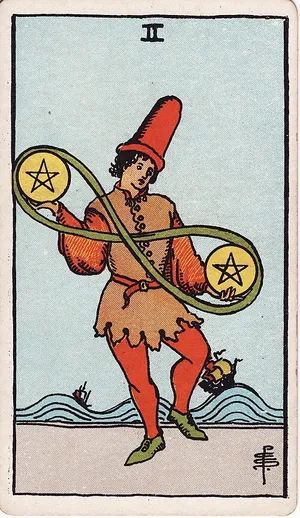

The Two of Pentacles is the second card of the suit of Pentacles, one of the 36 numbered cards among the 56 Minor Arcana of the Rider–Waite–Smith tarot, drawn by Pamela Colman Smith and published in London in 1909. A young man in a tall red hat dances on one foot, a pentacle in each hand, the two joined by a looping green cord, while ships ride high waves behind him. Upright, it is usually read as keeping several things in motion at once; reversed, as the balance slipping, or as cheerfulness put on for show.
Key facts
- Suit: Pentacles, which many readers today link with work, money and practical life. Today’s common pairing gives the suit the element Earth; other schools pair it differently, as the 1909 Rider–Waite–Smith tarot shows.
- Rank: Two, a numbered card, between the Ace and the Three of Pentacles. The Roman numeral II is printed at the top.
- Upright in one line: juggling demands, adapting on the move, a lively kind of balance.
- Reversed in one line: too much in the air; enjoyment that is only performed.
- Waite’s own key words (1910, shortened): “gaiety, recreation”; also “news and messages in writing”, “obstacles, agitation, trouble, embroilment”; reversed, “Enforced gaiety, simulated enjoyment”.
What the picture shows
The young man stands on a strip of flat grey ground in the foreground. His weight is on one leg; the other is bent at the knee, its foot lifted, so that he seems caught in the middle of a step. He wears a very tall red hat, a light brown tunic buttoned down the front with a jagged hem, a red belt, red sleeves and red hose, and pointed green shoes. His dark hair curls out from under the hat, and his face is turned a little to one side.
He holds a yellow pentacle in each hand, one raised higher than the other. A broad green band loops around both discs and crosses over itself in front of his body, making a figure of eight lying on its side. Waite describes it as “that endless cord which is like the number 8 reversed”.
Behind him is a sea with tall, rolling waves drawn in blue lines. On the left a small ship sits on a crest; on the right a larger one with yellow sails is tipped steeply on a high wave. Waite’s note does not mention the sea or the ships at all. Smith’s monogram is in the lower right corner.
Waite’s meanings in 1910
In Part III, §2 of The Pictorial Key to the Tarot, Waite opens his entry with the picture: “A young man, in the act of dancing, has a pentacle in either hand”. The divinatory meanings follow:
“On the one hand it is represented as a card of gaiety, recreation and its connexions, which is the subject of the design; but it is read also as news and messages in writing, as obstacles, agitation, trouble, embroilment. Reversed: Enforced gaiety, simulated enjoyment, literal sense, handwriting, composition, letters of exchange.”
Waite is open about the split. He names “gaiety, recreation” as “the subject of the design”; the written news, obstacles and agitation in the same list are not taken up in his note on the picture. The reversed list opens with enforced gaiety, and its latter part turns to written matters: handwriting, composition, and “letters of exchange”, which in his day meant bills of exchange, a kind of written order to pay.
Part III, §4, “Some Additional Meanings of the Lesser Arcana”, is a further set of meanings Waite lists:
“Two.—Troubles are more imaginary than real. Reversed: Bad omen, ignorance, injustice.”
Here the two lists clearly pull against each other, which Waite admits in general terms: the additional meanings, he says, are “very often in disagreement with those previously given”. Both lists are period fortune-telling formulas, kept as history, not statements about the reader.
How the card is usually read today
One common modern reading starts from the picture rather than from Waite’s lists: someone keeping two things going at once, light on his feet, while the sea behind him rises and falls. In that reading the card is about managing competing demands, such as work and home, two jobs, or money coming in and going out, and about the skill and good humour that takes. It is a prompt for reflection, not a forecast.
Upright. Readers often connect it with flexibility, multitasking, adjusting to change, and finding a rhythm that keeps things moving. Some stress the dance: the balance here is active, not still, and it can be enjoyed.
Reversed. Waite’s “Enforced gaiety, simulated enjoyment” sits close to a common reading today: keeping up a cheerful face while struggling to hold everything. Later readings add being overstretched, dropping one of the things in the air, or putting off a choice between two demands that cannot both be met.
Questions people often take from the card:
- What am I trying to keep in the air at the same time, and which of these matters most to me?
- Is my balance here a rhythm I can keep, or one I am only performing?
- Which of my “troubles” are real, and which am I imagining ahead of time?
Upright and reversed at a glance
| Upright | Reversed | |
|---|---|---|
| Waite, 1910 | Gaiety, recreation; also written news, obstacles, agitation, trouble | Enforced gaiety, simulated enjoyment; handwriting, letters of exchange |
| Common reading today | Juggling demands; adapting; balance in motion | Overstretched; cheerfulness for show; a choice put off |
| A question to ask | What rhythm keeps this going? | What would I put down if I stopped pretending it was easy? |
The Two of Pentacles in a spread
- Three cards (Past, Present, Future). In the Past position, it can recall a period of keeping two things going that shaped where you are now. In the Present, it asks how you are sharing your time, money or energy between demands. In the Future position, readers usually take it as an invitation to think about which commitments you can keep in motion, not as a fixed event.
- Celtic cross. In the Present position, it can invite you to look at how many things you are carrying at once. In the Challenge position, it may point to the strain of balancing, or to a decision that has been postponed by keeping both options in the air.
The positions of both spreads and the names of all 78 cards are in the tarot glossary; where the deck and its pictures come from is in the 1909 Rider–Waite–Smith tarot.
Cards often read next to the Two of Pentacles
- Ace of Pentacles, the card before it: a single pentacle held out from a cloud; one resource before it has to be shared.
- Three of Pentacles, the card after it: in Waite’s entry for it, “A sculptor at his work in a monastery”, where the juggling settles into skilled labour.
- Two of Swords: in Waite’s entry for it, “A hoodwinked female figure balances two swords upon her shoulders”; a held, frozen balance rather than a moving one.
- Two of Wands: Waite’s entry has “A tall man” looking out “over sea and shore” with a globe in his hand; often read as weighing plans rather than juggling them.
In HeyFate, each card you draw is turned upright or reversed at random with even odds, and an AI model writes the reading. This page is the reference behind the card, not a reading of your own question.
Sources
- A. E. Waite, The Pictorial Key to the Tarot, Part III, §2, “The Suit of Pentacles: Two” (Wikisource, from the 1922 reprint)
- A. E. Waite, The Pictorial Key to the Tarot, Part III, §4, “Some Additional Meanings of the Lesser Arcana” (Wikisource, from the 1922 reprint)
- Wikimedia Commons: Pents02.jpg (Pam-A scan, public domain)
AI-generated content, for reference only; not medical, legal, financial or psychological advice. These methods come from cultural traditions, and HeyFate offers them for cultural interest, entertainment and self-reflection.