Three of Pentacles Tarot Card Meaning: Upright, Reversed and Symbolism
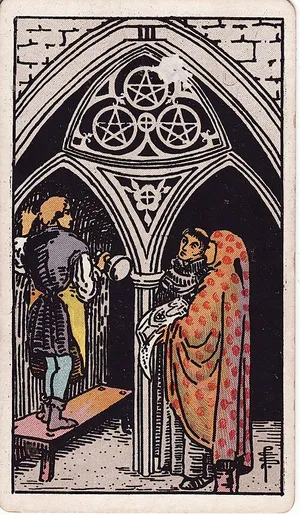

The Three of Pentacles is the third card of the suit of Pentacles, a numbered card among the 56 Minor Arcana of the Rider–Waite–Smith tarot, drawn by Pamela Colman Smith and published in London in 1909. Inside a stone building, a young craftsman stands on a bench beneath a pointed arch carved with three pentacles, while a monk and a cloaked figure look on, one holding a drawn plan. Upright, it is usually read as skilled work, often done with others, and the recognition it can earn; reversed, as work that is careless, poorly coordinated or left unfinished.
Key facts
- Suit: Pentacles, which many readers today connect with work, craft, money and the material world. Today’s common pairing gives the suit the element Earth; the pairings differ between schools, as the tarot glossary notes.
- Rank: Three, a numbered card, between the Two and the Four of Pentacles. The Roman numeral III is printed at the top of the arch.
- Upright in one line: craftsmanship, teamwork, a skill put to serious use.
- Reversed in one line: mediocre or hurried work; a team that is not pulling together.
- Waite’s own key words (1910, shortened): “Métier, trade, skilled labour”; also “nobility, aristocracy, renown, glory”; reversed, “Mediocrity”.
What the picture shows
The scene is an interior. A tall pointed arch, drawn in pale stone, rises over two dark openings, divided by a slender column in the middle; above it, at the top of the card, is a plain brick wall. In the stonework of the arch, three pentacles are carved in a triangle, one above and two below, linked by curling tracery, with a small circle holding a cross between the lower two. Below them, in a triangular panel, is a carved flower with a cross at its centre. A small white patch is visible beside the upper pentacle in this scan.
On the left, a young man with reddish-brown hair stands on a low wooden bench so that he can reach the stone. He wears a dark, belted tunic over full white sleeves, pale blue hose and grey boots. In one raised hand he holds a tool with a round head, which looks like a mallet. His face is in profile, turned towards the two figures on the right.
They stand on the floor beside the column. The nearer is a monk in a grey habit, his hair cut short, looking up at the craftsman. Between him and the cloaked figure is a large pale sheet covered with lines, which reads as a plan or a drawing. Beside him, partly behind, stands a figure in a long hooded cloak of orange-brown spotted with red, the hood drawn up. Smith’s monogram is in the lower right corner.
Waite’s note is short: “A sculptor at his work in a monastery.” Waite does not identify the other two figures; the picture shows only a monk, a cloaked figure and a plan.
Waite’s meanings in 1910
In Part III, §2 of The Pictorial Key to the Tarot, Waite links this card to another in the same suit: “Compare the design which illustrates the Eight of Pentacles. The apprentice or amateur therein has received his reward and is now at work in earnest.” The divinatory meanings follow:
“Métier, trade, skilled labour; usually, how-ever, regarded as a card of nobility, aristocracy, renown, glory. Reversed: Mediocrity, in work and otherwise, puerility, pettiness, weakness.”
The text is quoted exactly as Wikisource prints it, including the hyphen in “how-ever”. The two halves of the upright line look different: one is about a trade, the other about rank and fame. Waite says only that the sculptor works in a monastery; he does not identify the onlookers or explain how the craft and the standing are connected. The reversed line keeps to the work and the worker: “Mediocrity, in work and otherwise”.
Part III, §4, “Some Additional Meanings of the Lesser Arcana”, is a further set of meanings Waite lists, which he says are “very often in disagreement with those previously given”:
“Three.—If for a man, celebrity for his eldest son. Reversed: Depends on neighbouring cards.”
The first line is a period fortune-teller’s formula, written for a male querent and his eldest son, and it is kept here only as history. The reversed line is more useful: it simply hands the meaning over to the cards around it.
How the card is usually read today
One common modern reading takes the Three of Pentacles as the card of skilled work done with others: the craftsman knows his trade, but the building also needs the person with the plan and the person who commissioned it. In that reading the card is about competence, shared effort and being taken seriously for what you can do. Treat it as a question for reflection, not as a forecast.
Upright. Readers often connect it with learning a craft properly, collaboration, good feedback, a project that is taking shape, or recognition for careful work. Some point to the bench: the craftsman has to stand on something to reach the part of the stone that needs him.
Reversed. Waite gives “Mediocrity, in work and otherwise, puerility, pettiness, weakness”. Later readings often add a team that is not communicating, a plan that the workers have never seen, cutting corners, or skill that goes unnoticed. Some read it as a prompt to ask for help, or to listen to the person holding the drawing.
Questions people often take from the card:
- Where am I doing work I can be proud of, and who sees it?
- Is everyone involved working from the same plan?
- What part of this needs my skill, and what part needs someone else’s?
Upright and reversed at a glance
| Upright | Reversed | |
|---|---|---|
| Waite, 1910 | Métier, trade, skilled labour; nobility, renown, glory | Mediocrity, puerility, pettiness, weakness |
| Common reading today | Craftsmanship; teamwork; recognition for skill | Careless or hurried work; poor coordination |
| A question to ask | Who am I building this with? | Where have I stopped caring about the quality? |
The Three of Pentacles in a spread
- Three cards (Past, Present, Future). In the Past position, it can point to training or a shared project that gave you skills you still rely on. In the Present, it asks who you are working with and whether the roles are clear. In the Future position, readers usually take it as a prompt to think about what you would need to learn or whom you would need to involve, not as a promise of success.
- Celtic cross. In the Environment position, it can invite reflection on the people around the question: colleagues, teachers, clients. In the Crown position, it may point to an aim of doing something well and having it seen, which is worth naming plainly.
The positions of both spreads and the names of all 78 cards are in the tarot glossary; where the deck and its pictures come from is in the 1909 Rider–Waite–Smith tarot.
Cards often read next to the Three of Pentacles
- Two of Pentacles, the card before it: a young man juggling two pentacles in a dance; the restless balancing before the work settles.
- Four of Pentacles, the card after it: a crowned figure holding tightly to four pentacles; from making to keeping.
- Eight of Pentacles: the card Waite himself asks you to compare; in his entry for it, “An artist in stone at his work”. He reads the Three as the later stage, the apprentice now “at work in earnest”.
- Three of Cups: in Waite’s entry for it, “Maidens in a garden-ground with cups uplifted”; another three working together, but in celebration rather than labour.
In HeyFate, each card you draw is turned upright or reversed at random with even odds, and an AI model writes the reading. This page is the reference behind the card, not a reading of your own question.
Sources
- A. E. Waite, The Pictorial Key to the Tarot, Part III, §2, “The Suit of Pentacles: Three” (Wikisource, from the 1922 reprint)
- A. E. Waite, The Pictorial Key to the Tarot, Part III, §4, “Some Additional Meanings of the Lesser Arcana” (Wikisource, from the 1922 reprint)
- Wikimedia Commons: Pents03.jpg (Pam-A scan, public domain)
AI-generated content, for reference only; not medical, legal, financial or psychological advice. These methods come from cultural traditions, and HeyFate offers them for cultural interest, entertainment and self-reflection.