Three of Cups Tarot Card Meaning: Upright, Reversed and Symbolism
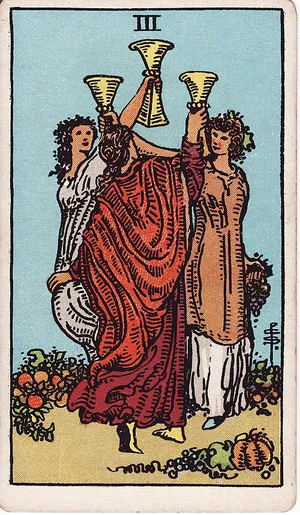

The Three of Cups is the third card of the suit of Cups, one of the four suits of the 56 Minor Arcana in the Rider–Waite–Smith tarot, drawn by Pamela Colman Smith and published in London in 1909. It shows three women close together in a garden, each lifting a cup high, with fruit and a gourd at their feet. Upright, it is usually read as shared celebration, friendship and a good outcome enjoyed with others; reversed, as celebration tipping into excess, or a group that has lost its ease.
Key facts
- Suit: Cups, the suit usually linked with feelings, relationships and the inner life. Today’s common pairing gives Cups the element of Water; other traditions pair it differently, as the tarot glossary and the 1909 Rider–Waite–Smith tarot explain.
- Rank: Three, a numbered card. It carries the Roman numeral III at the top.
- Upright in one line: friendship, community, a toast to something that has gone well.
- Reversed in one line: too much of a good thing, a gathering gone sour, or feeling outside the circle.
- Waite’s own key words (1910): plenty, perfection, merriment, happy issue, victory, fulfilment, solace, healing; reversed, “Expedition, dispatch, achievement, end”.
What the picture shows
Against a pale blue sky, three women stand in a tight group, each raising a golden cup above her head. Waite’s note is brief: “Maidens in a garden-ground with cups uplifted, as if pledging one another.”
The woman in the centre has her back to us. She wears a full red robe that falls in heavy folds, and she lifts her cup highest. On the left, a woman with dark curly hair, in a white dress, turns her face towards the others and rests her free hand at her waist. On the right, a woman in a long brown-orange robe over a white skirt has leaves in her hair; her lowered hand holds a bunch of grapes.
The ground around them is a harvest scene. On the left a bush is hung with round orange-red fruit, and on the right there is more greenery. In the foreground lie a ribbed orange gourd or pumpkin, a bunch of grapes, green leaves and a curling tendril. Smith’s monogram is on the right, just above the bushes.
Because the centre figure is seen from behind and the other two half turn towards her, the three bodies form a closed ring.
Waite’s meanings in 1910
From Part III, §2, of The Pictorial Key to the Tarot:
“Divinatory Meanings: The conclusion of any matter in plenty, perfection and merriment; happy issue, victory, fulfilment, solace, healing. Reversed: Expedition, dispatch, achievement, end. It signifies also the side of excess in physical enjoyment, and the pleasures of the senses.”
Two things stand out. First, the reversed words are not the opposite of the upright ones: “Expedition, dispatch” mean speed and prompt handling, so the reversed card here still points to a matter brought to an end, with the first words suggesting speed or prompt handling. Second, the last sentence about “the side of excess in physical enjoyment” comes after the reversed list. Waite does not say plainly whether it belongs to the reversed card alone or to the card as a whole; later readers have used it both ways.
Section 4, “Some Additional Meanings of the Lesser Arcana”, is a further set of meanings Waite lists for each card. For the Three:
“Three.—Unexpected advancement for military man. Reversed: Consolation, cure. end of the business.”
Waite notes after the §4 list that these meanings “have little connexion with the pictorial designs”, and this card shows it: a soldier’s promotion sits next to a garden of women raising cups. These lines are period fortune-telling formulas, kept here as history; they say nothing about the reader.
How the card is usually read today
One common modern reading treats the Three of Cups as joy that grows by being shared: friends, family or colleagues marking a success together, or simply enjoying each other’s company. In that reading the card is about belonging and mutual support more than about the occasion itself. Use it to reflect, not to foretell an event.
Upright. Readers often connect it with friendship, reunion, teamwork, a celebration, or the relief of being with people who are on your side. The three raised cups can suggest everyone contributing to the celebration.
Reversed. Waite gives speed and an ending, plus the note on excess. Later readings more often take the reversed Three as overindulgence, gossip or tension inside a group, a third person complicating a pair, or feeling left out of a circle you once belonged to. Some read it as a cue to look at which gatherings still nourish you.
Some questions to sit with:
- Who has stood with me lately, and have I told them?
- Is there something worth marking that I have rushed past?
- In this group, do I feel part of the ring, or outside it looking in?
Upright and reversed at a glance
| Upright | Reversed | |
|---|---|---|
| Waite, 1910 | Conclusion in plenty and merriment; happy issue, victory, fulfilment, solace, healing | Expedition, dispatch, achievement, end |
| Common reading today | Friendship, celebration, community, shared success | Overindulgence, friction in a group, feeling left out |
| A question to ask | Who do I want to share this with? | Where has enjoyment turned into something else? |
The Three of Cups in a spread
Let the position shape the question.
- Three cards (Past, Present, Future). As the Past, it can recall a time of companionship that still supports you. As the Present, it asks who is around you now and how you are sharing what you have. In the Future position, readers usually take it as an invitation to think about which connections you want to nurture, not as a promise of a celebration.
- Celtic cross. In the Environment position, the card can point to the friends and groups that surround the question. In the Crown position, it invites you to consider what kind of shared success you are aiming for. Beside a card such as the Five of Cups, many readers read it as the support still within reach.
The positions of both spreads and the names of all 78 cards are in the tarot glossary; where the deck and its pictures come from is in the 1909 Rider–Waite–Smith tarot.
Cards often read next to the Three of Cups
- Two of Cups, the card before it: a bond between two, before it opens out to a group.
- Four of Cups, the card after it: one person sitting apart, unmoved by the cups in front of him.
- Seven of Cups: in §4, Waite’s reversed line for the Seven reads “Success, if accompanied by the Three of Cups”.
- Three of Swords: in Waite’s Part III, §2 entry for the Three of Swords, “Three swords piercing a heart; cloud and rain behind”; the same number turned towards sorrow instead of celebration.
In HeyFate, each card you draw is turned upright or reversed at random with even odds, and an AI model writes the reading. This page is the reference behind the card, not a reading of your own question.
Sources
- A. E. Waite, The Pictorial Key to the Tarot, Part III, §2, “The Suit of Cups: Three”, with one line from “Swords: Three” (Wikisource, from the 1922 reprint)
- A. E. Waite, The Pictorial Key to the Tarot, Part III, §4, “Some Additional Meanings of the Lesser Arcana” (Wikisource, from the 1922 reprint)
- Wikimedia Commons: Cups03.jpg (Pam-A scan, public domain)
AI-generated content, for reference only; not medical, legal, financial or psychological advice. These methods come from cultural traditions, and HeyFate offers them for cultural interest, entertainment and self-reflection.