Seven of Cups Tarot Card Meaning: Upright, Reversed and Symbolism
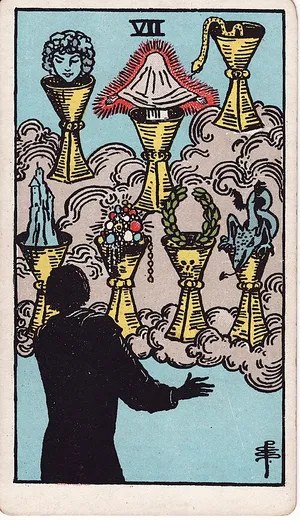

The Seven of Cups is the seventh card of the suit of Cups, one of the four suits of the 56 Minor Arcana in the Rider–Waite–Smith tarot, drawn by Pamela Colman Smith and published in London in 1909. It shows a figure in dark silhouette, seen from behind, facing seven cups that float on a bank of cloud, each holding a different strange vision. Upright, it is usually read as imagination, daydreams and too many options to choose from; reversed, as the haze clearing and a decision taking shape.
Key facts
- Suit: Cups, the suit usually linked with feelings, relationships and the inner life. Today’s common pairing gives Cups the element of Water; schools pair the suits differently, as the tarot glossary and the 1909 Rider–Waite–Smith tarot explain.
- Rank: Seven, a numbered card, with the Roman numeral VII at the top.
- Upright in one line: fantasy, wishful thinking, many tempting choices, nothing yet solid.
- Reversed in one line: clarity returning, choosing one thing, desire turned into a plan.
- Waite’s own key words (1910): “Fairy favours, images of reflection, sentiment, imagination”; “nothing permanent or substantial is suggested”; reversed, “Desire, will, determination, project”.
What the picture shows
The background is a pale blue. In the lower left corner stands a figure drawn entirely in black, as a silhouette seen from behind, with one arm stretched out towards the scene in front. Above and to the right, a mass of grey cloud holds seven golden cups, arranged in two rows: three above and four below.
In the top row, from left to right: a cup with a human head rising out of it, a face with curly hair and lowered eyes; a cup in the centre on which stands a figure entirely covered by a white cloth, arms out to the sides, surrounded by a red glow; and a cup with a spotted yellow snake rising out of it and curling over the rim.
In the lower row, from left to right: a cup holding a pale blue tower or castle on a rocky base; a cup heaped with jewels, with a string of pearls hanging over the side; a cup crowned by a green wreath of leaves, with a small skull-like face marked on its bowl; and a cup with a blue, dragon-like creature coiled on it, its tail ending in a point. Smith’s monogram is at the lower right.
Waite’s note does not list any of these contents: “Strange chalices of vision, but the images are more especially those of the fantastic spirit.” The identifications above come from looking at the scan.
Waite’s meanings in 1910
From Part III, §2, of The Pictorial Key to the Tarot:
“Divinatory Meanings: Fairy favours, images of reflection, sentiment, imagination, things seen in the glass of contemplation; some attainment in these degrees, but nothing permanent or substantial is suggested. Reversed: Desire, will, determination, project.”
Waite’s upright list is all about the inner eye: favours from fairyland, reflections, “things seen in the glass of contemplation”. He allows “some attainment in these degrees”, meaning something can be reached at that level, but adds that “nothing permanent or substantial is suggested”. The reversed meanings swing the other way, towards will and planning, as if the visions have been turned into a purpose.
Section 4, “Some Additional Meanings of the Lesser Arcana”, is a further set of meanings Waite lists for each card. For the Seven it reads:
“Seven.—Fair child; idea, design, resolve, movement. Reversed: Success, if accompanied by the Three of Cups.”
“Fair child” in the period sense means a light-complexioned child, the kind of physical description period fortune-telling attached to cards. The reversed line is unusual because it depends on another card being drawn too. Waite notes after the §4 list that these meanings “are very often in disagreement with those previously given”. They are period fortune-telling formulas, kept here as history; they say nothing about the reader.
How the card is usually read today
One common modern reading treats the Seven of Cups as a moment of many possibilities, each attractive and none yet real. In that reading the card is not against imagination; it asks which vision is worth turning into something solid, and which are only shimmering on the cloud. It asks you to sort your wishes; it does not say which will come true.
Upright. Readers often connect it with daydreaming, wishful thinking, being spoilt for choice, illusion, or creative imagination that has not yet found a form.
Reversed. Waite gives “Desire, will, determination, project”. Later readings commonly take the reversed Seven in a similar direction: seeing through an illusion, narrowing many options to one, or making a realistic plan. Some readers also take it as feeling overwhelmed by choice; the cards around it can help decide which.
Some questions to sit with:
- Of everything I could want here, which one would I still want tomorrow?
- Which option looks good mainly because it is far away?
- What would one practical step towards my choice look like?
Upright and reversed at a glance
| Upright | Reversed | |
|---|---|---|
| Waite, 1910 | Fairy favours, images of reflection, sentiment, imagination; nothing permanent or substantial is suggested | Desire, will, determination, project |
| Common reading today | Daydreams, illusion, too many choices | Clarity, a decision, a realistic plan |
| A question to ask | Which vision is worth making real? | What have I decided, and what is the first step? |
The Seven of Cups in a spread
The position tells you where to look.
- Three cards (Past, Present, Future). As the Past, it can point to a time of many plans or dreams that left a mark. As the Present, it asks how many options you are juggling and how real each one is. In the Future position, readers usually take it as an invitation to sort the options in front of you, not as a sign that any of them will come true.
- Celtic cross. In the Hopes position, it fits naturally: it asks you to look plainly at what you are wishing for. In the Crown position, it may invite you to check whether the aim is clear or still a cloud of possibilities. When the Seven is reversed and the Three of Cups is nearby, some readers recall Waite’s §4 line, while still reading the pair as a prompt rather than a sign.
The positions of both spreads and the names of all 78 cards are in the tarot glossary; where the deck and its pictures come from is in the 1909 Rider–Waite–Smith tarot.
Cards often read next to the Seven of Cups
- Six of Cups, the card before it: memory, where the Seven turns to imagination and possibility.
- Eight of Cups, the card after it: in Waite’s Part III, §2 entry for the Eight of Cups, “A man of dejected aspect is deserting the cups of his felicity”; often read as walking away from what no longer satisfies.
- Three of Cups: named in Waite’s §4 reversed line for the Seven, “Success, if accompanied by the Three of Cups”.
- Seven of Pentacles: in Waite’s Part III, §2 entry for the Seven of Pentacles, a young man who “looks intently at seven pentacles attached to a clump of greenery on his right”; weighing real results rather than visions.
In HeyFate, each card you draw is turned upright or reversed at random with even odds, and an AI model writes the reading. This page is the reference behind the card, not a reading of your own question.
Sources
- A. E. Waite, The Pictorial Key to the Tarot, Part III, §2, “The Suit of Cups: Seven”, with lines from “Cups: Eight” and “Pentacles: Seven” (Wikisource, from the 1922 reprint)
- A. E. Waite, The Pictorial Key to the Tarot, Part III, §4, “Some Additional Meanings of the Lesser Arcana” (Wikisource, from the 1922 reprint)
- Wikimedia Commons: Cups07.jpg (Pam-A scan, public domain)
AI-generated content, for reference only; not medical, legal, financial or psychological advice. These methods come from cultural traditions, and HeyFate offers them for cultural interest, entertainment and self-reflection.