Six of Cups Tarot Card Meaning: Upright, Reversed and Symbolism
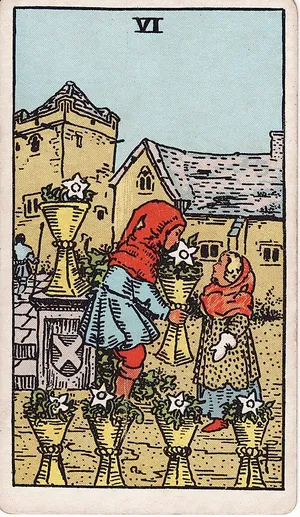

The Six of Cups is the sixth card of the suit of Cups, one of the four suits of the 56 Minor Arcana in the Rider–Waite–Smith tarot, drawn by Pamela Colman Smith and published in London in 1909. It shows two children in the courtyard of an old house, the taller one handing the smaller a cup holding a white flower and green leaves, with five more such cups around them. Upright, it is usually read as memory, childhood and simple kindness; reversed, as being held by the past, or as leaving it behind to look ahead.
Key facts
- Suit: Cups, the suit usually linked with feelings, relationships and the inner life. Today’s common pairing gives Cups the element of Water; pairings differ between traditions, as the tarot glossary and the 1909 Rider–Waite–Smith tarot explain.
- Rank: Six, a numbered card, with the Roman numeral VI at the top.
- Upright in one line: nostalgia, innocence, a small gift given freely, memories of home.
- Reversed in one line: clinging to the past, or turning from it towards what comes next.
- Waite’s own key words (1910): “A card of the past and of memories”; happiness “coming rather from the past”; reversed, “The future, renewal”.
What the picture shows
Under a pale blue sky stand old stone buildings: a square tower with a pointed roof on the left, and on the right a house with a grey slate roof, a chimney and small windows, one of them a pointed arch in the gable. In the courtyard below, two children face each other.
The taller child, on the left of the pair, wears a red hood, a blue tunic and red stockings, and bends forward to hold out a golden cup filled with green leaves and a white, star-shaped flower. The smaller child, on the right, wears a red hood or headscarf and a speckled dress, has a white mitten on one hand, and looks up at the taller one.
There are six cups in all, each holding leaves and a white flower. Four stand in a row along the bottom of the card, one is in the taller child’s hands, and one sits on a stone pedestal at the left. The front of the pedestal bears a shield marked with an X-shaped cross. Behind the pedestal, a small figure in blue walks away from the children along a stone path, carrying a long staff.
Waite’s note is short: “Children in an old garden, their cups filled with flowers.” The scan shows more paving and stonework than garden, but there are plants and leaves around the cups. He does not explain the shield or the figure walking away.
Waite’s meanings in 1910
From Part III, §2, of The Pictorial Key to the Tarot:
“Divinatory Meanings: A card of the past and of memories, looking back, as—for example—on childhood; happiness, enjoyment, but coming rather from the past; things that have vanished. Another reading reverses this, giving new relations, new knowledge, new environment, and then the children are disporting in an unfamiliar precinct. Reversed: The future, renewal, that which will come to pass presently.”
Waite offers two readings for the upright card. The main one looks backwards: memories, childhood, a joy that belongs to “things that have vanished”. The second, which he introduces with “Another reading reverses this”, looks at the same scene as something new, in which “the children are disporting in an unfamiliar precinct”. His reversed meanings then point firmly forward: “The future, renewal”. These are Waite’s old divination words, recorded as history, not statements about what is coming for the reader.
Section 4, “Some Additional Meanings of the Lesser Arcana”, is a further set of meanings Waite lists for each card. For the Six it is brief:
“Six.—Pleasant memories. Reversed: Inheritance to fall in quickly.”
Waite notes after the §4 list that these meanings “have little connexion with the pictorial designs”. Like the rest of §4, this line is a period fortune-telling formula, kept here as history.
How the card is usually read today
One common modern reading treats the Six of Cups as the comfort of the familiar: memories, old friends, places from childhood, and the plain kindness of giving someone a flower. In that reading the card can be warm or wistful, depending on whether the past is a resource or a refuge. It invites a look at your relationship with the past, not an expectation about the future.
Upright. Readers often connect it with nostalgia, reunion, innocence, generosity without calculation, or reconnecting with something you loved when you were young. The gift between the two children fits that reading of care that asks nothing in return.
Reversed. Waite gives “The future, renewal, that which will come to pass presently”. Later readings commonly take the reversed Six either as being stuck in the past, idealising it or unable to let it go, or, closer to Waite, as stepping out of old patterns towards something new.
Some questions to sit with:
- Which memory keeps returning to me, and what does it want me to notice?
- Is there a simple kindness I could give, or accept, without keeping score?
- Am I visiting the past, or living there?
Upright and reversed at a glance
| Upright | Reversed | |
|---|---|---|
| Waite, 1910 | The past and memories; happiness coming from the past; things that have vanished | The future, renewal, that which will come to pass presently |
| Common reading today | Nostalgia, innocence, kindness, reunion | Stuck in the past; or moving on from it |
| A question to ask | What from the past still nourishes me? | What am I ready to leave behind? |
The Six of Cups in a spread
Each position gives the card a different angle.
- Three cards (Past, Present, Future). In the Past position, it sits very naturally, pointing to childhood or an earlier chapter that still shapes your feelings. As the Present, it asks whether something old is coming back into view. In the Future position, readers usually take it as an invitation to consider what from your past you want to carry forward, not as a fixed event.
- Celtic cross. In the Root position, the Six can point to early experiences under the present question. In the Hopes position, it may invite a look at whether you are hoping to recover something that is gone. In the Outcome position, many readers look at the cards before it to see whether the past is helping or holding back.
The positions of both spreads and the names of all 78 cards are in the tarot glossary; where the deck and its pictures come from is in the 1909 Rider–Waite–Smith tarot.
Cards often read next to the Six of Cups
- Five of Cups, the card before it: grief over what has spilt, set beside the comfort of the Six.
- Seven of Cups, the card after it: from memory to imagination and many possible choices.
- Six of Pentacles: in Waite’s Part III, §2 entry for the Six of Pentacles, a figure dressed as a merchant who “weighs money in a pair of scales and distributes it to the needy and distressed”; giving, but measured.
- Six of Swords: in Waite’s Part III, §2 entry for the Six of Swords, “A ferryman carrying passengers in his punt to the further shore”; moving away from the past rather than returning to it.
In HeyFate, each card you draw is turned upright or reversed at random with even odds, and an AI model writes the reading. This page is the reference behind the card, not a reading of your own question.
Sources
- A. E. Waite, The Pictorial Key to the Tarot, Part III, §2, “The Suit of Cups: Six”, with lines from the Sixes of Pentacles and Swords (Wikisource, from the 1922 reprint)
- A. E. Waite, The Pictorial Key to the Tarot, Part III, §4, “Some Additional Meanings of the Lesser Arcana” (Wikisource, from the 1922 reprint)
- Wikimedia Commons: Cups06.jpg (Pam-A scan, public domain)
AI-generated content, for reference only; not medical, legal, financial or psychological advice. These methods come from cultural traditions, and HeyFate offers them for cultural interest, entertainment and self-reflection.