Five of Cups Tarot Card Meaning: Upright, Reversed and Symbolism
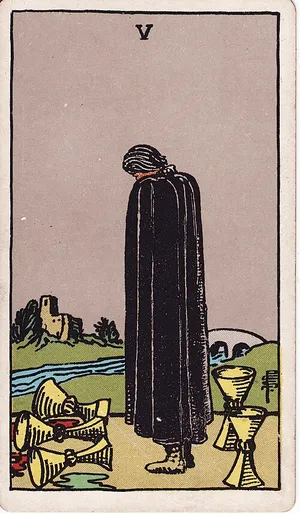

The Five of Cups is the fifth card of the suit of Cups, one of the four suits of the 56 Minor Arcana in the Rider–Waite–Smith tarot, drawn by Pamela Colman Smith and published in London in 1909. It shows a figure in a long black cloak standing with bowed head over three overturned cups, while two more cups stand upright behind. Upright, it is usually read as loss and regret, with attention fixed on what has gone; reversed, as grief beginning to ease and attention turning to what remains.
Key facts
- Suit: Cups, the suit usually linked with feelings, relationships and the inner life. Today’s common pairing gives Cups the element of Water; other schools differ, as the tarot glossary and the 1909 Rider–Waite–Smith tarot explain.
- Rank: Five, a numbered card, with the Roman numeral V at the top.
- Upright in one line: disappointment, mourning, dwelling on what was spilt.
- Reversed in one line: acceptance, turning around, finding what is still standing.
- Waite’s own key words (1910): “a card of loss, but something remains over”; inheritance “not corresponding to expectations”; reversed, news, alliances, return, “false projects”.
What the picture shows
The sky is a flat grey-brown, with the numeral V at the top. A tall figure stands slightly right of centre, wrapped from shoulders to ankles in a black cloak; only a thin red collar at the neck and a pair of grey boots show beneath it. The head is bowed so far forward that the face is hidden, and it is turned towards the left of the card.
There, on the ground, three golden cups lie on their sides, knocked over. Red liquid has run out beneath them and a pool of green liquid has spread at the front. To the right, slightly behind the figure, two cups still stand upright. A river runs across the middle ground from the left. On its far bank, to the left, a small ruined tower or keep stands among dark trees; on the right, a grey stone bridge with arches crosses the water towards a green rise. Smith’s monogram is on the right, beside the two standing cups.
Waite’s note reads: “A dark, cloaked figure, looking sideways at three prone cups; two others stand upright behind him; a bridge is in the background, leading to a small keep or holding.” The scan keeps the main points, but in it the ruined building is on the left and the bridge on the right, so it is not clear that the bridge leads there. And with the head so deeply bowed, “looking sideways” is hard to see. Waite does not interpret the bridge or the building.
Waite’s meanings in 1910
From Part III, §2, of The Pictorial Key to the Tarot:
“Divinatory Meanings: It is a card of loss, but something remains over; three have been taken, but two are left; it is a card of inheritance, patrimony, transmission, but not corresponding to expectations; with some interpreters it is a card of marriage, but not without bitterness or frustration. Reversed: News, alliances, affinity, consanguinity, ancestry, return, false projects.”
Waite reads the picture almost as arithmetic: “three have been taken, but two are left”. Each clause then carries a “but”: loss, but something remains; inheritance, but not as expected; marriage, but with bitterness. The reversed meanings turn towards family and connection: kinship (“consanguinity”), ancestry, a return, and, at the end, “false projects”.
Section 4, “Some Additional Meanings of the Lesser Arcana”, is a further set of meanings Waite lists for each card, and for the Five it reads almost the other way:
“Five.—Generally favourable; a happy marriage; also patrimony, legacies, gifts, success in enterprise. Reversed: Return of some relative who has not been seen for long.”
So the same card is a card of loss in §2 and “Generally favourable” in §4. Waite notes after the §4 list that these meanings “are very often in disagreement with those previously given”, and this card shows it plainly. The §4 lines are period fortune-telling formulas, kept here as history; they say nothing about anyone’s marriage, family or money.
How the card is usually read today
One common modern reading treats the Five of Cups as grief and regret that narrow one’s view: the figure sees only the spilt cups and has not yet turned round to the two still standing. In that reading the card does not deny the loss, but asks what else is in the picture. The card invites a look at how you are carrying a loss; it does not foretell one.
Upright. Readers often connect it with disappointment, mourning, regret over a choice, or a setback that still stings. The black cloak, the colour of mourning dress, fits that reading.
Reversed. Waite gives “News, alliances, affinity, consanguinity, ancestry, return, false projects”. Later readings commonly take the reversed Five as the turn after grief: acceptance, forgiving oneself or others, reaching out to people again, or noticing the two cups. Some readers also see a warning in it against pushing grief aside before it has been felt.
Some questions to sit with:
- What have I lost, and have I let myself feel it?
- What is still standing that I have not looked at?
- If I turned round and looked at the whole picture, what else would I see?
Upright and reversed at a glance
| Upright | Reversed | |
|---|---|---|
| Waite, 1910 | Loss, but something remains; inheritance not as expected; marriage with bitterness | News, alliances, affinity, consanguinity, ancestry, return, false projects |
| Common reading today | Grief, regret, focus on what is gone | Acceptance, moving on, turning to what remains |
| A question to ask | What am I mourning? | What is still here for me? |
The Five of Cups in a spread
Read it with its position in mind.
- Three cards (Past, Present, Future). As the Past, it can point to a loss that still shapes how you feel. As the Present, it asks where your attention is resting: on the spilt cups, or on the standing ones. In the Future position, readers usually take it as an invitation to consider how you want to carry a disappointment, not as a forecast of one.
- Celtic cross. In the Root position, the Five can point to an old hurt under the present question. In the Past position, it may be read as grief you have been working through. Next to the Six of Cups or a card of support, many readers read the two standing cups as something to come back to.
The positions of both spreads and the names of all 78 cards are in the tarot glossary; where the deck and its pictures come from is in the 1909 Rider–Waite–Smith tarot.
Cards often read next to the Five of Cups
- Four of Cups, the card before it: discontent with what is there, where the Five shows loss.
- Six of Cups, the card after it: memory and kindness, set beside the Five’s grief.
- Five of Pentacles: in Waite’s Part III, §2 entry for the Five of Pentacles, “Two mendicants in a snow-storm pass a lighted casement”; hardship of a material kind, passing a lit window.
- Five of Swords: in Waite’s Part III, §2 entry for the Five of Swords, “A disdainful man looks after two retreating and dejected figures”; there the weight falls on loss after conflict rather than on grief.
In HeyFate, each card you draw is turned upright or reversed at random with even odds, and an AI model writes the reading. This page is the reference behind the card, not a reading of your own question.
Sources
- A. E. Waite, The Pictorial Key to the Tarot, Part III, §2, “The Suit of Cups: Five”, with lines from the Fives of Pentacles and Swords (Wikisource, from the 1922 reprint)
- A. E. Waite, The Pictorial Key to the Tarot, Part III, §4, “Some Additional Meanings of the Lesser Arcana” (Wikisource, from the 1922 reprint)
- Wikimedia Commons: Cups05.jpg (Pam-A scan, public domain)
AI-generated content, for reference only; not medical, legal, financial or psychological advice. These methods come from cultural traditions, and HeyFate offers them for cultural interest, entertainment and self-reflection.