Four of Cups Tarot Card Meaning: Upright, Reversed and Symbolism
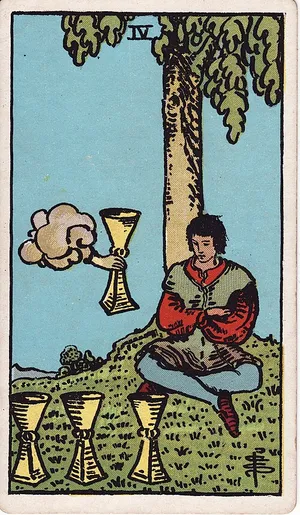

The Four of Cups is the fourth card of the suit of Cups, one of the four suits of the 56 Minor Arcana in the Rider–Waite–Smith tarot, drawn by Pamela Colman Smith and published in London in 1909. It shows a young man sitting cross-legged under a tree with his arms folded, three cups on the grass before him and a hand from a cloud offering a fourth. Upright, it is usually read as weariness, withdrawal or a sense that nothing on offer appeals; reversed, as interest returning and a readiness to look up again.
Key facts
- Suit: Cups, the suit usually linked with feelings, relationships and the inner life. Today’s common pairing gives Cups the element of Water; pairings vary between schools, as the tarot glossary and the 1909 Rider–Waite–Smith tarot explain.
- Rank: Four, a numbered card, with the Roman numeral IV at the top.
- Upright in one line: boredom, discontent, turning inward, overlooking what is offered.
- Reversed in one line: new interest, a fresh start in feeling, looking outward again.
- Waite’s own key words (1910): weariness, disgust, aversion, “imaginary vexations”; reversed, “Novelty, presage, new instruction, new relations”.
What the picture shows
The scene is outdoors under a pale blue sky. A broad tree trunk rises up the middle of the card, and its drooping green foliage fills the top, partly framing the numeral IV. At its foot a young man with dark hair sits cross-legged on a grassy mound, leaning back against the trunk. He wears a red shirt under a green jerkin, blue leggings and red shoes. His arms are folded tightly across his chest and his eyes are lowered.
In front of him, along the bottom of the card, three golden cups stand in a row on the grass. To the left, at about the height of his face, a hand reaches out of a small grey-brown cloud holding a fourth cup towards him. Behind, the ground falls away to a small bushy tree and a line of pale distant hills. Smith’s monogram is at the lower right.
Waite’s note: “A young man is seated under a tree and contemplates three cups set on the grass before him; an arm issuing from a cloud offers him another cup. His expression notwithstanding is one of discontent with his environment.” The picture does not show whether he has noticed the fourth cup at all; the folded arms and lowered eyes are what set the mood.
The hand emerging from a cloud also appears on the Ace of Cups. Waite does not draw a link between the two cards, though his meanings here speak of “another wine, as if a fairy gift”.
Waite’s meanings in 1910
From Part III, §2, of The Pictorial Key to the Tarot:
“Divinatory Meanings: Weariness, disgust, aversion, imaginary vexations, as if the wine of this world had caused satiety only; another wine, as if a fairy gift, is now offered the wastrel, but he sees no consolation therein. This is also a card of blended pleasure. Reversed: Novelty, presage, new instruction, new relations.”
Waite’s words are sharper than the picture’s quiet mood. He calls the young man “the wastrel”, someone who has had enough of “the wine of this world” and finds only “satiety”. The troubles are “imaginary vexations”, Waite’s own phrase for them. Yet he adds that this is “also a card of blended pleasure”, so the card is not wholly bleak. The reversed meanings point outward: novelty, a sign of what is coming, something new to learn, new relations.
Section 4, “Some Additional Meanings of the Lesser Arcana”, is a further set of meanings Waite lists for each card. For the Four it is very brief:
“Four.—Contrarieties. Reversed: Presentiment.”
“Contrarieties” here means things going against one’s wishes. Waite notes after the §4 list that these meanings “are very often in disagreement with those previously given”. They are period fortune-telling formulas, kept here as history and not as statements about the reader.
How the card is usually read today
One common modern reading treats the Four of Cups as a pause in which feeling has gone flat: what is already there does not satisfy, and what is newly offered goes unseen. Some readers stress the apathy; others see the same posture as healthy reflection, a step back to work out what one really wants. Either way, the card asks about your state of mind; it does not foretell events.
Upright. Readers often connect it with boredom, disengagement, emotional fatigue, or comparing what one has with what is missing. It is also read as meditation or a deliberate time-out.
Reversed. Waite gives “Novelty, presage, new instruction, new relations”. Later readings commonly take the reversed Four as coming out of a slump: noticing an opportunity, saying yes to something new, or reconnecting with people. A few readers take it the other way, as withdrawal going deeper; the surrounding cards can help decide which.
Some questions to sit with:
- What am I tired of, and is it the thing itself or how I am approaching it?
- Is something being offered to me that I have not looked at properly?
- Do I need a real rest, or am I avoiding a choice?
Upright and reversed at a glance
| Upright | Reversed | |
|---|---|---|
| Waite, 1910 | Weariness, disgust, aversion, imaginary vexations; blended pleasure | Novelty, presage, new instruction, new relations |
| Common reading today | Apathy, boredom, withdrawal; or a reflective pause | Renewed interest; noticing what is offered |
| A question to ask | What have I stopped seeing? | What is drawing my attention back? |
The Four of Cups in a spread
Position changes the emphasis.
- Three cards (Past, Present, Future). As the Past, it can point to a stretch of discontent or withdrawal that you have come through, or are still coming through. As the Present, it asks whether the dissatisfaction is about the situation or about your own tiredness. In the Future position, readers usually take it as an invitation to notice what you might be overlooking, not as a fixed event.
- Celtic cross. In the Self position, the Four can invite an honest look at how engaged you feel with the question. In the Challenge position, it may point to a loss of interest that is making things harder. Next to an Ace, the pair can prompt the question of what new offer is waiting to be noticed.
The positions of both spreads and the names of all 78 cards are in the tarot glossary; where the deck and its pictures come from is in the 1909 Rider–Waite–Smith tarot.
Cards often read next to the Four of Cups
- Three of Cups, the card before it: shared celebration, in contrast to his solitary mood.
- Five of Cups, the card after it: grief over what is spilt, set beside the Four’s dissatisfaction.
- Four of Swords: in Waite’s Part III, §2 entry for the Four of Swords, “The effigy of a knight in the attitude of prayer, at full length upon his tomb”; rest and retreat of a more deliberate kind.
- Four of Pentacles: in Waite’s Part III, §2 entry for the Four of Pentacles, “He holds to that which he has”; holding on, where the Four of Cups holds back.
In HeyFate, each card you draw is turned upright or reversed at random with even odds, and an AI model writes the reading. This page is the reference behind the card, not a reading of your own question.
Sources
- A. E. Waite, The Pictorial Key to the Tarot, Part III, §2, “The Suit of Cups: Four”, with lines from the Fours of Swords and Pentacles (Wikisource, from the 1922 reprint)
- A. E. Waite, The Pictorial Key to the Tarot, Part III, §4, “Some Additional Meanings of the Lesser Arcana” (Wikisource, from the 1922 reprint)
- Wikimedia Commons: Cups04.jpg (Pam-A scan, public domain)
AI-generated content, for reference only; not medical, legal, financial or psychological advice. These methods come from cultural traditions, and HeyFate offers them for cultural interest, entertainment and self-reflection.