Four of Pentacles Tarot Card Meaning: Upright, Reversed and Symbolism
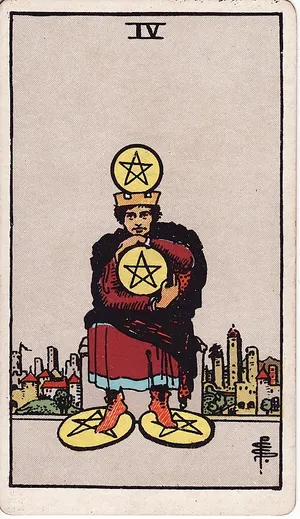

The Four of Pentacles is the fourth card of the suit of Pentacles, a numbered card among the 56 Minor Arcana of the Rider–Waite–Smith tarot, drawn by Pamela Colman Smith and published in London in 1909. A crowned man sits in front of a town with one pentacle balanced on his crown, another clasped to his chest and one under each foot. Upright, it is usually read as security, saving and holding on to what you have; reversed, as that grip either loosening or tightening into something that blocks the way.
Key facts
- Suit: Pentacles, which many readers today connect with money, possessions, the body and practical security. Today’s common pairing gives the suit the element Earth; for other pairings, see the 1909 Rider–Waite–Smith tarot.
- Rank: Four, a numbered card, between the Three and the Five of Pentacles. The Roman numeral IV is printed at the top.
- Upright in one line: keeping hold, saving, protecting what has been built.
- Reversed in one line: holding on too hard, or the hold being tested; things kept waiting.
- Waite’s own key words (1910): “The surety of possessions, cleaving to that which one has”; also “gift, legacy, inheritance”; reversed, “Suspense, delay, opposition”.
What the picture shows
The man is placed squarely in the middle of the card, facing out. He wears a gold crown with square points, and on top of it, balanced like a second, larger crown, rests a pentacle. He has dark hair, a short beard and a steady, level look. Behind his legs you can see the edges of a plain grey block, so he appears to be seated on it, though Waite’s note does not say whether he sits or stands.
He is dressed in a long red robe with a blue band at the hem, a heavy black mantle over his shoulders and red shoes. With both arms and hands he presses a second pentacle against his chest, so that it covers him from the chin almost to the waist. One more disc lies flat on the ground under each foot, which makes four in all. Waite counts them in the same way: “having a pentacle over his crown”, “clasps another with hands and arms”, and “two pentacles are under his feet”.
Behind him, on both sides, is a town: tall grey and cream towers, houses with red roofs and a few trees, all set well back on a low horizon. The sky is an even grey, and so is the strip of ground he sits on. Smith’s monogram is in the lower right corner.
Waite sums up the figure in one short sentence: “He holds to that which he has.”
Waite’s meanings in 1910
In Part III, §2 of The Pictorial Key to the Tarot, Waite gives the divinatory meanings for the Four of Pentacles. The semicolon after “Reversed” is as Wikisource prints it:
“The surety of possessions, cleaving to that which one has, gift, legacy, inheritance. Reversed; Suspense, delay, opposition.”
The upright line is not a judgement. “The surety of possessions” is security, and “gift, legacy, inheritance” are ways of coming to possess something, not of grasping it. Nothing in Waite’s line calls the man miserly; his words describe someone who has something and keeps it. His reversed meanings move from having to waiting: “Suspense, delay, opposition”.
Part III, §4, “Some Additional Meanings of the Lesser Arcana”, is a further set of meanings Waite lists, which he says are “very often in disagreement with those previously given”:
“Four.—For a bachelor, pleasant news from a lady. Reversed: Observation, hindrances.”
This is plainly a fortune-teller’s formula of its time, addressed to an unmarried man, and it has nothing to do with the picture. It is kept here as history; it says nothing about the reader.
How the card is usually read today
One common modern reading takes the Four of Pentacles as a card about control and security: the man has gathered enough and is determined not to lose it. In that reading the card can point either way, to sensible saving and steady boundaries, or to a grip so tight that nothing can come in or go out. Use it to reflect on your own situation; it does not foretell one.
Upright. Readers often connect it with budgeting, protecting resources, stability, or guarding time and energy. Many also see the shadow in the same picture: possessiveness, fear of loss, or difficulty sharing, whether money, feelings or control.
Reversed. Waite gives “Suspense, delay, opposition”, which some readers take as something held up or blocked. Later readings often read the reversed card as the grip changing: loosening and letting go, for better or worse, or, for others, tightening into stinginess or anxious hoarding.
Questions people often take from the card:
- What am I holding on to so firmly that I cannot use it?
- Is this security, or fear of losing what I have?
- What would I let in if I loosened my grip a little?
Upright and reversed at a glance
| Upright | Reversed | |
|---|---|---|
| Waite, 1910 | The surety of possessions; holding to what one has; gift, legacy, inheritance | Suspense, delay, opposition |
| Common reading today | Security; saving; control; possessiveness | Letting go, or holding on too hard; things held up |
| A question to ask | What am I protecting, and why? | What happens if I loosen my hold? |
The Four of Pentacles in a spread
- Three cards (Past, Present, Future). In the Past position, it can point to a time of saving or self-protection that still shapes your habits. In the Present, it asks what you are guarding and what that guarding costs. In the Future position, readers usually take it as a prompt to think about which resources you want to keep and which you are ready to use, not as a fixed outcome.
- Celtic cross. In the Self position, it can invite reflection on your own attitude to security and control. In the Challenge position, it may point to a reluctance to spend, share or change that is getting in the way.
The positions of both spreads and the names of all 78 cards are in the tarot glossary; where the deck and its pictures come from is in the 1909 Rider–Waite–Smith tarot.
Cards often read next to the Four of Pentacles
- Three of Pentacles, the card before it: a craftsman at work with others; the Four turns from making to keeping.
- Five of Pentacles, the card after it: in Waite’s entry for it, “Two mendicants in a snow-storm”; the fear of loss in the Four is often read against the hardship shown in the Five.
- Four of Cups: in Waite’s entry for it, “A young man is seated under a tree and contemplates three cups”; another closed-off figure, withdrawn rather than holding fast.
- Four of Wands: Waite lists its meanings as “country life, haven of refuge” and “prosperity, peace”; a secure place that is shared and celebrated rather than clutched.
In HeyFate, each card you draw is turned upright or reversed at random with even odds, and an AI model writes the reading. This page is the reference behind the card, not a reading of your own question.
Sources
- A. E. Waite, The Pictorial Key to the Tarot, Part III, §2, “The Suit of Pentacles: Four” (Wikisource, from the 1922 reprint)
- A. E. Waite, The Pictorial Key to the Tarot, Part III, §4, “Some Additional Meanings of the Lesser Arcana” (Wikisource, from the 1922 reprint)
- Wikimedia Commons: Pents04.jpg (Pam-A scan, public domain)
AI-generated content, for reference only; not medical, legal, financial or psychological advice. These methods come from cultural traditions, and HeyFate offers them for cultural interest, entertainment and self-reflection.