Four of Wands Tarot Card Meaning: Upright, Reversed and Symbolism
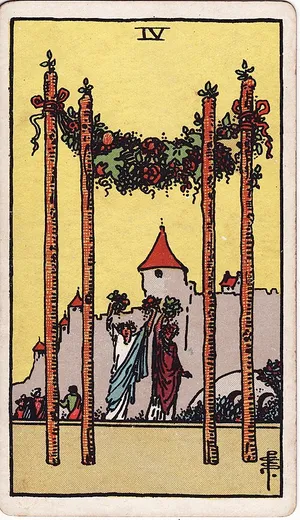

The Four of Wands is the fourth card of the suit of Wands, one of the four suits of 14 cards that make up the 56 Minor Arcana in the Rider–Waite–Smith tarot, drawn by Pamela Colman Smith and published in London in 1909. It shows a garland of flowers and fruit hung between four tall staves, with two figures raising bouquets in front of a castle. Upright, it is usually read as celebration, welcome and a settled moment of harmony; reversed, Waite keeps the meaning unaltered, though later readings add a celebration delayed or a home that feels unsettled.
Key facts
- Suit: Wands, often linked today with energy, drive, ambition and creative work. Fire is today’s common pairing for the suit, but schools differ; see the tarot glossary and the 1909 Rider–Waite–Smith tarot.
- Rank: a numbered card, the Four, marked only with the Roman numeral IV at the top.
- Upright in one line: celebration, homecoming, a milestone shared with others.
- Reversed in one line: in Waite, the same good meaning; in later readings, joy postponed or a sense of not quite belonging.
- Waite’s own key words (1910, abridged): country life, haven of refuge, repose, concord, harmony, prosperity, peace; reversed, “The meaning remains unaltered”.
What the picture shows
The sky is a strong, even yellow. Four tall staves stand across the front of the card, two near each side, each sprouting small leaves at the top. Strung between them is a thick garland of green leaves, red roses and a few round fruits, its ends tied to the two outer staves with red ribbons whose loose tails hang down. The staves frame the scene behind them like the posts of an open gateway.
Under the garland, two figures raise bouquets above their heads. The one on the left wears a long white robe with a blue drape; the one on the right is in a dark red robe. Waite calls them “two female figures” who “uplift nose-gays”. Behind them a long grey wall runs across the card, with a round tower capped by a red conical roof in the centre, smaller red-roofed turrets to the left, and a red-roofed house on the right. In the lower left corner a small group of people stands by the wall.
Waite’s note continues: “at their side is a bridge over a moat, leading to an old manorial house.” On the right, among dark bushes, a low grey arch is visible and can be read as that bridge; the water of a moat is not clearly shown in this scan. Smith’s monogram is at the lower right.
Waite’s meanings in 1910
In Part III, §2 of The Pictorial Key to the Tarot, Waite gives the divinatory meanings for the Four of Wands:
“They are for once almost on the surface—country life, haven of refuge, a species of domestic harvest-home, repose, concord, harmony, prosperity, peace, and the perfected work of these. Reversed: The meaning remains unaltered; it is prosperity, increase, felicity, beauty, embellishment.”
By saying the meanings are “for once almost on the surface”, Waite admits that this picture says what it means: a harvest festival at home, people at ease, work brought to completion. The reversed meaning keeps the upright’s good sense; he only shifts the stress from peace to “increase, felicity, beauty, embellishment”.
Section 4, “Some Additional Meanings of the Lesser Arcana”, is a further set of meanings Waite lists for each card; after the list he notes that they “are very often in disagreement with those previously given”. They are period fortune-telling formulas, kept here as history, not as anything about the reader. For this card:
“Unexpected good fortune. Reversed: A married woman will have beautiful children.”
The reversed line belongs to a time when cartomancy spoke of marriages and children as a matter of course; it is quoted only as part of the record.
How the card is usually read today
One common modern reading treats the Four of Wands as the suit’s first resting place: after the spark, the plan and the ships at sea, there is something to celebrate and somewhere to come home to. In that reading the garland marks a threshold, an open gateway rather than a closed door. Take it as a prompt for reflection, not a forecast.
Upright. Readers often connect it with celebration, community, a milestone reached, a sense of welcome, or a home or group that feels stable. Some readers point to the people gathered by the wall and read the card as joy that is shared rather than private.
Reversed. Waite keeps the meaning “unaltered”. Later readings often add a softer shadow: a celebration postponed, tension in a household or team, a transition between homes, or the feeling of standing outside a gathering. Others keep Waite’s view and read the reversal as the same harmony, simply felt more quietly.
Questions people often take from the card:
- What has been completed that I have not yet stopped to mark?
- Where do I feel at home, and who is there with me?
- What would make this place more welcoming, to me or to others?
Upright and reversed at a glance
| Upright | Reversed | |
|---|---|---|
| Waite, 1910 | Country life, haven of refuge, repose, concord, harmony, prosperity, peace | The meaning remains unaltered; prosperity, increase, felicity, beauty |
| Common reading today | Celebration, homecoming, a shared milestone | Joy delayed, unsettled ground at home, feeling outside the circle |
| A question to ask | What is worth celebrating here? | What keeps me from feeling at home? |
The Four of Wands in a spread
Position changes how the card is read.
- Three cards (Past, Present, Future). In the Past position, it can recall a time of stability or celebration that still supports you. In the Present, it asks whether you have let yourself enjoy what has been achieved. In the Future position, readers usually take it as an invitation to think about what you would like to build and share, not as a promise of a happy event.
- Celtic cross. In the Environment position, it may point to a household, team or community and how it feels to be part of it. In the Root position, it can ask what sense of home lies under the question. In the Outcome position, many readers read it with the cards around it, as a pause to take stock rather than an ending.
The positions of both spreads and the names of all 78 cards are in the tarot glossary; where the deck and its pictures come from is in the 1909 Rider–Waite–Smith tarot.
Cards often read next to the Four of Wands
- Three of Wands, the card before it: a figure on a ridge watching ships at sea; effort still travelling before this card’s arrival.
- Five of Wands, the card after it: five youths brandishing staves; the calm gives way to competition.
- Four of Swords: in Waite’s Part III, §2 entry for the Four of Swords, “The effigy of a knight in the attitude of prayer”; rest again, but alone and withdrawn rather than shared.
- Four of Pentacles: in Waite’s Part III, §2 entry for the Four of Pentacles, “He holds to that which he has”; security held tightly rather than celebrated openly.
In HeyFate, each card you draw is turned upright or reversed at random with even odds, and an AI model writes the reading. This page is the reference behind the card, not a reading of your own question.
Sources
- A. E. Waite, The Pictorial Key to the Tarot, Part III, §2, “The Suit of Wands: Four”, with lines from the Fours of Swords and Pentacles (Wikisource, from the 1922 reprint)
- A. E. Waite, The Pictorial Key to the Tarot, Part III, §4, “Some Additional Meanings of the Lesser Arcana” (Wikisource, from the 1922 reprint)
- Wikimedia Commons: Wands04.jpg (Pam-A scan, public domain)
AI-generated content, for reference only; not medical, legal, financial or psychological advice. These methods come from cultural traditions, and HeyFate offers them for cultural interest, entertainment and self-reflection.