Three of Wands Tarot Card Meaning: Upright, Reversed and Symbolism
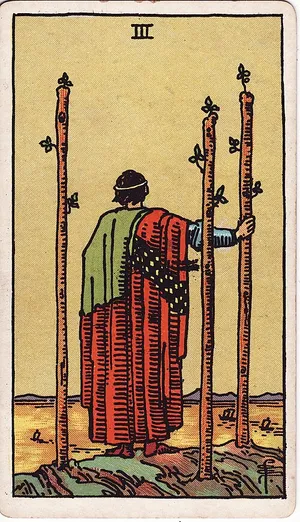

The Three of Wands is the third card of the suit of Wands, one of the four suits of 14 cards that make up the 56 Minor Arcana in the Rider–Waite–Smith tarot, drawn by Pamela Colman Smith and published in London in 1909. It shows a cloaked figure seen from behind, standing on a ridge among three staves and looking out over a golden sea where small ships are sailing. Upright, it is usually read as looking ahead once something is under way: expansion, foresight, waiting for efforts to return; reversed, as delay, frustration or plans that do not travel far.
Key facts
- Suit: Wands, often linked today with energy, drive, ambition and creative work. Fire is today’s common pairing for the suit, but schools differ; see the tarot glossary and the 1909 Rider–Waite–Smith tarot.
- Rank: a numbered card, the Three, marked only with the Roman numeral III at the top.
- Upright in one line: something launched, a wider horizon, watching for what comes back.
- Reversed in one line: delays, a narrower view, effort that seems slow to return.
- Waite’s own key words (1910, abridged): established strength, enterprise, effort, trade, commerce, discovery, “able co-operation in business”; reversed, the end of troubles.
What the picture shows
The whole sky is a warm ochre yellow. In the centre a figure stands with his back to us on a rough ridge of green and red-brown rock. He wears a plain band round his head, a long red robe, and a green cloak hanging from his left shoulder; a dark sash patterned with small yellow squares crosses his back diagonally, and his right arm, in a blue-grey sleeve, reaches out to grip one of the staves. Waite’s note: “A calm, stately personage, with his back turned, looking from a cliff’s edge at ships passing over the sea. Three staves are planted in the ground, and he leans slightly on one of them.”
The three staves are tall and straight, each with sprigs of leaves: one stands on the left, two on the right, and it is the furthest right that he holds. Below the ridge spreads a wide sea, painted the same yellow as the sky, with a few small ships on it and a low line of purple hills along the far shore. We never see his face; we see only what he is looking at. Smith’s monogram is at the lower right.
Waite’s meanings in 1910
In Part III, §2 of The Pictorial Key to the Tarot, Waite gives the divinatory meanings for the Three of Wands:
“He symbolizes established strength, enterprise, effort, trade, commerce, discovery; those are his ships, bearing his merchandise, which are sailing over the sea. The card also signifies able co-operation in business, as if the successful merchant prince were looking from his side towards yours with a view to help you. Reversed: The end of troubles, suspension or cessation of adversity, toil and disappointment.”
Waite reads the picture directly: the ships belong to the man, and they carry his goods. The “merchant prince” comes in only as a comparison: the card signifies able co-operation in business “as if” such a man were looking “from his side towards yours” with a view to help. The second sentence thus turns the image towards the querent rather than naming the figure’s trade. Here the reversed meaning is not a darker version of the upright. It is relief, the end of a hard stretch.
Section 4, “Some Additional Meanings of the Lesser Arcana”, is a further set of meanings Waite lists for each card; after the list he notes that they “are very often in disagreement with those previously given”. They are period fortune-telling formulas, kept here as history, not as anything about the reader. For this card:
“A very good card; collaboration will favour enterprise.”
Here §2 and §4 agree, both pointing to shared work and enterprise.
How the card is usually read today
One common modern reading treats the Three of Wands as the stage after planning: the Two’s figure on the battlement held a globe, and here the ships are already out. In that reading the card is about foresight and patience while something launched is still travelling, and about looking further than the near shore. Take it as a prompt for reflection, not a forecast.
Upright. Readers often connect it with expansion, long-range plans, work that reaches other places or people, and the confidence of having started. Waite’s “able co-operation” leads some readers to ask who else is part of the venture, and who might help.
Reversed. Waite’s reversed meaning is the end of troubles. Later readings more often take the reversed Three as the opposite of the upright: delays, setbacks, plans that stay close to home, or impatience while waiting for results. Some read it as a prompt to check whether the view from the ridge is as wide as it seems.
Questions people often take from the card:
- What have I already set going, and what am I waiting to see return?
- How far ahead am I looking, and is that far enough?
- Who could I work with on this, rather than watching alone?
Upright and reversed at a glance
| Upright | Reversed | |
|---|---|---|
| Waite, 1910 | Established strength, enterprise, trade, discovery; able co-operation in business | The end of troubles; suspension or cessation of adversity, toil and disappointment |
| Common reading today | Expansion, foresight, waiting for efforts to return | Delays, setbacks, a narrow view |
| A question to ask | What am I watching for on the horizon? | What would help me wait, or change course? |
The Three of Wands in a spread
Each position gives the card a slightly different question.
- Three cards (Past, Present, Future). In the Past position, it can point to something you set in motion earlier that is still under way. In the Present, it asks what you are waiting on and how you are using the wait. In the Future position, readers usually take it as an invitation to think further ahead, not as a sign that ships will come in.
- Celtic cross. In the Environment position, it may point to partners or contacts who share the venture. In the Hopes position, it can ask what you hope will come back from the effort already made. In the Outcome position, it can be set beside the cards around it, a settled card such as the Four of Wands for instance, to ask whether the matter still reads as a stage in progress.
The positions of both spreads and the names of all 78 cards are in the tarot glossary; where the deck and its pictures come from is in the 1909 Rider–Waite–Smith tarot.
Cards often read next to the Three of Wands
- Two of Wands, the card before it: a man on a castle roof holding a globe; the plan before the ships set out.
- Four of Wands, the card after it: a garland hung between four staves, read as arrival and celebration.
- Three of Cups: in Waite’s Part III, §2 entry for the Three of Cups, “Maidens in a garden-ground with cups uplifted”; shared joy rather than shared enterprise.
- Three of Pentacles: in Waite’s Part III, §2 entry for the Three of Pentacles, “A sculptor at his work in a monastery”; skilled work again, but a craftsman at his task rather than a merchant at trade.
In HeyFate, each card you draw is turned upright or reversed at random with even odds, and an AI model writes the reading. This page is the reference behind the card, not a reading of your own question.
Sources
- A. E. Waite, The Pictorial Key to the Tarot, Part III, §2, “The Suit of Wands: Three”, with lines from the Threes of Cups and Pentacles (Wikisource, from the 1922 reprint)
- A. E. Waite, The Pictorial Key to the Tarot, Part III, §4, “Some Additional Meanings of the Lesser Arcana” (Wikisource, from the 1922 reprint)
- Wikimedia Commons: Wands03.jpg (Pam-A scan, public domain)
AI-generated content, for reference only; not medical, legal, financial or psychological advice. These methods come from cultural traditions, and HeyFate offers them for cultural interest, entertainment and self-reflection.