Two of Wands Tarot Card Meaning: Upright, Reversed and Symbolism
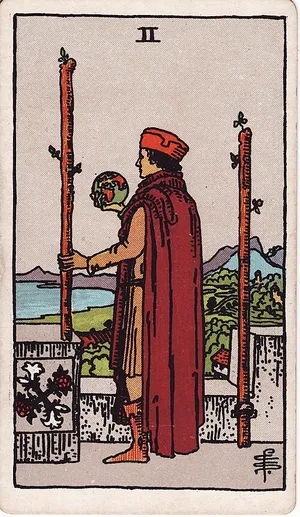

The Two of Wands is the second card of the suit of Wands, one of the four suits of 14 cards that make up the 56 Minor Arcana in the Rider–Waite–Smith tarot, drawn by Pamela Colman Smith and published in London in 1909. It shows a man in a red cloak standing on a castle roof between two staves, holding a small globe and looking out over sea and land. Upright, it is usually read as planning and looking ahead from a secure place; reversed, as hesitation, fear of the unknown or plans that stay on paper.
Key facts
- Suit: Wands, often linked today with energy, drive, ambition and creative work. Fire is today’s common pairing for the suit, but schools differ; see the tarot glossary and the 1909 Rider–Waite–Smith tarot.
- Rank: a numbered card, the Two. Like the other numbered cards it carries only a Roman numeral, II, at the top, with no printed title.
- Upright in one line: looking ahead, weighing a wider world, a plan taking shape.
- Reversed in one line: holding back, unease about leaving familiar ground, a plan that does not move.
- Waite’s own key words (1910, abridged): riches, fortune, magnificence; or, on the other reading, physical suffering, disease, chagrin, sadness; reversed, surprise, wonder, enchantment, trouble, fear.
What the picture shows
The man stands in profile, facing left, on a flat stone roof edged with a low battlement. He wears a red cap, a long dark red cloak over a tan tunic, and red stockings. Waite describes him as “A tall man” who “looks from a battlemented roof over sea and shore; he holds a globe in his right hand, while a staff in his left rests on the battlement; another is fixed in a ring.” The scan matches: he grips the staff on the left, which rests on the stone, and holds up a small globe painted green with red patches. The second staff stands on the right, held to the wall by a metal ring.
On the left, a square stone panel set into the battlement shows a dark cross with red roses and white lilies growing over it. Waite points it out specifically: “The Rose and Cross and Lily should be noticed on the left side.” He does not explain it in this entry. The same two flowers grow in the Magician’s garden, and there, in Part II, “I. The Magician”, Waite writes of “roses and lilies” “changed into garden flowers, to shew the culture of aspiration”; he does not connect the two cards himself.
Beyond the roof the view opens wide. To the left lies a stretch of blue water with purple hills behind it; to the right, green country with trees, fields and a small red-roofed house, and grey-blue mountains on the horizon. The sky is a pale grey. Smith’s monogram is at the lower right.
Waite’s meanings in 1910
In Part III, §2 of The Pictorial Key to the Tarot, Waite gives the divinatory meanings for the Two of Wands:
“Between the alternative readings there is no marriage possible; on the one hand, riches, fortune, magnificence; on the other, physical suffering, disease, chagrin, sadness, mortification. The design gives one suggestion; here is a lord overlooking his dominion and alternately contemplating a globe; it looks like the malady, the mortification, the sadness of Alexander amidst the grandeur of this world’s wealth. Reversed: Surprise, wonder, enchantment, emotion, trouble, fear.”
When Waite says there is “no marriage possible”, he means that the two traditional readings cannot be joined: one says wealth, the other says suffering. Waite then lets the picture hold both: the lord has everything in view and still seems sad. He compares him to Alexander but does not explain the allusion.
Section 4, “Some Additional Meanings of the Lesser Arcana”, is a further set of meanings Waite lists for each card; after the list he notes that they “are very often in disagreement with those previously given”. They are period fortune-telling formulas, kept here as history, not as anything about the reader. For the Two of Wands:
“A young lady may expect trivial disappointments.”
How the card is usually read today
One common modern reading treats the Two of Wands as the moment after the Ace’s spark, when energy turns into a plan: someone stands on secure ground and looks at a wider world, deciding whether and where to go. In that reading the globe is the world held in the hand, studied but not yet travelled. Take it as a prompt for reflection, not a forecast.
Upright. Readers often connect it with planning, ambition, weighing options, and the wish to go beyond familiar walls. Some notice that the man already has a castle and a view, and is asking what comes next.
Reversed. Waite gives “Surprise, wonder, enchantment, emotion, trouble, fear”. Later readings often take the reversed Two as hesitation: staying behind the battlement, fear of leaving what is known, or a plan studied so long that it never starts.
Questions people often take from the card:
- What am I looking at from a safe distance, and what would it take to go nearer?
- Is my plan waiting for information, or for courage?
- What do I already hold, and does it satisfy me?
Upright and reversed at a glance
| Upright | Reversed | |
|---|---|---|
| Waite, 1910 | Riches, fortune, magnificence; or suffering, chagrin, sadness | Surprise, wonder, enchantment, emotion, trouble, fear |
| Common reading today | Planning, looking ahead, weighing a wider world | Hesitation, fear of the unknown, a plan that stalls |
| A question to ask | Where do I want to go from here? | What keeps me behind the wall? |
The Two of Wands in a spread
Each position asks the card something slightly different.
- Three cards (Past, Present, Future). In the Past position, it can point to a plan or decision made earlier that still shapes the view. In the Present, it asks what you are weighing now, and from how secure a place. In the Future position, readers usually take it as an invitation to sketch the next move, not as a sign that a journey will happen.
- Celtic cross. In the Crown position, it can ask what you are aiming at and how wide your view of it is. In the Self position, it may point to someone who is good at planning but slow to leave the battlement.
The positions of both spreads and the names of all 78 cards are in the tarot glossary; where the deck and its pictures come from is in the 1909 Rider–Waite–Smith tarot.
Cards often read next to the Two of Wands
- Ace of Wands, the card before it: the single wand held out from a cloud, read as the spark the plan grows from.
- Three of Wands, the card after it: another figure looking out to sea, now watching ships under way.
- Two of Swords: in Waite’s Part III, §2 entry for the Two of Swords, “A hoodwinked female figure balances two swords”; also a card of weighing, but with the eyes covered.
- Two of Pentacles: in Waite’s Part III, §2 entry for the Two of Pentacles, a young man “in the act of dancing” with a pentacle in either hand; balance kept in motion rather than surveyed from a height.
In HeyFate, each card you draw is turned upright or reversed at random with even odds, and an AI model writes the reading. This page is the reference behind the card, not a reading of your own question.
Sources
- A. E. Waite, The Pictorial Key to the Tarot, Part II, “I. The Magician”, one line on its roses and lilies (Wikisource, from the 1922 reprint)
- A. E. Waite, The Pictorial Key to the Tarot, Part III, §2, “The Suit of Wands: Two”, with lines from the Twos of Swords and Pentacles (Wikisource, from the 1922 reprint)
- A. E. Waite, The Pictorial Key to the Tarot, Part III, §4, “Some Additional Meanings of the Lesser Arcana” (Wikisource, from the 1922 reprint)
- Wikimedia Commons: Wands02.jpg (Pam-A scan, public domain)
AI-generated content, for reference only; not medical, legal, financial or psychological advice. These methods come from cultural traditions, and HeyFate offers them for cultural interest, entertainment and self-reflection.