Ace of Wands Tarot Card Meaning: Upright, Reversed and Symbolism
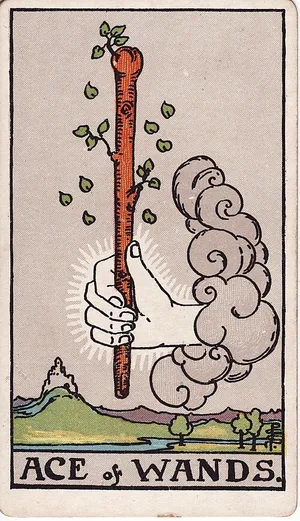

The Ace of Wands opens the suit of Wands, one of the four suits of 14 cards that make up the 56 Minor Arcana in the Rider–Waite–Smith tarot, drawn by Pamela Colman Smith and published in London in 1909. It shows a hand reaching out of a cloud and gripping a stout, sprouting wand above a quiet landscape. Upright, it is usually read as a spark: a new idea, a burst of energy or the start of a project; reversed, as that spark delayed, scattered or slow to catch.
Key facts
- Suit: Wands, often linked today with energy, drive, ambition and creative work. Fire is today’s common pairing for the suit, but schools differ; see the tarot glossary and the 1909 Rider–Waite–Smith tarot.
- Rank: Ace, the opening rank of the suit, followed by Two to Ten and the four court cards.
- Printed title: ACE of WANDS, along the bottom. Waite’s note calls the object “a stout wand or club”.
- Upright in one line: a beginning, a rush of energy, an idea ready to be acted on.
- Reversed in one line: a start that stalls, energy without direction, enthusiasm that fades.
- Waite’s own key words (1910, abridged): creation, invention, enterprise, beginning, source, birth; reversed, fall, decadence, ruin, and “a certain clouded joy”.
What the picture shows
A pale grey sky fills most of the card. From a bank of curling grey cloud on the right, a white hand reaches out and closes round a long red-brown wand held upright. Short white rays surround the hand, as if it were glowing. The wand is a rough branch rather than a smooth rod: it swells into a rounded knob at the top and has a knot about halfway up. Three small sprigs of green leaves grow from it, one beside the knob and two lower down, and eight loose leaves drift in the air on either side.
Waite’s own note is a single line: “A hand issuing from a cloud grasps a stout wand or club.” Everything else is Smith’s. Below the hand, a green hill on the left carries a white castle on its summit; a blue river winds across the low ground; three small trees stand on the right; and a band of purple mountains runs along the horizon. Smith’s monogram sits at the lower right beside the trees.
Two remarks by Waite help with the picture. In Part III, §1, he says that the numbered cards of the Lesser Arcana were all given figures or pictures, “the Aces only excepted”; so the Ace shows the suit’s emblem itself rather than a scene with people in it. And in his entry for the Queen of Wands he writes: “The Wands throughout this suit are always in leaf, as it is a suit of life and animation.” The leaves on this Ace are the first sign of it.
Waite’s meanings in 1910
In Part III, §2 of The Pictorial Key to the Tarot, Waite gives the divinatory meanings for the Ace of Wands:
“Creation, invention, enterprise, the powers which result in these; principle, beginning, source; birth, family, origin, and in a sense the virility which is behind them; the starting point of enterprises; according to another account, money, fortune, inheritance. Reversed: Fall, decadence, ruin, perdition, to perish; also a certain clouded joy.”
The upright list is about origins: where things begin and the force that makes them begin. Waite brings in birth and family as well as enterprise, and he keeps the money reading apart, as “another account” rather than his main line.
Section 4, “Some Additional Meanings of the Lesser Arcana”, is a further set of meanings Waite lists for each card; after the list he notes that they “are very often in disagreement with those previously given”. They are period fortune-telling formulas, kept here as history, not as anything about the reader. For this card:
“Calamities of all kinds. Reversed: A sign of birth.”
This nearly turns §2 upside down: the upright now carries calamity, and birth moves to the reversed side. Waite prints both and does not reconcile them.
How the card is usually read today
One common modern reading treats the Ace of Wands as the raw spark of a suit about action: energy that comes before any plan, the moment an idea feels alive enough to try. A cut branch that still puts out leaves fits that reading of growth that has not stopped. Take it as a prompt for reflection, not a forecast.
Upright. Readers often connect it with inspiration, enthusiasm, a new project or a fresh start in work or creative life, and the nerve to begin. Because the wand is held out by a hand from beyond the picture, some readers ask what is being offered and whether the person asking is ready to take hold of it.
Reversed. Waite gives fall and ruin, softened by “a certain clouded joy”. Later readings are usually milder: a start that keeps being postponed, energy spread over too many things, or enthusiasm that burns out before anything is built.
Questions people often take from the card:
- What idea keeps coming back to me, asking to be tried?
- If I began this week, what would the opening step be?
- Where is my energy going, and is that where I want it to go?
Upright and reversed at a glance
| Upright | Reversed | |
|---|---|---|
| Waite, 1910 | Creation, invention, enterprise; beginning, source, birth; or money, fortune, inheritance | Fall, decadence, ruin, perdition; a certain clouded joy |
| Common reading today | Inspiration, a new start, energy to act | A delayed start, scattered energy, enthusiasm fading |
| A question to ask | What wants to begin here? | What keeps the spark from catching? |
The Ace of Wands in a spread
Position changes the question the card asks.
- Three cards (Past, Present, Future). In the Past position, it can point back to the moment something began. In the Present, it asks what is ready to start now and what you are waiting for. In the Future position, readers usually take it as an invitation to think about what you would like to begin, not as a promise that anything will.
- Celtic cross. In the Root position, it may ask what original impulse lies under the whole question. In the Challenge position, it can point to energy that is hard to direct, or a beginning that keeps being put off. In the Outcome position, it is often read as a question about what is worth starting next.
The positions of both spreads and the names of all 78 cards are in the tarot glossary; where the deck and its pictures come from is in the 1909 Rider–Waite–Smith tarot.
Cards often read next to the Ace of Wands
- Two of Wands, the next card in the suit: often read as the spark turning into a plan.
- Ace of Cups: the same hand from a cloud, holding a cup; read on the side of feeling rather than action.
- Ace of Swords: the hand grasps a crowned sword; often read as a clear idea or decision.
- Ace of Pentacles: often read as a practical or material beginning.
In HeyFate, each card you draw is turned upright or reversed at random with even odds, and an AI model writes the reading. This page is the reference behind the card, not a reading of your own question.
Sources
- A. E. Waite, The Pictorial Key to the Tarot, Part III, §2, “The Suit of Wands: Ace”, with one line from “Wands: Queen” (Wikisource, from the 1922 reprint)
- A. E. Waite, The Pictorial Key to the Tarot, Part III, §1, “Distinction between the Greater and Lesser Arcana”, and §4, “Some Additional Meanings of the Lesser Arcana” (Wikisource, from the 1922 reprint)
- Wikimedia Commons: Wands01.jpg (Pam-A scan, public domain)
AI-generated content, for reference only; not medical, legal, financial or psychological advice. These methods come from cultural traditions, and HeyFate offers them for cultural interest, entertainment and self-reflection.