Ace of Cups Tarot Card Meaning: Upright, Reversed and Symbolism
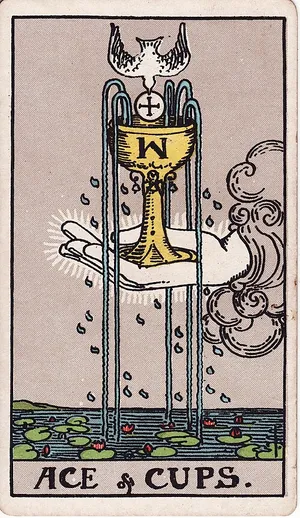

The Ace of Cups is the opening card of the suit of Cups, one of the four suits that make up the 56 Minor Arcana in the Rider–Waite–Smith tarot, drawn by Pamela Colman Smith and published in London in 1909. It shows a hand reaching out of a cloud with a golden cup on its palm, streams of water spilling over the rim, and a dove bringing a round wafer down to it. Upright, it is usually read as an opening of feeling: affection, warmth or emotional renewal offered freely; reversed, as that feeling held back, unsettled or not yet trusted.
Key facts
- Suit: Cups, the suit usually linked with feelings, relationships and the inner life. Today’s common pairing gives Cups the element of Water; other schools pair the suits differently, as the table in the 1909 Rider–Waite–Smith tarot shows. In his Part III, §2 entry for the King of Cups, Waite writes that “the Sign of the Cup naturally refers to water”.
- Rank: Ace, the card that opens the suit. Aces are not court cards; they come before the numbered cards Two to Ten.
- Upright in one line: an overflowing heart, a new feeling or bond, something given without being earned.
- Reversed in one line: feeling withheld or unsteady, a gift you hesitate to accept.
- Waite’s own key words (1910): “House of the true heart”, joy, content, nourishment, abundance; reversed, “House of the false heart”, instability.
What the picture shows
The background is a flat grey. From a curling cloud on the right a large white hand comes out palm upward, and a thin halo of rays surrounds it. On the open palm stands a golden cup with a knotted, decorated stem. A large black letter is drawn on its bowl, shaped like an M, or a W turned upside down; Waite does not mention it.
Above the cup, a white dove dives head first with its wings raised, carrying in its beak a white disc marked with an equal-armed cross. Waite describes this as “a dove, bearing in its bill a cross-marked Host”, which “descends to place the Wafer in the Cup”.
Water arches over the rim on both sides and falls in long, straight streams to the pool at the bottom of the card. Waite writes that “four streams are pouring”; in this scan there are five, two on the left and three on the right. Loose drops of water hang in the air all around, as in his note: “the dew of water is falling on all sides”. The pool below is dark blue-green and covered with lily pads and red water-lilies, with a strip of land on the far left. Smith’s monogram is at the lower right, standing in the water. The title along the bottom reads ACE of CUPS.
Waite’s meanings in 1910
In Part III, §2, of The Pictorial Key to the Tarot, Waite gives each Minor Arcana card a short picture note and then its meanings. After describing the Ace, he adds one line: “It is an intimation of that which may lie behind the Lesser Arcana”. Then:
“Divinatory Meanings: House of the true heart, joy, content, abode, nourishment, abundance, fertility; Holy Table, felicity hereof. Reversed: House of the false heart, mutation, instability, revolution.”
“Holy Table” fits the Host and the dove in the picture: Waite’s own wording keeps the card close to the image of a communion table, while the other words are about a settled, well-fed home and a contented heart. The reversed list turns that house into its opposite, a “false heart”, and adds change and upheaval.
Section 4, “Some Additional Meanings of the Lesser Arcana”, is a further set of meanings Waite lists for each card; after the list he notes that they “are very often in disagreement with those previously given”. For the Ace of Cups:
“Ace.—Inflexible will, unalterable law. Reversed: Unexpected change of position.”
These §4 lines are period fortune-telling formulas, kept here as history; they say nothing about the reader. For the Ace of Cups they sit oddly beside the §2 entry, which is about the heart rather than the will.
How the card is usually read today
One common modern reading treats the Ace of Cups as the root of the whole suit: feeling in its first, undivided form, before it becomes a particular relationship, celebration or loss. In that reading the card is about capacity rather than outcome, about being open to give and receive. Treat it as a question about your own openness, not a forecast.
Upright. Readers often connect it with warmth, compassion, a renewed sense of connection, creative feeling, or a moment of being moved. The water spilling on every side fits that reading of feeling that does not need to be rationed.
Reversed. Waite gives “House of the false heart, mutation, instability, revolution”. Later readings more often take the reversed Ace as feeling that is blocked or turned inward: holding back affection, finding it hard to accept care, or emotions that are close to the surface but not yet understood.
Some questions to sit with:
- Where in my life am I being offered something I have not yet taken in?
- What would it look like to let a feeling run freely instead of measuring it out?
- Is there a part of me that has closed up, and what made it close?
Upright and reversed at a glance
| Upright | Reversed | |
|---|---|---|
| Waite, 1910 | House of the true heart; joy, content, nourishment, abundance | House of the false heart; mutation, instability, revolution |
| Common reading today | Emotional openness, warmth, a new bond or feeling | Feeling held back or unsettled; trouble receiving care |
| A question to ask | What is being offered to me? | What keeps me from accepting it? |
The Ace of Cups in a spread
Read it alongside its position.
- Three cards (Past, Present, Future). As the Past, it can bring to mind an experience of warmth or welcome that still colours how you feel. As the Present, it asks where your feelings are open right now. In the Future position, readers usually take it as an invitation to notice what you are ready to give or receive, not as a promise of a new relationship.
- Celtic cross. In the Root position, the Ace can point to the feelings that lie under the whole question. In the Self position, it asks how open you are allowing yourself to be. Next to harder cards, many readers read it as a source of care that is still available.
The positions of both spreads and the names of all 78 cards are in the tarot glossary; where the deck and its pictures come from is in the 1909 Rider–Waite–Smith tarot.
Cards often read next to the Ace of Cups
- Two of Cups, the next card in the suit: the feeling of the Ace shared between two people.
- Ace of Wands: in Waite’s §2 entry, “A hand issuing from a cloud grasps a stout wand or club”, and his meanings begin with “Creation, invention, enterprise”; often read as a start in energy or will rather than feeling.
- Ace of Swords: the same gesture with a sword, which many readers take as clarity of mind.
- Ace of Pentacles: the same gesture with a pentacle, often read as a beginning in material or practical matters.
In HeyFate, each card you draw is turned upright or reversed at random with even odds, and an AI model writes the reading. This page is the reference behind the card, not a reading of your own question.
Sources
- A. E. Waite, The Pictorial Key to the Tarot, Part III, §2, “The Suit of Cups: Ace”, with one line from “Cups: King” (Wikisource, from the 1922 reprint)
- A. E. Waite, The Pictorial Key to the Tarot, Part III, §4, “Some Additional Meanings of the Lesser Arcana” (Wikisource, from the 1922 reprint)
- Wikimedia Commons: Cups01.jpg (Pam-A scan, public domain)
AI-generated content, for reference only; not medical, legal, financial or psychological advice. These methods come from cultural traditions, and HeyFate offers them for cultural interest, entertainment and self-reflection.