King of Wands Tarot Card Meaning: Upright, Reversed and Symbolism
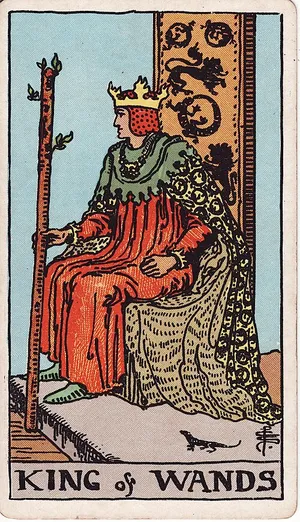

The King of Wands is the highest of the four court cards in the suit of Wands, one of the four suits that make up the 56 Minor Arcana in the Rider–Waite–Smith tarot, drawn by Pamela Colman Smith and published in London in 1909. It shows a crowned king seated in profile on a throne decorated with a lion and lizard-like motifs, holding a tall leafy wand, with a small lizard on the floor beside him. Upright, it is usually read as vision, leadership and the confidence to act on a plan; reversed, as that force turned impatient, overbearing or harsh.
Key facts
- Suit: Wands. The pairing commonly given today is Fire, but writers differ and his entries for the suit do not name one; see the 1909 Rider–Waite–Smith tarot. In his entry for the Queen of Wands, Waite calls it “a suit of life and animation”; today it is usually linked with energy, drive, work and plans.
- Rank: a court card, the highest of the four (Page, Knight, Queen, King). Waite’s book describes each suit from the King down, so this is the card that opens the Wands in his Part III.
- Upright in one line: leadership, vision, honesty, the energy to carry a plan through.
- Reversed in one line: impatience, severity, high demands, force without warmth.
- Waite’s own key words (1910, shortened): “ardent, lithe, animated, impassioned, noble”; “The card always signifies honesty”; reversed, “Good, but severe; austere, yet tolerant”.
What the picture shows
The King sits in profile, facing left, on a throne that stands on a pale grey platform. The tall back of the throne is an orange-brown panel decorated in black: a lion near the top, lizard-like motifs below it, one curled round into a ring, and the dark shape of another lion behind his shoulder. He wears a gold crown with flame-shaped points set over a red cap dotted with black. Round his shoulders is a green cape with a jagged edge and a chain or necklace lying over it. Beneath it he wears a long red robe, and a yellow mantle patterned with black rings spills over the throne behind him. His shoes are green.
He holds a tall wooden staff upright in front of him with one hand, its foot resting on the ground below the platform’s edge; small green leaves sprout near its top and along the shaft. His other hand rests in his lap. On the platform near the lower right a small black lizard runs across the floor, beside Smith’s monogram. Behind him the sky is blue, with a stretch of orange-brown ground at the right edge. The title KING of WANDS runs along the bottom.
Waite’s note: “The physical and emotional nature to which this card is attributed is dark, ardent, lithe, animated, impassioned, noble. The King uplifts a flowering wand, and wears, like his three correspondences in the remaining suits, what is called a cap of maintenance beneath his crown. He connects with the symbol of the lion, which is emblazoned on the back of his throne.” The red cap under the crown is that cap of maintenance, a ceremonial cap of rank known from English ceremony and heraldry. Waite says he “uplifts” the wand; in the scan he holds it upright with its foot on the ground rather than raised. He names the lion but does not comment on the lizard-like motifs or the small lizard on the floor.
Waite’s meanings in 1910
In Part III, §2 of The Pictorial Key to the Tarot, Waite gives the divinatory meanings:
“Dark man, friendly, countryman, generally married, honest and conscientious. The card always signifies honesty, and may mean news concerning an unexpected heritage to fall in before very long. Reversed: Good, but severe; austere, yet tolerant.”
Waite’s King is a decent, steady man of the country, and the one quality he insists on is honesty: “always”. The reversed meaning, as with the Queen, is not a simple opposite. “Good, but severe; austere, yet tolerant” describes the same man turned stricter. The “unexpected heritage”, an inheritance, is a stock promise of the period fortune-telling lists, quoted here as history. And “Dark man” reflects the period practice of matching a court card to a person’s colouring; in §7, describing the Celtic method, Waite assigns the Wands courts to “very fair people, with yellow or auburn hair, fair complexion and blue eyes”, and he does not reconcile the two.
Section 4, “Some Additional Meanings of the Lesser Arcana”, is a further set of meanings Waite lists for each card; after the list he notes that they “are very often in disagreement with those previously given”. For the King:
“King.—Generally favourable; may signify a good marriage. Reversed: Advice that should be followed.”
These §4 lines are period fortune-telling formulas, kept here as history, not as anything about the reader. They match the §2 entry in tone: even reversed, the King’s card in §4 gives advice rather than trouble.
How the card is usually read today
One common modern reading treats the King of Wands as the suit’s fire matured into leadership: the Page’s spark and the Knight’s charge now steadied by experience and pointed at a goal. In that reading he can stand for a person, or for qualities you are being asked to use: vision, initiative, the ability to rally others, honesty about what you want. Use it to reflect on your situation, not as a forecast about anyone.
Upright. Common readings are taking charge, seeing the larger picture, entrepreneurial energy, setting a direction others can follow, or speaking plainly. Some readers point to his profile view: he is looking ahead, past the edge of the card.
Reversed. Waite gives “Good, but severe; austere, yet tolerant”. Later readings go further: impatience with others, expecting too much, acting on impulse, a forceful manner that leaves no room for anyone else, or a vision that has lost touch with practical steps.
Questions people often take from the card:
- Where am I being asked to lead, and am I willing to?
- Is my vision clear enough for others to follow?
- Where has my drive become pressure on myself or the people around me?
Upright and reversed at a glance
| Upright | Reversed | |
|---|---|---|
| Waite, 1910 | A friendly, honest, conscientious man; always honesty | Good, but severe; austere, yet tolerant |
| Common reading today | Leadership, vision, initiative | Impatience, severity, overbearing force |
| A question to ask | What direction am I setting? | Where is my drive becoming pressure? |
The King of Wands in a spread
Each position puts a different weight on the King.
- Three cards (Past, Present, Future). In the Past position, it can invite a look at a decision you led, or a person whose example shaped you. In the Present, it asks where you are taking charge and how. In the Future position, readers usually take it as a prompt to think about the kind of leadership a plan will need, not as a fixed event.
- Celtic cross. In the Crown position, it may point to an aim of leading or building something of your own. In the Challenge position, it can ask whether force or impatience is getting in the way. In the Outcome position, many readers look at the cards around it to see whether the vision has the support it needs.
The positions of both spreads and the names of all 78 cards are in the tarot glossary; where the deck and its pictures come from is in the 1909 Rider–Waite–Smith tarot.
Cards often read next to the King of Wands
- Queen of Wands, the court card before him: also on a lion throne. In her entry Waite says her personality “corresponds to that of the King, but is more magnetic”.
- Ace of Wands: a single sprouting staff held out from a cloud; set beside the King, the suit’s emblem on its own against the court card that rules it.
- King of Swords: another king facing out from his throne, sword upright; authority through judgement rather than drive.
- King of Pentacles: a king robed in vines, a castle behind him; authority through steady resources.
In HeyFate, each card you draw is turned upright or reversed at random with even odds, and an AI model writes the reading. This page is the reference behind the card, not a reading of your own question.
Sources
- A. E. Waite, The Pictorial Key to the Tarot, Part III, §2, “The Suit of Wands: King”, with the Queen of Wands entry on the suit (Wikisource, from the 1922 reprint)
- A. E. Waite, The Pictorial Key to the Tarot, Part III, §4, “Some Additional Meanings of the Lesser Arcana” (Wikisource, from the 1922 reprint)
- A. E. Waite, The Pictorial Key to the Tarot, Part III, §7, “An Ancient Celtic Method of Divination” (Wikisource, from the 1922 reprint)
- Wikimedia Commons: Wands14.jpg (Pam-A scan, public domain)
AI-generated content, for reference only; not medical, legal, financial or psychological advice. These methods come from cultural traditions, and HeyFate offers them for cultural interest, entertainment and self-reflection.