Queen of Wands Tarot Card Meaning: Upright, Reversed and Symbolism
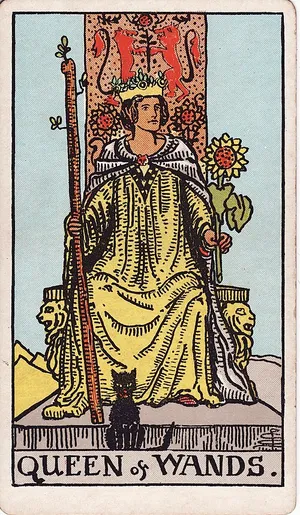

The Queen of Wands is one of the four court cards in the suit of Wands, one of the four suits that make up the 56 Minor Arcana in the Rider–Waite–Smith tarot, drawn by Pamela Colman Smith and published in London in 1909. It shows a crowned queen seated on a throne carved with lions, a tall leafy wand in one hand and a sunflower in the other, with a black cat sitting at her feet. Upright, it is usually read as warmth, confidence and steady vitality; reversed, as that confidence shaken, or turned into jealousy or a need for control.
Key facts
- Suit: Wands. The pairing commonly given today is Fire, but writers differ and his entries for the suit do not name one; see the 1909 Rider–Waite–Smith tarot. This card’s own entry is where Waite describes the whole suit: its wands are “always in leaf, as it is a suit of life and animation”. Today the suit is usually linked with energy, drive, work and plans.
- Rank: a court card, the third of the four (Page, Knight, Queen, King).
- Upright in one line: warmth, self-assurance, generosity, energy held with calm.
- Reversed in one line: self-doubt, jealousy, a temper that runs hot, or kindness without an outlet.
- Waite’s own key words (1910, shortened): “friendly, chaste, loving, honourable”; “a certain success in business”; reversed, “Good, economical, obliging, serviceable”.
What the picture shows
The Queen sits with her body facing us and her face turned slightly to the right, on a throne set on a grey stone platform. The tall back of the throne rises behind her head in a dotted orange-brown panel: at the top, two red lions stand on their hind legs facing each other, and lower down two red-centred sunflowers flank her face. The arms of the throne end in two carved lion heads, one on each side of her. She wears a gold crown wreathed with green leaves over dark hair, a long yellow gown, and a grey-white cloak fastened at the throat with a small red clasp. A red shoe shows beneath the hem.
In her right hand she holds a tall wooden wand, its foot resting on the platform and a few green leaves sprouting near the top. In her left she holds a sunflower on a leafy stem. In front of her, at the edge of the platform, a black cat sits facing out of the card. Behind the throne, yellow pyramid-like shapes rise on the left and grey hills on the right under a blue sky. The title QUEEN of WANDS runs along the bottom, and Smith’s monogram is on the front of the platform at the lower right.
Waite’s note does not describe her pose or these objects. It says only that “The Wands throughout this suit are always in leaf, as it is a suit of life and animation”, and that “Emotionally and otherwise, the Queen’s personality corresponds to that of the King, but is more magnetic.” He does not mention the cat or the sunflower. The lions also appear on the King’s throne.
Waite’s meanings in 1910
In Part III, §2 of The Pictorial Key to the Tarot, Waite gives the divinatory meanings:
“A dark woman, countrywoman, friendly, chaste, loving, honourable. If the card beside her signifies a man, she is well disposed towards him; if a woman, she is interested in the Querent. Also, love of money, or a certain success in business. Reversed: Good, economical, obliging, serviceable. Signifies also—but in certain positions and in the neighbourhood of other cards tending in such directions—opposition, jealousy, even deceit and infidelity.”
This is one of the entries where the reversed meaning is mostly good: “Good, economical, obliging, serviceable”. The darker words, jealousy and deceit, need two conditions: “in certain positions” and “in the neighbourhood of other cards tending in such directions”. As with the other courts, “dark woman” reflects the period habit of matching a court card to a person’s colouring, and in §7 Waite assigns the Wands courts to “very fair people, with yellow or auburn hair, fair complexion and blue eyes”. He leaves the two passages side by side without comment.
Section 4, “Some Additional Meanings of the Lesser Arcana”, is a further set of meanings Waite lists for each card; after the list he notes that they “are very often in disagreement with those previously given”. For the Queen:
“Queen.—A good harvest, which may be taken in several senses. Reversed: Good-will towards the Querent, but without the opportunity to exercise it.”
These §4 lines are period fortune-telling formulas, kept here as history, not as anything about the reader. The reversed line is a gentle one: the goodwill is there, only the chance to act on it is missing.
How the card is usually read today
One common modern reading treats the Queen of Wands as confidence that does not need to shout: the suit’s fire held steadily, warm rather than restless. In that reading she can stand for a person, or for qualities you are being asked to find in yourself: courage, generosity, enjoyment of life, the ability to inspire others. Read it as a prompt for reflection, not as a forecast about anyone.
Upright. Common readings are self-assurance, warmth and sociability, determination, a creative or practical project handled with energy and good humour, or someone whose presence lifts others.
Reversed. Waite’s reversed list is largely kind. Later readings tend to take the reversed Queen as warmth under strain: self-doubt, burnout, jealousy, being demanding or controlling, or, echoing §4, goodwill that finds no outlet.
Questions people often take from the card:
- Where do I feel most confident, and what does that confidence rest on?
- Is my warmth reaching the people around me, or being held back?
- What would it look like to take up more space here?
Upright and reversed at a glance
| Upright | Reversed | |
|---|---|---|
| Waite, 1910 | A friendly, loving, honourable woman; love of money, or a certain success in business | Good, economical, obliging, serviceable; in certain positions, with neighbouring cards tending that way, jealousy or deceit |
| Common reading today | Confidence, warmth, vitality, generosity | Self-doubt, jealousy, control, burnout |
| A question to ask | Where can I lead with warmth? | What is unsettling my confidence? |
The Queen of Wands in a spread
Position changes how her qualities are read.
- Three cards (Past, Present, Future). In the Past position, it can invite a look at a time, or a person, that gave you confidence. In the Present, it asks how you are using your energy and presence now. In the Future position, readers usually take it as a prompt to grow into a steadier confidence, not as a fixed event.
- Celtic cross. In the Self position, it may point to your own warmth and assurance. In the Environment position, it can stand for a lively, generous influence around you. In the Challenge position, many readers read it as confidence tipping into pride or control, and ask what would rebalance it.
The positions of both spreads and the names of all 78 cards are in the tarot glossary; where the deck and its pictures come from is in the 1909 Rider–Waite–Smith tarot.
Cards often read next to the Queen of Wands
- Knight of Wands, the court card before her: the suit’s energy on a rearing horse; the Queen shows the suit seated and still.
- King of Wands, the court card after her: Waite says her personality “corresponds to that of the King, but is more magnetic”.
- Queen of Cups: another queen, enthroned at the water’s edge and gazing at an ornate covered cup; the two can be contrasted as feeling turned inward and warmth turned outward.
- Queen of Pentacles: a queen in a garden with a pentacle in her lap; care for practical things beside the Queen of Wands’ spirit.
In HeyFate, each card you draw is turned upright or reversed at random with even odds, and an AI model writes the reading. This page is the reference behind the card, not a reading of your own question.
Sources
- A. E. Waite, The Pictorial Key to the Tarot, Part III, §2, “The Suit of Wands: Queen” (Wikisource, from the 1922 reprint)
- A. E. Waite, The Pictorial Key to the Tarot, Part III, §4, “Some Additional Meanings of the Lesser Arcana” (Wikisource, from the 1922 reprint)
- A. E. Waite, The Pictorial Key to the Tarot, Part III, §7, “An Ancient Celtic Method of Divination” (Wikisource, from the 1922 reprint)
- Wikimedia Commons: Wands13.jpg (Pam-A scan, public domain)
AI-generated content, for reference only; not medical, legal, financial or psychological advice. These methods come from cultural traditions, and HeyFate offers them for cultural interest, entertainment and self-reflection.