Queen of Cups Tarot Card Meaning: Upright, Reversed and Symbolism
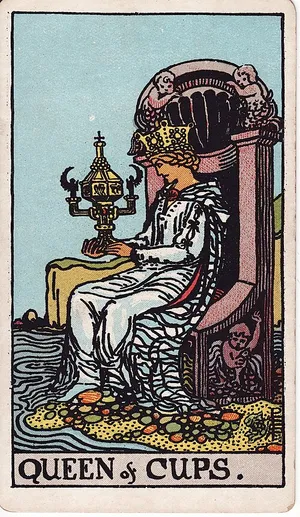

The Queen of Cups is one of the 56 Minor Arcana in the Rider–Waite–Smith tarot: the Queen, one of the four court cards in the suit of Cups, drawn by Pamela Colman Smith and published in London in 1909. It shows a crowned woman seated on a carved throne at the edge of the sea, gazing at an ornate, lidded cup she holds in both hands. Upright, it is usually read as compassion, intuition and emotional depth; reversed, as feelings that overwhelm, or care given at the cost of yourself.
Key facts
- Suit: Cups, one of the four suits of 14 cards. Today’s common pairing links Cups with water, and the suit with feelings, intuition and relationships; pairings differ between schools, as the 1909 Rider–Waite–Smith tarot article explains.
- Rank: a court card, the Queen, between the Knight and the King of Cups. The printed title at the bottom reads QUEEN of CUPS.
- Upright in one line: empathy, intuition, emotional steadiness, care for others.
- Reversed in one line: being swamped by feeling, over-giving, or care that turns into control.
- Waite’s own key words (1910, shortened): “loving intelligence, and hence the gift of vision”; “success, happiness, pleasure; also wisdom, virtue”; reversed, “The accounts vary”.
What the picture shows
The sky is a pale blue. On the right, a queen sits in profile on a heavy stone throne, turned to the left, facing the sea. She wears a gold crown set with round jewels and a long white robe shaded with blue-grey, with a red lining showing at her side and a small red clasp at her collar. Her eyes rest on the cup in her hands.
The cup is the most elaborate object in the suit’s court cards. It is gold and closed with a lid, which is topped by a small cross. Its body has several flat sides with tiny figures on the panels, and two arms branch out from the stem, each holding a small dark figure with raised wings, like an angel. Waite’s note does not describe the cup at all.
The throne is carved in pinkish stone. Its back is a dark, fluted shape like a scallop shell, with a small child-like figure at each upper corner. On the side panel another small carved figure holds one arm up. The throne stands on a strip of shore covered with coloured pebbles, and water runs in from the left almost to the hem of her robe. Behind her, on the left, rises a low yellow-brown cliff, with a small rock in the water beside it. Smith’s monogram is among the pebbles at the lower right, and the title QUEEN of CUPS runs along the bottom.
Waite’s note on the card is short: “Beautiful, fair, dreamy—as one who sees visions in a cup. This is, however, only one of her aspects; she sees, but she also acts, and her activity feeds her dream.”
Waite’s meanings in 1910
In Part III, §2 of The Pictorial Key to the Tarot, Waite gives the divinatory meanings:
“Good, fair woman; honest, devoted woman, who will do service to the Querent; loving intelligence, and hence the gift of vision; success, happiness, pleasure; also wisdom, virtue; a perfect spouse and a good mother. Reversed: The accounts vary; good woman; otherwise, distinguished woman but one not to be trusted; perverse woman; vice, dishonour, depravity.”
The upright list mixes two things. One is a type of person, described in the gendered terms of the time: a “Good, fair woman”, “a perfect spouse and a good mother”. The other is a set of qualities that later readings still use: “loving intelligence, and hence the gift of vision”, the idea that her vision, which echoes the “visions in a cup” of his picture note, grows out of her care. The reversed line is openly uncertain. Waite begins with “The accounts vary”, gives “good woman” as one account, and then a run of darker ones.
His picture note matters as much as the list. The phrase “she sees, but she also acts” separates this Queen from a pure dreamer; the vision in the cup is fed by what she does.
Part III, §4, “Some Additional Meanings of the Lesser Arcana”, is a further set of meanings Waite lists for each card. For the Queen: “Sometimes denotes a woman of equivocal character. Reversed: A rich marriage for a man and a distinguished one for a woman.” These are period fortune-telling formulas, kept here as history and not as anything about the reader’s marriage or character. They also sit uneasily beside §2, and Waite admits after the list that the additional meanings “are very often in disagreement with those previously given”.
How the card is usually read today
One common modern reading takes the Queen of Cups as emotional maturity: someone who feels deeply and can hold those feelings, her own and other people’s, without being carried off by them. In that reading her steady gaze at the cup is attention, and Waite’s “she sees, but she also acts” is the point: intuition put to use. Read it as a prompt for reflection, not a description of anyone in your life.
Upright. Readers often connect it with empathy, listening, trusting your intuition, creative sensitivity, or a person who makes others feel safe. Some read it as permission to take your own feelings seriously.
Reversed. Waite gives “The accounts vary”, then a mix of good and bad. Later readings more often take the reversed Queen as an imbalance in the same gifts: absorbing other people’s moods, giving until you are empty, losing yourself in feeling, or caring in a way that smothers.
Questions people often take from the card:
- What am I sensing here that I have not said out loud?
- Whose feelings am I holding, and are any of them really mine?
- How could my care for others include care for myself?
Upright and reversed at a glance
| Upright | Reversed | |
|---|---|---|
| Waite, 1910 | Good, fair woman; loving intelligence, the gift of vision; success, happiness, wisdom | The accounts vary; good woman, or one not to be trusted; vice, dishonour |
| Common reading today | Compassion; intuition; emotional steadiness | Overwhelm; over-giving; care that smothers |
| A question to ask | What does my intuition tell me? | Where do I end and others begin? |
The Queen of Cups in a spread
Where the card falls changes the question it asks.
- Three cards (Past, Present, Future). In the Past position, it can recall someone’s care, or your own, that shaped how you deal with feelings. In the Present, it asks what you are sensing beneath the surface of the situation. In the Future position, readers usually take it as an invitation to bring more patience and attention to what you feel, not as a person who will appear.
- Celtic cross. In the Self position, it can invite a look at how you hold your own emotions. In the Environment position, it may point to people around you who offer understanding, or who lean on yours. In the Outcome position, many readers look at the cards beside it, for instance the Knight or King of Cups, and read them together as how feeling becomes action.
The positions of both spreads and the names of all 78 cards are in the tarot glossary; where the deck and its pictures come from is in the 1909 Rider–Waite–Smith tarot.
Cards often read next to the Queen of Cups
- Knight of Cups, the card before it: the Knight of Cups, who “too is a dreamer” in Waite’s Part III, §2 entry, riding with his cup held out.
- King of Cups, the card after it: a cup held on a throne in the middle of the sea, feeling under command.
- Queen of Pentacles: in Waite’s Part III, §2 entry for the Queen of Pentacles, she “contemplates her symbol and may see worlds therein”, another queen gazing at what she holds.
- Queen of Swords: in Waite’s Part III, §2 entry for the Queen of Swords, a face that “suggests familiarity with sorrow”, the same rank in a sharper, more guarded mood.
In HeyFate, each card you draw is turned upright or reversed at random with even odds, and an AI model writes the reading. This page is the reference behind the card, not a reading of your own question.
Sources
- A. E. Waite, The Pictorial Key to the Tarot, Part III, §2, “The Suit of Cups: Queen”, with lines from “The Suit of Cups: Knight” and the Queens of Pentacles and Swords (Wikisource, from the 1922 reprint)
- A. E. Waite, The Pictorial Key to the Tarot, Part III, §4, “Some Additional Meanings of the Lesser Arcana” (Wikisource, from the 1922 reprint)
- Wikimedia Commons: Cups13.jpg (Pam-A scan, public domain)
AI-generated content, for reference only; not medical, legal, financial or psychological advice. These methods come from cultural traditions, and HeyFate offers them for cultural interest, entertainment and self-reflection.