Knight of Cups Tarot Card Meaning: Upright, Reversed and Symbolism
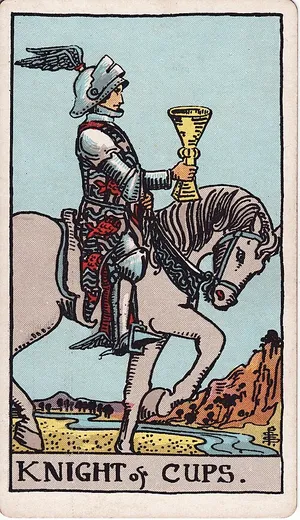

The Knight of Cups is one of the 56 Minor Arcana in the Rider–Waite–Smith tarot: the Knight, one of the four court cards in the suit of Cups, drawn by Pamela Colman Smith and published in London in 1909. It shows an armoured knight in a winged helmet riding a grey horse at a slow walk, holding a gold cup out in front of him. Upright, it is usually read as an invitation, an offer or a romantic, idealistic impulse; reversed, as moodiness, unreliability or a promise that is more charm than substance.
Key facts
- Suit: Cups, one of the four suits of 14 cards. Today’s common pairing links Cups with water, and the suit with feelings, imagination and relationships; pairings differ between schools, as the 1909 Rider–Waite–Smith tarot article explains.
- Rank: a court card, the Knight, between the Page and the Queen of Cups. The printed title at the bottom reads KNIGHT of CUPS.
- Upright in one line: an offer or invitation; following a feeling or an ideal.
- Reversed in one line: moodiness, empty charm, an offer that does not hold up.
- Waite’s own key words (1910): “Arrival, approach—sometimes that of a messenger; advances, proposition, demeanour, invitation, incitement”; reversed, “Trickery, artifice, subtlety, swindling, duplicity, fraud”.
What the picture shows
The sky is a pale, even blue. A knight in silver plate armour rides from left to right on a large grey horse. The horse moves at a walk: its head is lowered and drawn in by the reins, and one foreleg is lifted and bent, the hoof just clear of the ground. Its bridle and reins are dark, with a wavy pattern along them.
The knight sits upright and holds a gold cup out in front of him in his right hand, at about the height of his chest, looking ahead past it. His helmet has a pair of silver wings at the back, and a second small wing is drawn at his heel, just behind the stirrup. Over his armour he wears a dark tunic patterned with red fish and blue-grey wavy lines, fish that appear again in the Page’s cup and on the King’s pendant.
The ground below is sandy and dotted. A narrow river winds across the foreground, and the horse is about to step towards it. On the left the land is low, with a line of small trees and distant hills; on the right rises a steep reddish-brown slope with dark trees on its face. Smith’s monogram is at the lower right, and the title KNIGHT of CUPS runs along the bottom.
Waite’s note: “Graceful, but not warlike; riding quietly, wearing a winged helmet, referring to those higher graces of the imagination which sometimes characterize this card. He too is a dreamer, but the images of the side of sense haunt him in his vision.” The “too” most likely looks back to the entry before his in Waite’s order, “The Suit of Cups: Queen”, who is “dreamy—as one who sees visions in a cup”.
Waite’s meanings in 1910
In Part III, §2 of The Pictorial Key to the Tarot, Waite gives the divinatory meanings:
“Arrival, approach—sometimes that of a messenger; advances, proposition, demeanour, invitation, incitement. Reversed: Trickery, artifice, subtlety, swindling, duplicity, fraud.”
Almost every upright word is about something coming towards someone: an arrival, an approach, a proposition, an invitation. The reversed list turns that approach into its bad copy: the same advance made with “Trickery”, “duplicity” or “fraud”. His picture note adds a second theme, imagination. The winged helmet points to “higher graces of the imagination”, but the knight is also haunted by “the images of the side of sense”, the pull of the senses and pleasure.
In his Part III, §2 entry for the Knight of Wands, Waite writes: “The motion of the horse is a key to the character of its rider”. Applying that observation to the Knight of Cups, this knight’s slow, careful horse matches a rider who is “riding quietly”. In the other suits, the Knight of Swords is “riding in full course”, and the Knight of Pentacles “rides a slow, enduring, heavy horse”.
Part III, §4, “Some Additional Meanings of the Lesser Arcana”, is a further set of meanings Waite lists for each card. For the Knight: “A visit from a friend, who will bring unexpected money to the Querent. Reversed: Irregularity.” These are period fortune-telling formulas, kept here as history; they say nothing about visitors or money in the reader’s life.
How the card is usually read today
One common modern reading takes the Knight of Cups as the suit’s romantic: someone who follows the heart and brings an offer, whether of affection, an idea or an invitation. In that reading the card is about how you act on a feeling, gracefully but perhaps without looking very far ahead. It describes a way of moving, not an event that will come to you.
Upright. Readers often connect it with invitations, creative projects pursued for love, charm, kindness, or a person who leads with feeling. The cup carried carefully at a walk fits that reading of something offered with care rather than in a rush.
Reversed. Waite gives “Trickery, artifice, subtlety, swindling, duplicity, fraud”. Later readings are usually milder: moodiness, unrealistic plans, promises made in the moment and not kept, or someone more in love with an idea than with the work it needs.
Questions people often take from the card:
- What am I offering, and is it something I can follow through on?
- Am I moving towards what I feel, or towards a picture of it?
- If an offer comes to me, what would help me see it clearly?
Upright and reversed at a glance
| Upright | Reversed | |
|---|---|---|
| Waite, 1910 | Arrival, approach; advances, proposition, invitation | Trickery, artifice, swindling, duplicity, fraud |
| Common reading today | An offer; following the heart; idealism | Moodiness; empty charm; promises not kept |
| A question to ask | What am I carrying towards someone? | Is this feeling real, or only appealing? |
The Knight of Cups in a spread
The same card asks a different question in each position.
- Three cards (Past, Present, Future). In the Past position, it can recall an offer, a gesture or an enthusiasm that set something in motion. In the Present, it asks what you are moving towards because you feel drawn to it. In the Future position, readers usually take it as an invitation to think about how you want to act on a feeling, not as someone who will arrive.
- Celtic cross. In the Challenge position, it may point to idealism that needs a reality check, or to an offer that is hard to judge. In the Self position, it can invite a look at how you approach others when you care. In the Outcome position, many readers look at the cards around it, such as the Queen or King of Cups, to ask what would help the feeling become something steadier.
The positions of both spreads and the names of all 78 cards are in the tarot glossary; where the deck and its pictures come from is in the 1909 Rider–Waite–Smith tarot.
Cards often read next to the Knight of Cups
- Page of Cups, the card before it: a youth standing by the sea and looking at the fish in his cup; the Knight carries his cup on horseback.
- Queen of Cups, the card after it: in Waite’s Part III, §2 entry, a Queen who “sees, but she also acts”, a dreamer who has found how to act on the vision.
- Knight of Swords: in Waite’s Part III, §2 entry for the Knight of Swords, “riding in full course”, the opposite pace in the same rank.
- Knight of Pentacles: in Waite’s Part III, §2 entry for the Knight of Pentacles, a knight on “a slow, enduring, heavy horse”, slow too, but for steadiness rather than reverie.
In HeyFate, each card you draw is turned upright or reversed at random with even odds, and an AI model writes the reading. This page is the reference behind the card, not a reading of your own question.
Sources
- A. E. Waite, The Pictorial Key to the Tarot, Part III, §2, “The Suit of Cups: Knight”, with lines from “The Suit of Cups: Queen”, “The Suit of Wands: Knight” and the Knights of Swords and Pentacles (Wikisource, from the 1922 reprint)
- A. E. Waite, The Pictorial Key to the Tarot, Part III, §4, “Some Additional Meanings of the Lesser Arcana” (Wikisource, from the 1922 reprint)
- Wikimedia Commons: Cups12.jpg (Pam-A scan, public domain)
AI-generated content, for reference only; not medical, legal, financial or psychological advice. These methods come from cultural traditions, and HeyFate offers them for cultural interest, entertainment and self-reflection.