Knight of Swords Tarot Card Meaning: Upright, Reversed and Symbolism
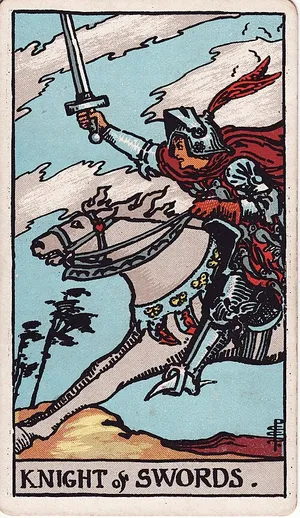

The Knight of Swords is one of the four court cards in the suit of Swords, one of the four suits of 14 cards that make up the 56 Minor Arcana of the Rider–Waite–Smith tarot, drawn by Pamela Colman Smith and published in London in 1909. It shows a knight in armour charging across the card at full gallop on a white horse, his sword raised high, under a sky of torn clouds. Upright, it is usually read as fast, decisive, single-minded action; reversed, as that drive turning reckless, impatient or aggressive.
Key facts
- Suit: Swords, a suit usually linked with thought, words, conflict and hard decisions. Today Swords are commonly paired with Air, though older writers did it differently (Papus gave them Earth); see the 1909 Rider–Waite–Smith tarot.
- Rank and place: a court card, the Knight; the title KNIGHT of SWORDS is printed at the bottom. It follows the Page of Swords and comes before the Queen.
- Upright in one line: charging ahead, speaking plainly, acting on a clear idea.
- Reversed in one line: haste without aim, a fight picked too quickly, plans outrunning sense.
- Waite’s own key words (1910, selected): skill, bravery, capacity, defence, enmity, wrath, war, resistance; reversed, “Imprudence, incapacity, extravagance”.
What the picture shows
The whole card leans to the left. The horse, pale grey and white, bursts in from the right with both forelegs flung out in front, its mouth open and its eye wide. Its mane streams back in pointed, flame-like locks. The knight rides low in the saddle in full plate armour, his face visible in profile under the helmet, turned in the direction of the charge. A red plume flies from the helmet and a red cloak billows out behind him. His right arm is stretched forward and up, holding the sword high, its blade reaching towards the top of the card.
The details of the harness repay a close look. A small red heart hangs on the horse’s brow band. The pale blue breast strap is decorated with yellow shapes that look like butterflies and with small red shapes that look like birds hanging from its lower edge. Waite does not describe these harness details in his entry. Behind the rider, ragged white clouds are drawn out in long streaks, as though by strong wind, and two dark trees on the left lean hard over. Below the outstretched forelegs is a low yellow and orange mound, with dark red-brown ground beyond. The title runs along the bottom and Smith’s monogram is at the lower right.
Waite’s note reaches for a figure from legend: “He is riding in full course, as if scattering his enemies. In the design he is really a prototypical hero of romantic chivalry. He might almost be Galahad, whose sword is swift and sure because he is clean of heart.” Galahad is the knight of Arthurian legend who achieves the Holy Grail. Waite’s comparison puts the speed of the charge together with a pure motive, which is one way to read the card at its most positive.
Waite’s meanings in 1910
In Part III, §2, which opens by promising “a harmony” of the Minor Arcana meanings gathered “from all sources”, Waite gives for the Knight of Swords:
“Skill, bravery, capacity, defence, address, enmity, wrath, war, destruction, opposition, resistance, ruin. There is therefore a sense in which the card signifies death, but it carries this meaning only in its proximity to other cards of fatality. Reversed: Imprudence, incapacity, extravagance.”
Address here has its older sense of skill or adroitness in handling things. The list holds both sides of a warrior: the skill and bravery, and the destruction. Waite’s sentence about death is hedged on purpose: he gives it only “in its proximity to other cards of fatality”, that is, as a fortune-teller’s rule about combinations of cards. It is quoted here as part of the card’s history, not as a meaning for anyone’s reading.
The §4 list, “Some Additional Meanings of the Lesser Arcana”, is a further set of meanings Waite lists, which he says are “very often in disagreement with those previously given”. Upright it names “A soldier, man of arms, satellite, stipendiary”, with a closing note about heroic action in store for a soldier; satellite means a follower or attendant and stipendiary someone paid. Reversed: “Dispute with an imbecile person; for a woman, struggle with a rival, who will be conquered.” These formulas, with their soldiers and rivals, belong to the cartomancy of Waite’s day and are kept as history.
How the card is usually read today
One common modern reading takes the Knight of Swords as an idea in motion: someone who has made up their mind and is going for it at full speed, words and all. Court cards are also often read as a person in the situation, or as a mode of your own behaviour. Read it as a prompt to reflect, not as a forecast.
Upright. Readers often connect it with ambition, quick decisions, directness, standing up for something, or cutting through delay. Waite’s Galahad comparison stresses being “clean of heart”; checking whether the aim is clear is a question this page adds, and in that light the charge can be read positively when it is joined to a clear purpose.
Reversed. Waite’s “Imprudence, incapacity, extravagance” sits close to later readings, which take the reversed Knight as speed without direction: rushing in, arguing for the sake of it, saying the cutting thing, or burning out after a fast start. Some read it as energy that has nowhere useful to go.
Questions to sit with:
- What am I charging towards, and have I checked that it is what I want?
- Is my speed helping here, or just leaving others behind?
- What would change if I waited one day before acting?
Upright and reversed at a glance
| Upright | Reversed | |
|---|---|---|
| Waite, 1910 | Skill, bravery, capacity, defence, enmity, wrath, war, resistance | Imprudence, incapacity, extravagance |
| Common reading today | Fast, decisive action; directness; drive | Recklessness, aggression, haste without aim |
| A question to ask | What cause is worth this speed? | Where would slowing down help? |
The Knight of Swords in a spread
A knight usually brings movement; the position shows where that movement sits.
- Three cards (Past, Present, Future). In the Past position, it can invite a look at a quick decision or a hard push that shaped where things are. In the Present, it asks where you are rushing, or where someone around you is. In the Future position, readers usually take it as a prompt to decide how fast you want to move and why, not as a fixed event.
- Celtic cross. In the Challenge position, it may point to haste or conflict cutting across the matter. In the Environment position, it can stand for a forceful, outspoken person nearby. In the Outcome position, many readers look at the Self card to ask whether the speed comes from you or is being pushed on you.
The positions of both spreads and the names of all 78 cards are in the tarot glossary; where the deck and its pictures come from is in the 1909 Rider–Waite–Smith tarot.
Cards often read next to the Knight of Swords
- Page of Swords, the court card before it: the young watcher on the hill; the Knight is the same alertness put into action.
- Queen of Swords, the next court card: the sword held still and upright, judgement instead of speed.
- Knight of Wands: in his entry Waite says that rider “is not on a warlike errand” and that the horse’s motion “suggests the precipitate mood”; another fast knight, but restless rather than combative.
- Knight of Pentacles: Waite’s knight who “rides a slow, enduring, heavy horse”; the opposite pace.
In HeyFate, each card you draw is turned upright or reversed at random with even odds, and an AI model writes the reading. This page is the reference behind the card, not a reading of your own question.
Sources
- A. E. Waite, The Pictorial Key to the Tarot, Part III, §2, “The Suit of Swords: Knight”, also citing the Knight of Wands and Knight of Pentacles (Wikisource, from the 1922 reprint)
- A. E. Waite, The Pictorial Key to the Tarot, Part III, §4, “Some Additional Meanings of the Lesser Arcana” (Wikisource, from the 1922 reprint)
- Wikimedia Commons: Swords12.jpg (Pam-A scan, public domain)
AI-generated content, for reference only; not medical, legal, financial or psychological advice. These methods come from cultural traditions, and HeyFate offers them for cultural interest, entertainment and self-reflection.