Page of Swords Tarot Card Meaning: Upright, Reversed and Symbolism
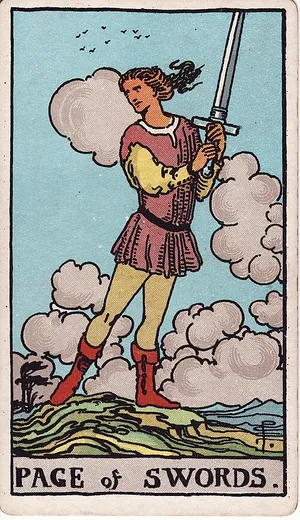

The Page of Swords is the lowest-ranking of the four court cards in the suit of Swords, one of the four suits of 14 cards that make up the 56 Minor Arcana of the Rider–Waite–Smith tarot, drawn by Pamela Colman Smith and published in London in 1909. It shows a young figure on a windswept hilltop, holding a sword high in both hands and looking back over his shoulder. Upright, it is usually read as curiosity, watchfulness and a quick, questioning mind; reversed, as that sharpness turning into gossip, suspicion or words spoken too fast.
Key facts
- Suit: Swords, a suit usually linked with thought, words, conflict and hard decisions. Air is the element commonly given to Swords today, but traditions disagree (Papus paired them with Earth); see the 1909 Rider–Waite–Smith tarot.
- Rank and place: a court card, the Page; the title PAGE of SWORDS is printed at the bottom. It follows the Ten of Swords and comes before the Knight.
- Other names: in Part III, §1, Waite lists the court cards as “King, Queen, Knight and Squire or Page”.
- Upright in one line: alert curiosity, new ideas, a readiness to ask and to check.
- Reversed in one line: prying, gossip, defensiveness, or speaking before thinking.
- Waite’s own key words (1910, selected): authority, overseeing, vigilance, spying, examination.
What the picture shows
The figure stands with his legs apart on a small, uneven hilltop of green and yellow ground, as if caught mid-stride or bracing against the wind. He wears a short red-violet tunic with a white collar and a black belt, yellow sleeves, yellow hose and red boots. His reddish hair streams out behind him to the right. He grips a long sword in both hands and holds it high beside the shoulder on the viewer’s right, the blade running up to the top edge of the card; it is raised and slightly tilted rather than straight up. His head is turned the other way, towards the left of the card, so he looks back over his shoulder, away from the raised sword.
Large grey-white clouds billow up behind him on both sides against a pale blue sky. At the top left a small flock of birds flies past. Far off on the left, a dark tree is bent over by the wind; on the right, low blue hills run along the horizon. The title is printed at the bottom and Smith’s monogram is at the lower right.
Waite’s note matches the picture closely: “A lithe, active figure holds a sword upright in both hands, while in the act of swift walking. He is passing over rugged land, and about his way the clouds are collocated wildly.” He adds: “He is alert and lithe, looking this way and that, as if an expected enemy might appear at any moment.” The wind in the hair, the bent tree and the birds show that weather in the picture; Waite does not assign these details an elemental meaning in this entry.
Waite’s meanings in 1910
In Part III, §2, where the Minor Arcana meanings, court cards included, are gathered “from all sources”, Waite gives for the Page of Swords:
“Authority, overseeing, secret service, vigilance, spying, examination, and the qualities thereto belonging. Reversed: More evil side of these qualities; what is unforeseen, unprepared state; sickness is also intimated.”
The list fits the watchful figure. The phrase “secret service” in 1910 meant intelligence work, and the meanings cluster round keeping watch and finding things out. The reversed card does not invent new qualities; it gives the “More evil side of these qualities”, adding surprise and lack of preparation. The mention of sickness is period fortune-telling vocabulary, not a statement about anyone’s health.
In §4, “Some Additional Meanings of the Lesser Arcana”, the further set of meanings Waite lists reads: “An indiscreet person will pry into the Querent’s secrets. Reversed: Astonishing news.” Querent is the person asking. These lines record how cartomancers of Waite’s day used the card; they are kept as history, and they say nothing about anyone who draws it now.
How the card is usually read today
One common modern reading takes the Page of Swords as a beginner’s mind with an edge: eager to learn, quick to question, not yet sure how to use what it knows. Court cards are also often read as a person, or as a part of yourself. Take it as a prompt for reflection, not as a description of what will happen.
Upright. Readers often connect it with curiosity, research, new ideas, honest questions, or a clear-eyed look at the facts. The figure’s backward glance is sometimes read as staying alert to what others are saying or doing.
Reversed. Waite’s “More evil side of these qualities” is close to how later readers see it: watchfulness turning into suspicion, curiosity into prying or gossip, quick words into careless ones. Some also read it as being caught unprepared, which echoes his “unprepared state”.
Questions to sit with:
- What do I want to find out here, and how could I ask about it openly?
- Am I watching this situation, or watching for a reason to be suspicious?
- Which of my words would I still stand by tomorrow?
Upright and reversed at a glance
| Upright | Reversed | |
|---|---|---|
| Waite, 1910 | Authority, overseeing, secret service, vigilance, spying, examination | The more evil side of these; the unforeseen; an unprepared state |
| Common reading today | Curiosity, alertness, new ideas, honest questions | Gossip, prying, hasty words, defensiveness |
| A question to ask | What do I need to learn first? | Is my watchfulness helping or hurting? |
The Page of Swords in a spread
As a court card it can stand for an attitude, or for someone in the situation.
- Three cards (Past, Present, Future). In the Past position, it can invite a look at a time of learning or questioning that set things moving. In the Present, it asks what you are trying to find out, and how. In the Future position, readers usually take it as a prompt to gather information and ask directly before deciding, not as a fixed event.
- Celtic cross. In the Environment position, it may point to a watchful or talkative person around you, or a mood of scrutiny. In the Self position, it can ask whether you are approaching the matter as a learner. In the Challenge position, it may point to suspicion or loose talk that complicates things.
The positions of both spreads and the names of all 78 cards are in the tarot glossary; where the deck and its pictures come from is in the 1909 Rider–Waite–Smith tarot.
Cards often read next to the Page of Swords
- Ten of Swords, the card before it: a figure brought down by ten swords; the Page is on his feet with one, often read as a fresh start in thinking.
- Knight of Swords, the next court card: the same sword, now carried at full gallop; curiosity turned into action.
- Page of Wands: in Waite’s entry a young man “in the act of proclamation”; announcing something, where the Page of Swords watches and checks.
- Page of Pentacles: Waite’s Page “looking intently at the pentacle” who “moves slowly”; patient study set against the Page of Swords’ quick alertness.
In HeyFate, each card you draw is turned upright or reversed at random with even odds, and an AI model writes the reading. This page is the reference behind the card, not a reading of your own question.
Sources
- A. E. Waite, The Pictorial Key to the Tarot, Part III, §2, “The Suit of Swords: Page”, also citing the Page of Wands and Page of Pentacles (Wikisource, from the 1922 reprint)
- A. E. Waite, The Pictorial Key to the Tarot, Part III, §4, “Some Additional Meanings of the Lesser Arcana” (Wikisource, from the 1922 reprint)
- A. E. Waite, The Pictorial Key to the Tarot, Part III, §1, “Distinction between the Greater and Lesser Arcana” (Wikisource, from the 1922 reprint)
- Wikimedia Commons: Swords11.jpg (Pam-A scan, public domain)
AI-generated content, for reference only; not medical, legal, financial or psychological advice. These methods come from cultural traditions, and HeyFate offers them for cultural interest, entertainment and self-reflection.