Page of Wands Tarot Card Meaning: Upright, Reversed and Symbolism
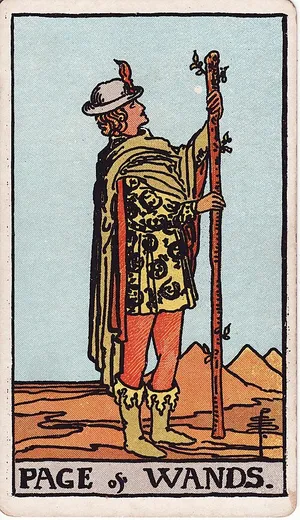

The Page of Wands is the first of the four court cards in the suit of Wands, one of the four suits that make up the 56 Minor Arcana in the Rider–Waite–Smith tarot, drawn by Pamela Colman Smith and published in London in 1909. It shows a young man in a plumed hat standing in a desert, holding a tall leafy staff and gazing up at its top. Upright, it is usually read as enthusiasm, curiosity and a new idea or message; reversed, as that spark scattered, delayed or never followed through.
Key facts
- Suit: Wands. The pairing commonly given today is Fire, but writers differ and his entries for the suit do not name one; see the 1909 Rider–Waite–Smith tarot. In his entry for the Queen of Wands, Waite calls it “a suit of life and animation”; today it is usually linked with energy, drive, work and plans.
- Rank: a court card, the lowest of the four (Page, Knight, Queen, King). In Part III, §1, Waite lists the court cards as “King, Queen, Knight and Squire or Page”, so Squire is his other name for the rank.
- Upright in one line: eagerness, exploration, a first step, news or an invitation.
- Reversed in one line: restlessness, false starts, indecision, unwelcome news.
- Waite’s own key words (1910, shortened): “faithful, a lover, an envoy, a postman”; reversed, “Anecdotes, announcements, evil news”.
What the picture shows
The Page stands in profile, facing right, on reddish-orange desert ground marked with wavy lines. He holds a long wooden staff upright in front of him, one hand high on it and one lower down, and tilts his head back to look up at its top, where a few green leaves sprout. More small shoots grow from the shaft further down. The staff is taller than he is and its foot rests on the sand.
He wears a pale grey hat with a turned-up brim and a red-orange plume shaped like a flame, and reddish curly hair shows beneath it. His short yellow tunic is patterned with black, curling lizard-like shapes. An olive-green cloak, with a strip of red along its edge, is thrown over one shoulder and hangs down his back. His legs are in red hose, and his pale yellow boots have jagged, flame-like tops. To the right, behind the staff, rise three pointed mounds that look like pyramids. The sky is pale blue, the title PAGE of WANDS runs along the bottom, and Smith’s monogram stands on the sand at the lower right.
Waite’s note: “In a scene similar to the former, a young man stands in the act of proclamation. He is unknown but faithful, and his tidings are strange.” Waite’s book takes the courts from the King down, so “the former” is the Knight of Wands, whose entry mentions “mounds or pyramids”; the Page’s scan shows similar pointed mounds. In the scan the Page is not visibly speaking; he is looking at his staff.
Waite’s meanings in 1910
In Part III, §2 of The Pictorial Key to the Tarot, Waite gives the divinatory meanings:
“Dark young man, faithful, a lover, an envoy, a postman. Beside a man, he will bear favourable testimony concerning him. A dangerous rival, if followed by the Page of Cups. Has the chief qualities of his suit. He may signify family intelligence. Reversed: Anecdotes, announcements, evil news. Also indecision and the instability which accompanies it.”
Several phrases belong to the period fortune-telling practice of reading a court card as a person. “Dark” refers to hair and complexion. His “family intelligence” means news about the family. Notice how much of the list is about carrying messages: envoy, postman, testimony, announcements. Waite’s own list already ties this Page to carrying news, which is consistent with the modern reading of Pages as messengers.
There is a puzzle in the phrase “Dark young man”. In §7, describing the Celtic method, Waite writes that “The four Court Cards in Wands represent very fair people, with yellow or auburn hair, fair complexion and blue eyes”, and Smith gave this Page reddish hair. Waite does not explain the difference.
Section 4, “Some Additional Meanings of the Lesser Arcana”, is a further set of meanings Waite lists for each card; after the list he notes that they “are very often in disagreement with those previously given”. For the Page:
“Page.—Young man of family in search of young lady. Reversed: Bad news.”
These §4 lines are period fortune-telling formulas, kept here as history, not as anything about the reader. Here “of family” meant of good birth; the line is a stock character from the courtship plots of period card-reading.
How the card is usually read today
One common modern reading treats the Page of Wands as the beginner’s spark: a new interest, a plan in its first stage, the urge to explore before you know quite where it leads. In that reading the Page is less a particular person than a quality: curiosity, eagerness, a willingness to try. Use it to reflect on your own situation, not as a forecast of news to come.
Upright. Common readings are enthusiasm for a project, a fresh idea worth testing, an invitation or a message that stirs interest, or a playful, adventurous mood. Some readers still read Pages as messages, following Waite’s “envoy” and “postman”.
Reversed. Waite gives “Anecdotes, announcements, evil news” and “indecision and the instability which accompanies it”. Later readings stay close to that second part: ideas that never get started, enthusiasm that fades quickly, impatience, or jumping from one plan to the next.
Questions people often take from the card:
- What has caught my interest lately, and what would a first small step look like?
- Am I exploring, or just restless?
- What message have I been waiting to send, or to hear?
Upright and reversed at a glance
| Upright | Reversed | |
|---|---|---|
| Waite, 1910 | A faithful young man, a lover, an envoy, a postman; family news | Anecdotes, announcements, evil news; indecision and instability |
| Common reading today | Enthusiasm, curiosity, a new idea or message | Scattered energy, false starts, impatience |
| A question to ask | What am I eager to begin? | What keeps me from following through? |
The Page of Wands in a spread
The position shapes which side of the Page comes forward.
- Three cards (Past, Present, Future). In the Past position, it can invite a look at an early enthusiasm that set things in motion. In the Present, it asks what is exciting you now and how seriously you are taking it. In the Future position, readers usually take it as a prompt to stay open to a new start, not as a fixed event.
- Celtic cross. In the Self position, it may point to your own curiosity or restlessness. In the Challenge position, it can ask whether eagerness is running ahead of planning. In the Outcome position, many readers look at the cards nearby to see whether the spark has what it needs to grow.
The positions of both spreads and the names of all 78 cards are in the tarot glossary; where the deck and its pictures come from is in the 1909 Rider–Waite–Smith tarot.
Cards often read next to the Page of Wands
- Ten of Wands, the last numbered card before the courts: a man bent under ten staves; the Page, standing with a single staff, makes a contrast of load and lightness.
- Knight of Wands, the next court card: a rider on a rearing horse in a similar desert landscape with pyramids.
- Page of Cups: named in Waite’s own entry, which says the Page of Wands is “A dangerous rival, if followed by the Page of Cups”.
- Ace of Wands: a hand from a cloud holding out a single sprouting staff; the suit’s emblem shown on its own, where the Page is a figure holding one staff and studying it.
In HeyFate, each card you draw is turned upright or reversed at random with even odds, and an AI model writes the reading. This page is the reference behind the card, not a reading of your own question.
Sources
- A. E. Waite, The Pictorial Key to the Tarot, Part III, §2, “The Suit of Wands: Page”, with the Knight and Queen of Wands entries (Wikisource, from the 1922 reprint)
- A. E. Waite, The Pictorial Key to the Tarot, Part III, §4, “Some Additional Meanings of the Lesser Arcana” (Wikisource, from the 1922 reprint)
- A. E. Waite, The Pictorial Key to the Tarot, Part III, §1 “Distinction between the Greater and Lesser Arcana” and §7 “An Ancient Celtic Method of Divination” (Wikisource, from the 1922 reprint)
- Wikimedia Commons: Wands11.jpg (Pam-A scan, public domain)
AI-generated content, for reference only; not medical, legal, financial or psychological advice. These methods come from cultural traditions, and HeyFate offers them for cultural interest, entertainment and self-reflection.