Ten of Wands Tarot Card Meaning: Upright, Reversed and Symbolism
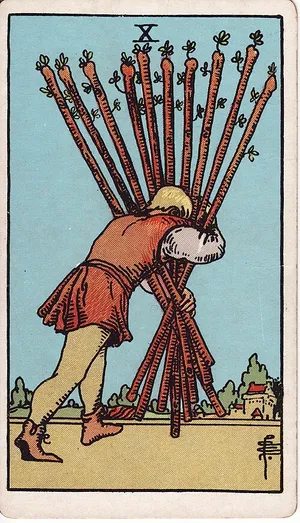

The Ten of Wands is the last numbered card in the suit of Wands, one of the four suits that make up the 56 Minor Arcana in the Rider–Waite–Smith tarot, drawn by Pamela Colman Smith and published in London in 1909. It shows a man bent forward under a bundle of ten staves, his face hidden in them, walking towards a small town. Upright, it is usually read as a heavy load: too many responsibilities, or success that has turned into a burden; reversed, as the strain coming to a head, or as the chance to put some of it down.
Key facts
- Suit: Wands. The pairing commonly given today is Fire, but writers differ and his entries for the suit do not name one; see the 1909 Rider–Waite–Smith tarot. Waite, in his entry for the Queen of Wands, calls it “a suit of life and animation”; today it is usually linked with energy, drive, work and plans.
- Rank: a numbered card, X, after the Nine of Wands; the court cards follow it.
- Upright in one line: burden, overload, carrying more than one person comfortably can.
- Reversed in one line: strain, complications, or letting go of part of the load.
- Waite’s own key words (1910, shortened): “The chief meaning is oppression simply”; also “fortune, gain, any kind of success”; “false-seeming, disguise, perfidy”.
What the picture shows
A man walks from left to right across flat, sandy-yellow ground. He is bent well forward, carrying ten long staves gathered in his arms and held upright in front of his body. Their lower ends nearly touch the ground; their upper ends fan out above his head like the ribs of an open fan, each tipped with small green leaves. He has his arms wrapped round the bundle, one white sleeve showing where it presses into the wood, and his head is pushed in among the staves so that only the top of his fair hair is visible. The staves stand between his face and the way ahead.
He wears a short red-brown tunic, pale yellow-green hose and brown shoes, and his back is half turned to us. Ahead of him, on the right, a house with a red roof and other buildings stand among green trees; smaller trees line the horizon on the left. The Roman numeral X is at the top, and Smith’s monogram at the lower right.
Waite’s note is a single line: “A man oppressed by the weight of the ten staves which he is carrying.” He returns to the picture in the divinatory meanings, with an unusual remark about the town: “The place which the figure is approaching may suffer from the rods that he carries.” He holds the bundle close against his face, which makes the pose look awkward.
Waite’s meanings in 1910
In Part III, §2 of The Pictorial Key to the Tarot, Waite gives the divinatory meanings:
“A card of many significances, and some of the readings cannot be harmonized. I set aside that which connects it with honour and good faith. The chief meaning is oppression simply, but it is also fortune, gain, any kind of success, and then it is the oppression of these things. It is also a card of false-seeming, disguise, perfidy. The place which the figure is approaching may suffer from the rods that he carries. Success is stultified if the Nine of Swords follows, and if it is a question of a lawsuit, there will be certain loss. Reversed: Contrarieties, difficulties, intrigues, and their analogies.”
This is one of the entries where Waite admits that the readings pull in different directions: some “cannot be harmonized”. He openly sets one meaning aside, honour and good faith, and joins the others with a turn that is still central to how the card is read: success, “and then it is the oppression of these things”. The weight on the man’s arms can be the reward itself. The line about the Nine of Swords shows the period practice of reading a card by the one that follows it; “stultified” means made useless or absurd.
Section 4, “Some Additional Meanings of the Lesser Arcana”, is a further set of meanings Waite lists for each card; after the list he notes that they “are very often in disagreement with those previously given”. For the Ten:
“Ten.—Difficulties and contradictions, if near a good card.”
These §4 lines are period fortune-telling formulas, kept here as history, not as anything about the reader. The condition “if near a good card” is another example of the period habit of reading cards by their neighbours.
How the card is usually read today
One common modern reading treats the Ten of Wands as the cost of taking on too much: the plans and energy of the earlier Wands have grown into a load that one person is carrying alone. In that reading the question is less “how do I carry this?” than “does all of it have to be carried by me, and like this?” Read it as a prompt for reflection, not as a forecast.
Upright. Common readings are overwork, a sense of duty that has grown heavy, a goal reached at a high price, or being so close to a task that you can no longer see past it, as the man cannot see past his staves. The town ahead adds a question of its own: how far there is still to go, and what the load is for when he gets there.
Reversed. Waite gives “Contrarieties, difficulties, intrigues”. Later readings split two ways. Some read the reversed Ten as the strain becoming too much: burnout, or the load slipping. Others read it as release: delegating, saying no, or setting down a responsibility that was never yours to carry.
Questions people often take from the card:
- Which of these staves did I pick up myself, and which was I handed?
- What would change if I carried this differently, or with help?
- Is the success I worked for now weighing on me?
Upright and reversed at a glance
| Upright | Reversed | |
|---|---|---|
| Waite, 1910 | Oppression; also fortune and success, and their oppression; false-seeming | Contrarieties, difficulties, intrigues |
| Common reading today | Burden, overload, too much responsibility | Strain coming to a head, or putting part of it down |
| A question to ask | What am I carrying that I could share? | What can I set down? |
The Ten of Wands in a spread
Position changes how the load is read.
- Three cards (Past, Present, Future). In the Past position, it can invite a look at a period of overload and what it taught you about your limits. In the Present, it asks what you are carrying right now and how. In the Future position, readers usually take it as a prompt to check your commitments before adding more, not as a fixed event.
- Celtic cross. In the Challenge position, it may point to a burden that blocks your view of everything else. In the Root position, it can ask which old obligation still shapes the situation. In the Outcome position, many readers look at nearby cards, such as a Page or an Ace, for signs of where the effort could be lightened or begun again.
The positions of both spreads and the names of all 78 cards are in the tarot glossary; where the deck and its pictures come from is in the 1909 Rider–Waite–Smith tarot.
Cards often read next to the Ten of Wands
- Nine of Wands, the card before it: a man guarding a row of staves; the two pictures contrast holding a position with carrying a heavy load.
- Page of Wands, the court card that follows the numbered cards: a young man standing with a single staff; set beside the Ten, one staff held up and looked at instead of ten carried.
- Nine of Swords: named in Waite’s own entry: if it follows the Ten, he says, “Success is stultified”.
- Ten of Swords: the same number in another suit, a figure lying under ten swords; an ending, where the Ten of Wands is still on its feet and walking.
In HeyFate, each card you draw is turned upright or reversed at random with even odds, and an AI model writes the reading. This page is the reference behind the card, not a reading of your own question.
Sources
- A. E. Waite, The Pictorial Key to the Tarot, Part III, §2, “The Suit of Wands: Ten”, with the Queen of Wands entry on the suit (Wikisource, from the 1922 reprint)
- A. E. Waite, The Pictorial Key to the Tarot, Part III, §4, “Some Additional Meanings of the Lesser Arcana” (Wikisource, from the 1922 reprint)
- Wikimedia Commons: Wands10.jpg (Pam-A scan, public domain)
AI-generated content, for reference only; not medical, legal, financial or psychological advice. These methods come from cultural traditions, and HeyFate offers them for cultural interest, entertainment and self-reflection.