Nine of Swords Tarot Card Meaning: Upright, Reversed and Symbolism
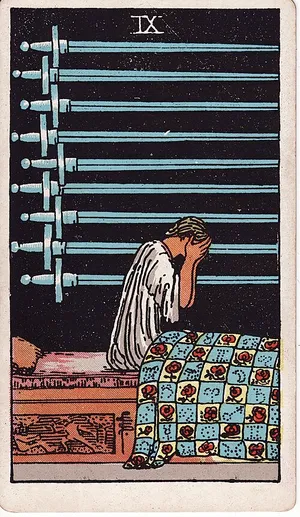

The Nine of Swords is a numbered card in the suit of Swords, one of the four suits of 14 cards that make up the 56 Minor Arcana of the Rider–Waite–Smith tarot, drawn by Pamela Colman Smith and published in London in 1909. It shows a figure sitting up in bed in the dark, face buried in both hands, with nine swords hanging level on the black wall behind. Upright, it is usually read as anxiety, sleepless worry and grief; reversed, as that worry beginning to ease, or as distress that has become hard to carry alone.
Key facts
- Suit: Swords, a suit usually linked with thought, words, conflict and hard decisions. Air is today’s common pairing for Swords; other systems pair them differently (Papus gave them Earth), as set out in the 1909 Rider–Waite–Smith tarot.
- Rank and place: a numbered card, IX printed at the top; it follows the Eight of Swords and comes before the Ten.
- Upright in one line: worry at night, guilt or grief that crowds out sleep.
- Reversed in one line: the fear easing, or reaching the point where it needs to be shared.
- Waite’s own key words (1910, selected): failure, delay, deception, disappointment, despair; “a card of utter desolation”.
What the picture shows
The background is solid black. Across it, nine swords lie horizontally one above another, evenly spaced like the rails of a fence, Their hilts are on the left and their exposed blades extend towards the right edge of the card. The lower blades disappear behind her upper body; none is shown piercing her.
Below, a figure in a long white nightgown sits upright in bed, bent forward, with both hands pressed over the face. The hair is short and light brown. Waite calls the figure “her”, so this page does too. A pink pillow lies behind her on the left. Over her legs is a quilt of small squares that alternate between red roses on pale yellow and blue squares marked with dotted signs. Waite does not describe the quilt. The bed is made of reddish wood, and its side carries a dark carved panel with small figures that are hard to make out in the scan. Smith’s monogram appears on the side of the bed, just right of that panel. A strip of grey floor runs along the bottom, and IX is printed at the top.
Waite’s note: “One seated on her couch in lamentation, with the swords over her. She is as one who knows no sorrow which is like unto hers. It is a card of utter desolation.” His middle sentence appears to echo Lamentations 1:12 in the King James Bible, “see if there be any sorrow like unto my sorrow”, though he does not cite it. The picture is notable for what it leaves out: the main scene shows no attacker and no wound, only a person alone with the swords.
Waite’s meanings in 1910
Waite’s Part III entry for the Nine of Swords reads:
“Death, failure, miscarriage, delay, deception, disappointment, despair. Reversed: Imprisonment, suspicion, doubt, reasonable fear, shame.”
The first word is the one people notice. It sits in a list of general misfortunes of the kind fortune-telling handbooks used, and it is quoted here as part of that history, not as a statement about anyone. In the English of his day miscarriage also meant a plan or undertaking that went wrong. After “Imprisonment”, much of the reversed list turns to suspicion, doubt, fear and shame; “reasonable fear” is fear with some ground under it.
His §4, “Some Additional Meanings of the Lesser Arcana”, lists a further set of meanings, which he says are “very often in disagreement with those previously given”: “An ecclesiastic, a priest; generally, a card of bad omen. Reversed: Good ground for suspicion against a doubtful person.” Formulas like these, with their stock characters, belong to the cartomancy Waite was collecting; they are kept as a record of how the card was once used.
How the card is usually read today
One common modern reading takes the Nine of Swords as the card of the mind at three in the morning: worries that grow larger in the dark than they are by day. In that reading the swords are thoughts on the wall rather than blows that have landed. It is a prompt for reflection, not a forecast.
Upright. Readers often connect it with anxiety, insomnia, guilt, regret, or replaying a conversation or a mistake again and again. Some point out that the figure has her eyes covered and so sees neither the swords nor the roses on her quilt.
Reversed. Waite’s “reasonable fear” and “doubt” are a useful bridge. Later readings take the reversed card as worry starting to lift, sleep returning, or a fear being said out loud and shrinking. Others read it as distress that has gone on too long to manage alone. If worry is regularly affecting your sleep or daily life, consider speaking with a doctor or counsellor.
Questions to sit with:
- Which of these worries have I checked against what has actually happened?
- What do I think about this in daylight, compared with at night?
- Who could I tell about this, even in part?
Upright and reversed at a glance
| Upright | Reversed | |
|---|---|---|
| Waite, 1910 | Death, failure, delay, deception, disappointment, despair | Imprisonment, suspicion, doubt, reasonable fear, shame |
| Common reading today | Anxiety, sleepless worry, guilt or grief | Worry easing; or distress that needs to be shared |
| A question to ask | Which fear here have I tested against the facts? | Who could help me carry this? |
The Nine of Swords in a spread
In a spread it usually points to how something feels, which can differ from how it stands.
- Three cards (Past, Present, Future). In the Past position, it can invite a look at a period of worry and what it left behind. In the Present, it asks what is keeping you awake and whether it is as large as it feels. In the Future position, readers usually take it as a prompt to deal with a worry early, before it grows in the dark, not as a fixed event.
- Celtic cross. In the Self position, it may point to how much of the matter is happening in your head. In the Hopes position, readers sometimes read it as hopes and fears tangled together. In the Challenge position, it can name anxiety itself as the thing in the way.
The positions of both spreads and the names of all 78 cards are in the tarot glossary; where the deck and its pictures come from is in the 1909 Rider–Waite–Smith tarot.
Cards often read next to the Nine of Swords
- Eight of Swords, the card before it: a blindfolded woman outdoors among swords; the Nine moves the trouble inside, into a bedroom at night.
- Ten of Swords, the card after it: the swords no longer hang on the wall but stand in a fallen figure; readers often treat it as the end point of the suit’s run of trouble.
- Nine of Cups: the same rank in Cups, where Waite’s figure “has feasted to his heart’s content”; contentment set against sleepless worry.
- Nine of Pentacles: Waite’s entry has “A woman, with a bird upon her wrist” in a garden; another woman alone, but at ease.
In HeyFate, each card you draw is turned upright or reversed at random with even odds, and an AI model writes the reading. This page is the reference behind the card, not a reading of your own question.
Sources
- A. E. Waite, The Pictorial Key to the Tarot, Part III, §2, “The Suit of Swords: Nine”, also citing the Nine of Cups and Nine of Pentacles (Wikisource, from the 1922 reprint)
- A. E. Waite, The Pictorial Key to the Tarot, Part III, §4, “Some Additional Meanings of the Lesser Arcana” (Wikisource, from the 1922 reprint)
- Lamentations 1:12, King James Version (Wikisource)
- Wikimedia Commons: Swords09.jpg (Pam-A scan, public domain)
AI-generated content, for reference only; not medical, legal, financial or psychological advice. These methods come from cultural traditions, and HeyFate offers them for cultural interest, entertainment and self-reflection.