Nine of Pentacles Tarot Card Meaning: Upright, Reversed and Symbolism
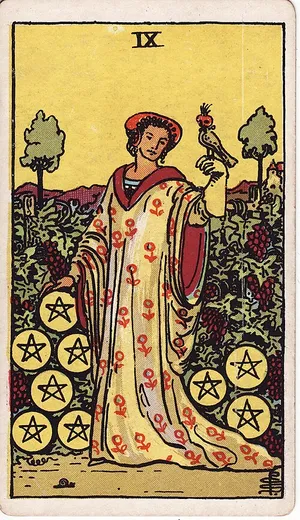

The Nine of Pentacles is one of the 56 Minor Arcana in the Rider–Waite–Smith tarot: the numbered card nine in the suit of Pentacles, drawn by Pamela Colman Smith and published in London in 1909. It shows a richly dressed woman standing alone among grapevines, one hand resting on a stack of pentacles and a hooded bird perched on the other. Upright, it is usually read as comfort, self-reliance and enjoying what your own effort has made; reversed, as that ease turning brittle, or resting on appearances.
Key facts
- Suit: Pentacles, the suit of 14 cards most often tied to work, money, the body and everyday material life. Today’s common pairing gives it earth; that is a convention, and other schools pair the suits differently (see the tarot glossary and the 1909 Rider–Waite–Smith tarot).
- Rank: a numbered card, the nine, between the Eight and the Ten of Pentacles, with the Roman numeral IX at the top.
- Suit name: the suit was coins in many older decks; in his entry for the King of Pentacles, Waite notes that “In many old Tarot packs this suit stood for current coin, money, deniers”.
- Upright in one line: ease, independence, a life you have tended yourself.
- Reversed in one line: comfort that depends on show, or that leaves you cut off.
- Waite’s own key words (1910): prudence, safety, success, accomplishment, certitude, discernment.
What the picture shows
The sky is a flat bright yellow. A woman stands in the middle of the card, facing us, in a long pale gold robe that falls in deep folds to the ground and trails behind her. It is printed all over with small red flower shapes, and its wide sleeve is lined with dark red. On her head is a red cap. Waite does not discuss the red motifs on her robe.
Her left hand is raised, gloved in white, and on it sits a bird with a red hood topped by a small crest. Waite calls it simply “a bird upon her wrist”. Her right hand rests on the top of a pile of six pentacles on our left; three more are on the right, so there are nine in all.
Behind her grapevines grow thickly on both sides, hung with dark red clusters. A slender tree rises above the vines on each side, low purple hills run along the horizon, and on the right, half hidden, stands a building with a red roof. Waite describes the setting as “the garden of a manorial house”. On the bare strip of ground at the bottom, near the hem of her robe, a small snail crawls; Waite does not mention it either. Smith’s monogram is at the lower right.
Waite’s meanings in 1910
Waite’s entry for the card in Part III, §2 of The Pictorial Key to the Tarot begins with a fuller note on the picture: “It is a wide domain, suggesting plenty in all things. Possibly it is her own possession and testifies to material well-being.” His divinatory meanings follow:
“Prudence, safety, success, accomplishment, certitude, discernment. Reversed: Roguery, deception, voided project, bad faith.”
The upright list is less about wealth than about good judgement: prudence and discernment open and close it. The “Possibly” in his note is worth keeping too. Waite does not say outright that the garden is hers, only that it may be.
Part III, §4, “Some Additional Meanings of the Lesser Arcana”, adds a further list:
“Prompt fulfilment of what is presaged by neighbouring cards. Reversed: Vain hopes.”
These are period fortune-telling formulas, kept here as history. This one is interesting because it gives the card no subject of its own: in the old method the Nine simply hastened whatever the cards beside it were taken to mean. That is a statement about how cartomancers once worked, not about the reader of this page.
How the card is usually read today
One common modern reading treats the Nine as the card of earned ease: a person at home in a place they have cultivated, comfortable enough to stand still and enjoy it. The vines and pentacles look like wealth, but Waite’s own list opens with prudence and closes with discernment, and in his King of Pentacles entry he says the suit’s cards “do not happen to deal especially with questions of money”. Read the Nine as a prompt about how you live with what you have, not as a promise about money or circumstances.
Upright. Readers often connect it with self-reliance, independence, refinement and taking pleasure in something you have tended over time. Some point to the hooded bird as discipline: energy that has been trained and is held calmly at rest. Others note that she stands alone, and read the card as being content in your own company.
Reversed. Waite gives “Roguery, deception, voided project, bad faith”. Later readings tend to turn inward: comfort that depends on keeping up appearances, a sense of worth tied to possessions, independence that has become isolation, or so much work spent on building a life that there is no time left to live in it.
Questions people often take from the card:
- What have I grown or built that I have not stopped to enjoy?
- Where does my sense of security really come from?
- Is my independence giving me room, or keeping others out?
Upright and reversed at a glance
| Upright | Reversed | |
|---|---|---|
| Waite, 1910 | Prudence, safety, success, accomplishment, certitude, discernment | Roguery, deception, voided project, bad faith |
| Common reading today | Earned ease, self-reliance, refinement | Comfort built on show; independence turned to isolation |
| A question to ask | What can I let myself enjoy? | What is this comfort really resting on? |
The Nine of Pentacles in a spread
- Three cards (Past, Present, Future). In the Past position, it can point to a time of stability or self-reliance that still supports you. In the Present, it asks whether you are able to enjoy what you already have. In the Future position, readers usually take it as an invitation to picture the kind of ease you are working towards, and what it would cost, not as a forecast.
- Celtic cross. In the Self position, the Nine can invite reflection on how much you rely on yourself, and whether that is a strength or a wall. In the Hopes position, it asks what security would actually feel like to you. In the Outcome position, many readers read it with the cards around it, especially any card of strain such as the Five of Pentacles, as a question about what you want to keep.
The positions of both spreads and the names of all 78 cards are in the tarot glossary; where the deck and its pictures come from is in the 1909 Rider–Waite–Smith tarot.
Cards often read next to the Nine of Pentacles
- Eight of Pentacles, the card before it: the young craftsman at his bench. The two are often read as the work and the life it pays for.
- Ten of Pentacles, the card after it: an archway scene with an old man, a man and a woman, a child and two dogs; where the Nine stands alone, the Ten is family and inheritance.
- Nine of Cups: the same number in another suit, a seated man with his cups behind him; read as contentment and wishes met.
- Nine of Swords: the same number in Swords, a figure sitting up in bed at night; read as worry, the opposite mood to this calm garden.
In HeyFate, each card you draw is turned upright or reversed at random with even odds, and an AI model writes the reading. This page is the reference behind the card, not a reading of your own question.
Sources
- A. E. Waite, The Pictorial Key to the Tarot, Part III, §2, “The Suit of Pentacles: Nine”, also citing “The Suit of Pentacles: King” (Wikisource, from the 1922 reprint)
- A. E. Waite, The Pictorial Key to the Tarot, Part III, §4, “Some Additional Meanings of the Lesser Arcana” (Wikisource, from the 1922 reprint)
- Wikimedia Commons: Pents09.jpg (Pam-A scan, public domain)
AI-generated content, for reference only; not medical, legal, financial or psychological advice. These methods come from cultural traditions, and HeyFate offers them for cultural interest, entertainment and self-reflection.