Ten of Pentacles Tarot Card Meaning: Upright, Reversed and Symbolism
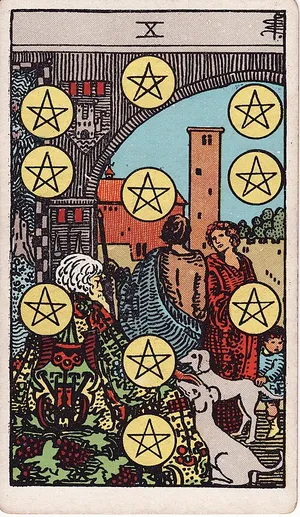

The Ten of Pentacles is one of the 56 Minor Arcana in the Rider–Waite–Smith tarot: the numbered card ten, the last of the numbered cards in the suit of Pentacles, drawn by Pamela Colman Smith and published in London in 1909. It shows an old man seated with two dogs in the foreground, and a man, a woman and a child standing under a great archway that leads to a house, with ten pentacles set over the whole scene. Upright, it is usually read as family, heritage and what lasts across generations; reversed, as strain in those ties, or a foundation that feels less secure.
Key facts
- Suit: Pentacles, the suit usually linked with work, money, the body, home and the material side of life. Today’s common pairing gives it earth; pairings differ between schools, as the 1909 Rider–Waite–Smith tarot article sets out.
- Rank: a numbered card, the ten, after the Nine of Pentacles; the Page, the lowest of the court cards, follows it.
- Suit name: the suit was coins in many older decks; in his entry for the King of Pentacles, Waite notes that “In many old Tarot packs this suit stood for current coin, money, deniers”.
- Upright in one line: family, inheritance, roots, lasting security.
- Reversed in one line: family strain, a shaky inheritance, a matter left to chance.
- Waite’s own key words (1910): “Gain, riches; family matters, archives, extraction, the abode of a family”.
What the picture shows
The numeral X is at the top, and Smith’s monogram, usually at the bottom, sits here in the upper right corner. A broad stone archway fills the upper left of the card. A shield carved or hung on it shows a small tower, and the pillar below it has small red windows. Through the arch you see a red-roofed building, a tall red-brown tower, a wall and trees against a blue sky.
Under the arch, a man stands with his back to us, wrapped in a blue patterned cloak over a brown garment, and a woman in red beside him looks round over her shoulder. At the right edge a small child in blue rests a hand on one of two pale grey dogs. The dogs turn towards the lower left, where an old man with white hair and a white beard sits in a robe covered in rich patterns, with grape clusters among them. A long staff with a pointed top rises beside his head. Waite’s note on the card describes this group: “They are accompanied by a child, who looks curiously at two dogs accosting an ancient personage seated in the foreground. The child’s hand is on one of them.”
The ten pentacles are not held by anyone. They float over the picture, as if laid on top of it. Waite does not explain the arrangement of the ten pentacles; he describes only the people, the dogs and “an archway which gives entrance to a house and domain”.
Waite’s meanings in 1910
In Part III, §2 of The Pictorial Key to the Tarot, Waite gives these divinatory meanings for the card:
“Gain, riches; family matters, archives, extraction, the abode of a family. Reversed: Chance, fatality, loss, robbery, games of hazard; sometimes gift, dowry, pension.”
A few of these words have shifted since 1910. The word “extraction” here means descent or lineage, the family a person comes from, and “archives” suggests family records; with “the abode of a family” they make the upright list as much about belonging as about wealth. The reversed list sets loss and chance beside “gift, dowry, pension”: “games of hazard” are games of chance. A dowry is money or property associated with marriage, while a pension is a regular payment or allowance, which may be earned through past service.
Part III, §4, “Some Additional Meanings of the Lesser Arcana”, adds a further list:
“Represents house or dwelling, and derives its value from other cards. Reversed: An occasion which may be fortunate or otherwise.”
These are period fortune-telling formulas, kept here as history. Like the Nine’s line, this one leans on the surrounding cards: the Ten stood for a house, and what the house meant depended on its neighbours. Even the reversed line declines to choose, “fortunate or otherwise”.
How the card is usually read today
One common modern reading takes the Ten as the card of what lasts beyond one person: family, roots, traditions and the things handed on. In that reading the old man, the man and woman and the child are less a picture of wealth than of continuity. It is a prompt for reflection, not a forecast about anyone’s family or finances: even Waite, whose list for this card opens with “Gain, riches”, says in his King of Pentacles entry that the suit’s cards “do not happen to deal especially with questions of money”.
Upright. Readers often connect it with belonging, long-term security, a settled home, care for older and younger generations, and the question of what you inherit and pass on, in values and habits as well as possessions.
Reversed. Waite’s reversed meanings are loss and chance, alongside gifts, dowries and pensions. Later readings more often take the reversed Ten as tension inside a family or a tradition: expectations that weigh heavily, disagreements over what is owed or handed down, feeling outside the family story, or security that turns out to rest on less than it seemed.
Questions people often take from the card:
- What have I been given by the people before me, and what do I want to keep?
- What am I building that I hope will outlast the present?
- Where do I feel I belong, and where do I feel I am only standing at the gate?
Upright and reversed at a glance
| Upright | Reversed | |
|---|---|---|
| Waite, 1910 | Gain, riches; family matters, archives, lineage, the family home | Chance, fatality, loss, robbery, games of hazard; sometimes gift, dowry, pension |
| Common reading today | Family, heritage, long-term security, belonging | Family strain, heavy expectations, a shaky foundation |
| A question to ask | What do I want to hand on? | What am I carrying only because it was handed to me? |
The Ten of Pentacles in a spread
- Three cards (Past, Present, Future). In the Past position, it can point to family, tradition or upbringing that still shapes the question. In the Present, it asks what part home, belonging or long-term plans play right now. In the Future position, readers usually take it as an invitation to think about what you want to build and keep over time, not as a promise.
- Celtic cross. In the Root position, the Ten invites a look at family patterns or inherited assumptions beneath the situation. In the Environment position, it can point to the influence of a household, a community or an institution. In the Outcome position, many readers read it with the cards around it and ask what would make a foundation feel secure to you.
The positions of both spreads and the names of all 78 cards are in the tarot glossary; where the deck and its pictures come from is in the 1909 Rider–Waite–Smith tarot.
Cards often read next to the Ten of Pentacles
- Nine of Pentacles, the card before it: a woman alone among grapevines. The Nine is ease for one; the Ten widens it to a household.
- Page of Pentacles, the card after it in the suit: a young figure studying a single pentacle, often read as starting again at the beginning.
- Ten of Cups: the same number in Cups, a family under a rainbow of cups; read as emotional fulfilment, where the Ten of Pentacles leans towards home and heritage.
- Ten of Wands: the same number in Wands, a figure carrying ten heavy wands; read as burden, a useful contrast when the reversed Ten feels like an inheritance too heavy to carry.
In HeyFate, each card you draw is turned upright or reversed at random with even odds, and an AI model writes the reading. This page is the reference behind the card, not a reading of your own question.
Sources
- A. E. Waite, The Pictorial Key to the Tarot, Part III, §2, “The Suit of Pentacles: Ten”, also citing “The Suit of Pentacles: King” (Wikisource, from the 1922 reprint)
- A. E. Waite, The Pictorial Key to the Tarot, Part III, §4, “Some Additional Meanings of the Lesser Arcana” (Wikisource, from the 1922 reprint)
- Wikimedia Commons: Pents10.jpg (Pam-A scan, public domain)
AI-generated content, for reference only; not medical, legal, financial or psychological advice. These methods come from cultural traditions, and HeyFate offers them for cultural interest, entertainment and self-reflection.