Ten of Cups Tarot Card Meaning: Upright, Reversed and Symbolism
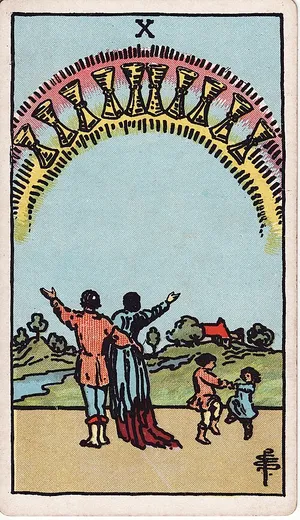

The Ten of Cups is one of the 56 Minor Arcana in the Rider–Waite–Smith tarot: the numbered card ten, the last of the numbered cards in the suit of Cups, drawn by Pamela Colman Smith and published in London in 1909. It shows a man and a woman with raised arms looking up at ten cups set in a rainbow, while two children dance beside them and a house stands beyond. Upright, it is usually read as lasting contentment shared with others; reversed, as that harmony strained or only on the surface.
Key facts
- Suit: Cups, one of the four suits of 14 cards. Today’s common pairing links Cups with water, and the suit with feelings, relationships and home life; pairings differ between schools, as the 1909 Rider–Waite–Smith tarot article explains.
- Rank: a numbered card, the ten, between the Nine of Cups and the Page of Cups. It carries only the Roman numeral X at the top.
- Upright in one line: shared happiness, peace at home, a sense of belonging.
- Reversed in one line: tension behind a happy picture, or an ideal that does not match daily life.
- Waite’s own key words (1910): “Contentment, repose of the entire heart”; “perfection of human love and friendship”; reversed, “Repose of the false heart, indignation, violence”.
What the picture shows
The top half of the card is sky. Across it bends a wide rainbow, drawn in bands of pink, yellow and pale green and edged with short black strokes like rays. Ten gold cups stand along the arc, tilting outwards as the curve falls away on each side. The numeral X sits above it.
Below, a man and a woman stand with their backs to us, looking up. Waite’s note describes them exactly: “His right arm is about her; his left is raised upward; she raises her right arm.” He wears a red tunic, blue hose and white boots; she wears a long blue dress with a deep red skirt or lining showing at the hem. Waite calls the pair “evidently husband and wife” and says they contemplate the rainbow “in wonder and ecstacy” (his spelling).
To the right, two small children hold hands and dance, one in a red tunic, the other in a blue dress. As Waite puts it, they “have not observed the prodigy but are happy after their own manner”: neither looks up. Behind them the land is green and gently rolling. A river winds in from the left, there are rounded trees, and on a rise to the right stands a house with a red roof, which Waite calls “a home-scene beyond”. The ground in front is a plain tan. Smith’s monogram is at the lower right.
Waite’s meanings in 1910
In Part III, §2 of The Pictorial Key to the Tarot, after the long picture note, Waite gives the divinatory meanings:
“Contentment, repose of the entire heart; the perfection of that state; also perfection of human love and friendship; if with several picture-cards, a person who is taking charge of the Querent’s interests; also the town, village or country inhabited by the Querent. Reversed: Repose of the false heart, indignation, violence.”
The wording echoes the opening of the suit. In the Ace of Cups entry Waite gives “House of the true heart” upright and “House of the false heart” reversed; here the Ten has “repose of the entire heart” and, reversed, “Repose of the false heart”. Set side by side, the numbered cards move from the heart as a house to the heart at rest; that comparison of the two entries is ours, not Waite’s. The middle of his upright list belongs to period card-reading practice: with “several picture-cards” (court cards) nearby, the card stands for a person looking after the Querent’s affairs, and it can also stand for the place where the Querent lives.
Part III, §4, “Some Additional Meanings of the Lesser Arcana”, is a further set of meanings Waite lists for each card. For the Ten: “For a male Querent, a good marriage and one beyond his expectations. Reversed: Sorrow; also a serious quarrel.” These are period fortune-telling formulas, written for a male questioner of the time and kept here as history, not as anything about the reader’s relationships. Waite notes after the list that such meanings “are very often in disagreement with those previously given”.
How the card is usually read today
One common modern reading takes the Ten of Cups as emotional fulfilment that is shared: the cups are not held by anyone, they are in the sky above everyone. In that reading the card is about belonging, mutual care and feeling at home, with family or with whoever counts as your people. It does not promise any relationship or family outcome; read it as a prompt for reflection.
Upright. Readers often connect it with harmony at home, reconciliation, gratitude for the people around you, or a picture of the life you want. The children who dance without looking up fit that reading: contentment can be ordinary and unnoticed.
Reversed. Waite gives “Repose of the false heart, indignation, violence”. Later readings more often take the reversed card as strain: a household that looks happy from outside, values that no longer line up, or an ideal family picture that real life keeps falling short of. Some read it as an invitation to let go of the perfect image.
Questions people often take from the card:
- Where do I feel most at home, and with whom?
- Is the happiness I picture something I share with others, or something I perform for them?
- What ordinary good thing am I too busy to look up and see?
Upright and reversed at a glance
| Upright | Reversed | |
|---|---|---|
| Waite, 1910 | Contentment, repose of the entire heart; perfection of human love and friendship | Repose of the false heart, indignation, violence |
| Common reading today | Shared happiness; harmony at home; belonging | Strain behind appearances; an ideal that does not fit |
| A question to ask | Who shares this with me? | What am I pretending is fine? |
The Ten of Cups in a spread
Position changes how the card is read.
- Three cards (Past, Present, Future). In the Past position, it can recall a home or a group where you felt you belonged. In the Present, it asks what is already working in your closest relationships. In the Future position, readers usually take it as an invitation to describe the life you want to build with others, not as a promise of it.
- Celtic cross. In the Environment position, it can point to the people around you and how much support they give. In the Hopes position, it may ask how much of your hope rests on a picture of an ideal family or circle. In the Outcome position, many readers look at the cards beside it, especially in Cups or Pentacles, and read them together as what shared contentment would need.
The positions of both spreads and the names of all 78 cards are in the tarot glossary; where the deck and its pictures come from is in the 1909 Rider–Waite–Smith tarot.
Cards often read next to the Ten of Cups
- Nine of Cups, the card before it: one man content before his cups; set beside it, the Ten’s contentment is shared by a household.
- Page of Cups, the next card in the suit: the court cards begin, with a young man looking at a fish in his cup.
- Ace of Cups: the suit’s opening card, Waite’s “House of the true heart”, which the Ten’s “repose of the entire heart” answers.
- Ten of Pentacles: another family scene; in Part III, §2, Waite’s Ten of Pentacles meanings include “the abode of a family”, with the weight on “riches” and family matters rather than feeling.
In HeyFate, each card you draw is turned upright or reversed at random with even odds, and an AI model writes the reading. This page is the reference behind the card, not a reading of your own question.
Sources
- A. E. Waite, The Pictorial Key to the Tarot, Part III, §2, “The Suit of Cups: Ten”, with one phrase from “The Suit of Cups: Ace” and one from “Pentacles: Ten” (Wikisource, from the 1922 reprint)
- A. E. Waite, The Pictorial Key to the Tarot, Part III, §4, “Some Additional Meanings of the Lesser Arcana” (Wikisource, from the 1922 reprint)
- Wikimedia Commons: Cups10.jpg (Pam-A scan, public domain)
AI-generated content, for reference only; not medical, legal, financial or psychological advice. These methods come from cultural traditions, and HeyFate offers them for cultural interest, entertainment and self-reflection.