Page of Cups Tarot Card Meaning: Upright, Reversed and Symbolism
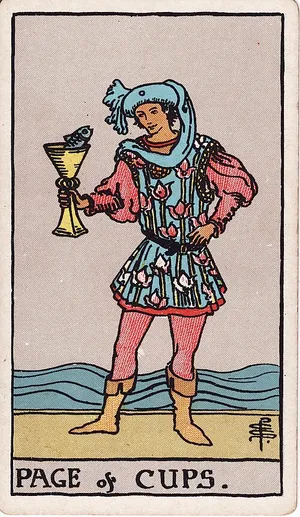

The Page of Cups is one of the 56 Minor Arcana in the Rider–Waite–Smith tarot: the Page, first of the four court cards (Page, Knight, Queen, King) in the suit of Cups, drawn by Pamela Colman Smith and published in London in 1909. It shows a young man in a flowered tunic standing by the sea and looking at a fish that has put its head out of the cup in his hand. Upright, it is usually read as a gentle message, a new feeling or a creative idea; reversed, as daydreaming, moodiness or a feeling not yet ready to be acted on.
Key facts
- Suit: Cups, one of the four suits of 14 cards. Today’s common pairing links Cups with water, and the suit with feelings, imagination and relationships; pairings differ between schools, as the 1909 Rider–Waite–Smith tarot article explains.
- Rank: a court card, the Page, after the Ten of Cups and before the Knight. The printed title at the bottom reads PAGE of CUPS.
- Upright in one line: a tender beginning, curiosity, an idea or message arriving.
- Reversed in one line: emotional immaturity, escapism, a hunch ignored or overplayed.
- Waite’s own key words (1910, shortened): “a studious youth; news, message; application, reflection, meditation”; reversed, “Taste, inclination, attachment, seduction, deception, artifice”.
What the picture shows
The background is a plain grey. A young man stands on a strip of tan ground; behind him runs a band of blue sea drawn in wavy lines. He holds a gold cup out at shoulder height in his right hand, and from it a small blue-grey fish has lifted its head and faces him. He looks straight back at it, his head tilted, his left hand resting on his hip.
His clothes are the brightest thing on the card. On his head is a blue hat with a long blue scarf that falls over his shoulder and around his neck. His tunic is blue, striped with thin vertical lines and scattered with pink flowers that look like lotuses or water lilies; it ends in a red hem above pink hose, and he wears a black belt, puffed pink sleeves and soft tan boots. Smith’s monogram is at the lower right, and the title PAGE of CUPS runs along the bottom.
Waite’s note matches the scene: “A fair, pleasing, somewhat effeminate page, of studious and intent aspect, contemplates a fish rising from a cup to look at him.” He then adds: “It is the pictures of the mind taking form.” In the King of Cups entry he also remarks that the Sign of the Cup “naturally refers to water, which appears in all the court cards”, meaning the four court cards of Cups; here it is the sea behind the page and the fish in the cup.
Waite’s meanings in 1910
In Part III, §2 of The Pictorial Key to the Tarot, Waite gives the divinatory meanings:
“Fair young man, one impelled to render service and with whom the Querent will be connected; a studious youth; news, message; application, reflection, meditation; also these things directed to business. Reversed: Taste, inclination, attachment, seduction, deception, artifice.”
As in several of his court-card entries, the upright meaning first describes a type of person, “Fair young man”, then lists qualities and events: news, study, reflection. The reversed list runs from mild to harsh: “Taste, inclination, attachment” are matters of liking something, while the last three words, “seduction, deception, artifice”, turn to seduction and deceit.
Part III, §4, “Some Additional Meanings of the Lesser Arcana”, is a further set of meanings Waite lists for each card. For the Page: “Good augury; also a young man who is unfortunate in love. Reversed: Obstacles of all kinds.” These are period fortune-telling formulas, kept here as history. The card also appears in another card’s entry: in “The Suit of Wands: Page”, Waite writes that the Page of Wands means “A dangerous rival, if followed by the Page of Cups”, an example of how the period system read cards through their neighbours.
How the card is usually read today
One common modern reading takes the Page of Cups as the first stirring of a feeling or an idea: something surprising surfaces, like a fish from a cup, and the page meets it with curiosity rather than alarm. In that reading the card is about being open to what you feel and imagine, before you know what to do with it. It describes an attitude to reflect on, not a message that is on its way to you.
Upright. Readers often connect it with creative beginnings, a sensitive or playful mood, intuition, a kind word, or a young or young-at-heart person. Waite’s “pictures of the mind taking form” fits the creative reading well: an image in the imagination starting to become something.
Reversed. Waite gives “Taste, inclination, attachment, seduction, deception, artifice”. Later readings more often take the reversed page as feelings handled immaturely: sulking, escaping into fantasy, or being so taken with an idea that you never test it. Some read it as a creative impulse that is blocked or not taken seriously.
Questions people often take from the card:
- What feeling or idea has surfaced lately that I have not looked at properly?
- Am I meeting it with curiosity, or brushing it off?
- What would a small, playful first step look like?
Upright and reversed at a glance
| Upright | Reversed | |
|---|---|---|
| Waite, 1910 | Fair young man; a studious youth; news, message; reflection, meditation | Taste, inclination, attachment; seduction, deception, artifice |
| Common reading today | A new feeling or idea; curiosity; a gentle message | Daydreaming; moodiness; a blocked creative impulse |
| A question to ask | What is rising to the surface? | What am I avoiding by staying in my head? |
The Page of Cups in a spread
Each position gives the card a slightly different question.
- Three cards (Past, Present, Future). In the Past position, it can recall an early feeling or inspiration that started something. In the Present, it asks what you are feeling that you have not yet said. In the Future position, readers usually take it as an invitation to stay open to an idea or a feeling as it develops, not as news that has to arrive.
- Celtic cross. In the Self position, it can invite you to look at your own sensitivity, as a strength or as something you hide. In the Crown position, it may ask what you are drawn towards before you can explain why. In the Outcome position, many readers look at the cards around it, for instance the Knight of Cups or another Page, and read them together as how an idea might be carried forward.
The positions of both spreads and the names of all 78 cards are in the tarot glossary; where the deck and its pictures come from is in the 1909 Rider–Waite–Smith tarot.
Cards often read next to the Page of Cups
- Ten of Cups, the card before it: the numbered cards close with a family under a rainbow of cups.
- Knight of Cups, the card after it: a rider carrying his cup at a walk; Waite’s entry for him says “He too is a dreamer”.
- Page of Pentacles: in Waite’s Part III, §2 entry for the Page of Pentacles, the meanings include “Application, study, scholarship, reflection”, close to this page’s “application, reflection”, but turned towards the material world.
- Page of Wands: in his entry for that card, Waite reads it as “A dangerous rival, if followed by the Page of Cups”.
In HeyFate, each card you draw is turned upright or reversed at random with even odds, and an AI model writes the reading. This page is the reference behind the card, not a reading of your own question.
Sources
- A. E. Waite, The Pictorial Key to the Tarot, Part III, §2, “The Suit of Cups: Page”, with lines from “The Suit of Cups: King”, “The Suit of Cups: Knight”, “The Suit of Wands: Page” and “The Suit of Pentacles: Page” (Wikisource, from the 1922 reprint)
- A. E. Waite, The Pictorial Key to the Tarot, Part III, §4, “Some Additional Meanings of the Lesser Arcana” (Wikisource, from the 1922 reprint)
- Wikimedia Commons: Cups11.jpg (Pam-A scan, public domain)
AI-generated content, for reference only; not medical, legal, financial or psychological advice. These methods come from cultural traditions, and HeyFate offers them for cultural interest, entertainment and self-reflection.