Page of Pentacles Tarot Card Meaning: Upright, Reversed and Symbolism
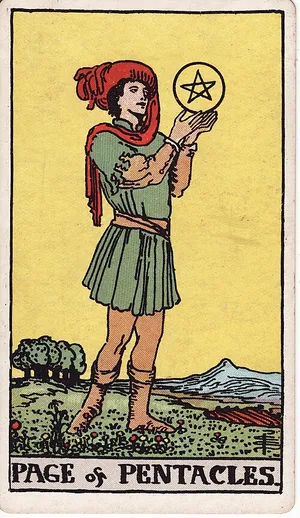

The Page of Pentacles is one of the 56 Minor Arcana in the Rider–Waite–Smith tarot: a court card, the Page in the suit of Pentacles, drawn by Pamela Colman Smith and published in London in 1909. It shows a young man standing in a flowering field, holding up a single pentacle in both hands and gazing at it. Upright, it is usually read as study, curiosity and the start of something practical; reversed, as attention that drifts, or a plan that never leaves the ground.
Key facts
- Suit: Pentacles, the suit usually connected with work, money, the body and the practical side of life. Today’s common pairing gives it earth; pairings differ between schools, as the 1909 Rider–Waite–Smith tarot article explains.
- Rank: a court card, the Page, the first of the four court ranks (Page, Knight, Queen, King). It follows the Ten of Pentacles and comes before the Knight.
- Suit name: the suit was coins in many older decks; in his entry for the King of Pentacles, Waite notes that “In many old Tarot packs this suit stood for current coin, money, deniers”.
- Upright in one line: study, application, a new and practical beginning.
- Reversed in one line: distraction, waste, a plan left half-made.
- Waite’s own key words (1910): “Application, study, scholarship, reflection”; also news and messages, rule and management.
What the picture shows
The sky is a flat bright yellow, and the title PAGE of PENTACLES is printed at the bottom. A young man stands in the middle of the card, turned slightly to our right. He wears a short green tunic belted with an orange-brown sash, with tan sleeves, and soft tan boots turned down at the top. On his head is a red hat with a long red scarf that falls from it over his shoulder and down his back.
He holds both hands up in front of him, palms open, and a pentacle hangs just above his fingertips, not quite resting on them. His face is lifted towards it. Waite’s note matches this closely: “A youthful figure, looking intently at the pentacle which hovers over his raised hands.” Waite adds, “He moves slowly, insensible of that which is about him.” In the scan one foot is set a little ahead of the other, so he could be standing or taking a slow step; the absorbed look is clear either way.
Around him the meadow is green and dotted with small red and yellow flowers. A clump of dark green trees stands on the left. On the right, beyond the field, is a strip of ploughed land in red furrows, and behind it a pale blue-grey mountain. Smith’s monogram is in the lower right, just above the title.
Waite’s meanings in 1910
In Part III, §2 of The Pictorial Key to the Tarot, Waite gives these divinatory meanings for the card:
“Application, study, scholarship, reflection; another reading says news, messages and the bringer thereof; also rule, management. Reversed: Prodigality, dissipation, liberality. luxury; unfavourable news.”
The text is quoted as the Wikisource transcription prints it, including the full stop after “liberality”. The upright list holds two ideas side by side. One is the scholar: application, study, reflection, which fits the picture of a youth lost in contemplation of one pentacle. The other, introduced with “another reading says”, is the Page as messenger, “the bringer” of news. The reversed list is about spending: “Prodigality” is wasteful spending, “dissipation” adds indulgence and squandering, and “liberality” here is open-handedness carried too far.
Part III, §4, “Some Additional Meanings of the Lesser Arcana”, adds a further list:
“A dark youth; a young officer or soldier; a child. Reversed: Sometimes degradation and sometimes pillage.”
These are period fortune-telling formulas, kept here as history. The upright line turns the card into a type of person who might appear in the querent’s life. This entry does not spell out what “dark” refers to; in §7, as a guide to choosing a card to stand for a person, Waite refers the Pentacles court cards to “persons with very dark brown or black hair, dark eyes and sallow or swarthy complexions”. Nothing in it describes the reader of this page.
How the card is usually read today
One common modern reading takes the Page of Pentacles as the student of the suit: someone at the beginning of a practical path, curious and patient, giving full attention to one small thing. Read it as a prompt for reflection, not a sign of what will come.
Upright. Readers often connect it with starting a course or a new skill, an early-stage plan, careful research, setting goals, or news about work or study. Some read the Page’s slow pace as a virtue: taking the time to understand something properly before acting on it.
Reversed. Waite gives wastefulness and “unfavourable news”. Later readings tend to put it in terms of attention and follow-through: procrastination, losing interest once the first excitement fades, plans that stay on paper, or being so absorbed in one idea that the world around you goes unnoticed, the darker side of Waite’s “insensible of that which is about him”.
Questions people often take from the card:
- What am I curious enough about to study slowly?
- What small, concrete first step would turn this idea into practice?
- Is my focus helping me, or making me miss what is around me?
Upright and reversed at a glance
| Upright | Reversed | |
|---|---|---|
| Waite, 1910 | Application, study, scholarship, reflection; news, messages; rule, management | Prodigality, dissipation, liberality, luxury; unfavourable news |
| Common reading today | A student’s curiosity; a practical beginning; careful planning | Procrastination, lost focus, plans that stay on paper |
| A question to ask | What am I ready to learn? | What would help me follow through? |
The Page of Pentacles in a spread
- Three cards (Past, Present, Future). In the Past position, it can point to an early interest or apprenticeship that set you on this path. In the Present, it asks what you are learning and whether you are giving it enough time. In the Future position, readers usually take it as an invitation to name a first practical step, not as news that is bound to arrive.
- Celtic cross. In the Self position, the Page can invite you to see yourself as a beginner, with the freedom that brings. In the Crown position, it asks what goal you are slowly working towards. In the Challenge position, it may point to a plan that has stalled at the thinking stage.
The positions of both spreads and the names of all 78 cards are in the tarot glossary; where the deck and its pictures come from is in the 1909 Rider–Waite–Smith tarot.
Cards often read next to the Page of Pentacles
- Ten of Pentacles, the card before it in the suit: a whole household and its heritage. After it, the Page starts again with a single pentacle.
- Knight of Pentacles, the next court card: the same pentacle carried on a heavy horse, read as steady, methodical effort.
- Ace of Pentacles: a hand from a cloud holding up one pentacle; both cards are read as a practical beginning, the Ace as the opportunity and the Page as the person studying it.
- Page of Cups: the same rank in Cups, a page looking at a fish rising from his cup; read as emotional or imaginative curiosity, where this Page’s curiosity is practical.
In HeyFate, each card you draw is turned upright or reversed at random with even odds, and an AI model writes the reading. This page is the reference behind the card, not a reading of your own question.
Sources
- A. E. Waite, The Pictorial Key to the Tarot, Part III, §2, “The Suit of Pentacles: Page”, also citing “The Suit of Pentacles: King” (Wikisource, from the 1922 reprint)
- A. E. Waite, The Pictorial Key to the Tarot, Part III, §4, “Some Additional Meanings of the Lesser Arcana” (Wikisource, from the 1922 reprint)
- A. E. Waite, The Pictorial Key to the Tarot, Part III, §7, “An Ancient Celtic Method of Divination” (Wikisource, from the 1922 reprint)
- Wikimedia Commons: Pents11.jpg (Pam-A scan, public domain)
AI-generated content, for reference only; not medical, legal, financial or psychological advice. These methods come from cultural traditions, and HeyFate offers them for cultural interest, entertainment and self-reflection.