Ace of Pentacles Tarot Card Meaning: Upright, Reversed and Symbolism
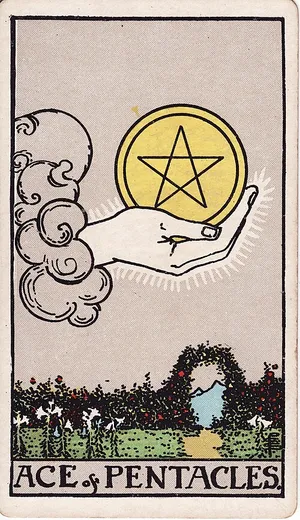

The Ace of Pentacles opens the suit of Pentacles, one of the four suits that make up the 56 Minor Arcana of the Rider–Waite–Smith tarot, drawn by Pamela Colman Smith and published in London in 1909. A hand reaches out of a cloud with a large gold pentacle resting in its palm, above a hedged garden. Upright, it is usually read as a solid, practical beginning, something real to work with; reversed, as that opening delayed, mishandled, or valued for the wrong reasons.
Key facts
- Suit: Pentacles, the suit most often linked today with work, money, the body and everyday material life. Today’s common pairing gives it the element Earth, but schools differ (Papus paired it with Air); see the 1909 Rider–Waite–Smith tarot. In his entry for the King of Pentacles, Waite notes that “In many old Tarot packs this suit stood for current coin, money, deniers”, and that he did not invent the change to pentacles.
- Rank: Ace, the card that opens the suit, before the Two.
- Other names: the card is printed ACE of PENTACLES. In decks that keep the older suit of coins that Waite mentions, the matching card is the Ace of Coins.
- Upright in one line: a tangible start: a resource, a skill or an opportunity you can actually hold.
- Reversed in one line: the start stalls or is misused; comfort that does not serve the person who has it.
- Waite’s own key words (1910, shortened): perfect contentment, felicity, ecstasy, gold; reversed, “The evil side of wealth”; and in his additional meanings, “The most favourable of all cards”.
What the picture shows
From a white cloud on the left, drawn as a stack of scrolled curls, a pale hand reaches out palm up. It does not grip the pentacle: the disc rests in the cupped hand, with the thumb laid across its lower edge. Short white rays fan out all round the hand, as if it were giving off light. Waite’s own note is brief: “A hand—issuing, as usual, from a cloud—holds up a pentacle.” The words “as usual” point to the other three Aces, where a hand from a cloud also holds up the emblem of its suit.
The pentacle is a large yellow disc with a double rim and a black five-pointed star drawn in one continuous line. Waite explains the emblem in his entry for the King of Pentacles: the sign of the suit is “engraved or blazoned with the pentagram, typifying the correspondence of the four elements in human nature and that by which they may be governed”.
The lower third of the card is a garden. A dark hedge dotted with small red flowers runs across the width of the card, and towards the right it rises into a rounded arch. Through the opening you can see pale blue mountain peaks in the distance, and a yellow path runs from the foreground up to the arch and through it. White lilies stand on the grass at the left, with one more beside the arch on the right. Smith’s monogram is in the lower right corner, against the hedge.
Waite’s note says nothing about the garden, the arch or the mountains.
Waite’s meanings in 1910
In Part III, §2 of The Pictorial Key to the Tarot, Waite gives the divinatory meanings for the Ace of Pentacles:
“Perfect contentment, felicity, ecstasy; also speedy intelligence; gold. Reversed: The evil side of wealth, bad intelligence; also great riches. In any case it shews prosperity, comfortable material conditions, but whether these are of advantage to the possessor will depend on whether the card is reversed or not.”
Here “intelligence” is the old word for news or information, so “speedy intelligence” means quick tidings, not quick wits, and “bad intelligence” means bad news. The last sentence is the one that carries the card: upright or reversed, it shows “prosperity, comfortable material conditions”; what the orientation changes is “whether these are of advantage to the possessor”.
Part III, §4, “Some Additional Meanings of the Lesser Arcana”, is a further set of meanings Waite lists. For this card it reads:
“Ace.—The most favourable of all cards. Reversed: A share in the finding of treasure.”
Straight after the Pentacles list, Waite himself warns that these additions have “little connexion” with the pictures and that they are “very often in disagreement with those previously given”. They are period fortune-telling formulas, kept here as history; they say nothing about the reader.
How the card is usually read today
One common modern reading treats the Ace of Pentacles as the seed of its suit: an opening that is concrete rather than emotional or intellectual, such as an offer of work, a sum of money, a place to live, or a skill that is ready to be used. In that reading the card is about something being placed in your hand, and what you then do with it. Use it to reflect on your own situation; it does not tell you what will come.
Upright. Readers often connect it with a sound start, practical support, a plan with real means behind it, or the quiet satisfaction of having enough. Some point to the open hand in the picture: the pentacle is offered and held lightly, not seized.
Reversed. Waite’s reversed line keeps the riches and turns the question to their use: “The evil side of wealth”. Later readings often speak of an opening that is missed or delayed, money or effort spent carelessly, or security bought at too high a cost.
Questions people often take from the card:
- What do I already have in hand that I have not yet started to use?
- Is this something I want to build on, or only something I want to own?
- If comfort were not the goal, what would I do with these resources?
Upright and reversed at a glance
| Upright | Reversed | |
|---|---|---|
| Waite, 1910 | Perfect contentment, felicity, ecstasy; quick news; gold | The evil side of wealth; bad news; also great riches |
| Common reading today | A practical start; resources in hand | A delayed or misused start; comfort with a cost |
| A question to ask | What can I build with what I have been given? | Is what I have actually serving me? |
The Ace of Pentacles in a spread
- Three cards (Past, Present, Future). In the Past position, it can point to a material beginning, such as a first job, a move or money put aside, that still shapes the situation. In the Present, it asks what concrete resource is available now and whether you are using it. In the Future position, readers usually take it as a prompt to think about what you would need to put in place for a plan to become real, not as a promise of gain.
- Celtic cross. In the Root position, it can invite reflection on the practical footing under the question: savings, skills, daily habits, a roof overhead. In the Outcome position, many readers look back at the cards before it to see whether they show the work that would turn a single coin into something lasting, such as the Three or the Eight of Pentacles.
The positions of both spreads and the names of all 78 cards are in the tarot glossary; where the deck and its pictures come from is in the 1909 Rider–Waite–Smith tarot.
Cards often read next to the Ace of Pentacles
- Two of Pentacles, the next card in the suit: one pentacle becomes two, kept moving by a dancing young man; the single gift turns into a balancing act.
- Ace of Wands: in Waite’s entry for it, “A hand issuing from a cloud grasps a stout wand or club”; usually read as a start of energy and enterprise rather than of means.
- Ace of Cups: the hand holds a cup “from which four streams are pouring”, in Waite’s entry for that card; often read as an opening of feeling.
- Ace of Swords: a sword whose point “is encircled by a crown”, in Waite’s entry for that card; often read as a start of clarity or decision.
In HeyFate, each card you draw is turned upright or reversed at random with even odds, and an AI model writes the reading. This page is the reference behind the card, not a reading of your own question.
Sources
- A. E. Waite, The Pictorial Key to the Tarot, Part III, §2, “The Suit of Pentacles: Ace”, with the suit note in “The Suit of Pentacles: King” (Wikisource, from the 1922 reprint)
- A. E. Waite, The Pictorial Key to the Tarot, Part III, §4, “Some Additional Meanings of the Lesser Arcana” (Wikisource, from the 1922 reprint)
- Wikimedia Commons: Pents01.jpg (Pam-A scan, public domain)
AI-generated content, for reference only; not medical, legal, financial or psychological advice. These methods come from cultural traditions, and HeyFate offers them for cultural interest, entertainment and self-reflection.