Ace of Swords Tarot Card Meaning: Upright, Reversed and Symbolism
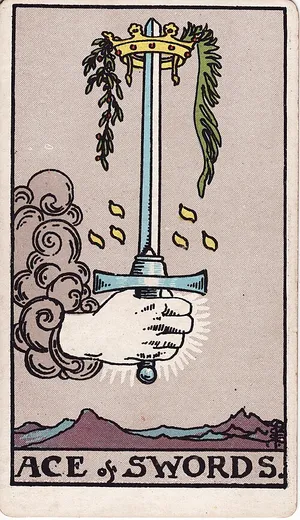

The Ace of Swords opens the suit of Swords, one of the four suits that make up the 56 Minor Arcana in the Rider–Waite–Smith tarot, drawn by Pamela Colman Smith and published in London in 1909. It shows a hand coming out of a cloud and holding up a sword whose point passes through a gold crown. Upright, it is usually read as a clear, forceful idea or decision that cuts through confusion; reversed, as that same force turned blunt, misdirected or used to wound.
Key facts
- Suit: Swords, 14 cards. Readers today commonly associate it with thought, speech, decisions and conflict. Today’s common pairing is Air, but schools differ: Papus paired Swords with Earth, and Waite does not specify an element for Swords in this book (see the 1909 Rider–Waite–Smith tarot). In his entry for the Two of Swords, Waite warns that “Swords generally are not symbolical of beneficent forces in human affairs”.
- Rank: Ace, the card that opens the suit. It is not a court card, and like the other Aces it carries its title at the bottom: ACE of SWORDS.
- Upright in one line: a clear idea, a decision, the force to cut through.
- Reversed in one line: force without judgement; a sharp mind turned against itself or others.
- Waite’s own key words (1910): triumph, conquest, “triumph of force”; “a card of great force, in love as well as in hatred”.
What the picture shows
Against a flat, pale grey ground, a billowing cloud drawn in tight spirals pushes in from the viewer’s left, and out of it comes a large white hand. The fist grips the hilt of a sword, and a ring of fine rays surrounds it, as if the hand were giving off light. The sword stands straight up: a long, pale blue blade with a broad crossguard, and a round pommel showing below the fist.
Near the top, the point passes through a gold crown decorated with small red dots. Waite’s note on the card says only this: “A hand issues from a cloud, grasping a sword, the point of which is encircled by a crown.” Two pieces of greenery hang from the crown. On the viewer’s left is a slender branch with narrow leaves and small red berries; on the right, a longer, broader green frond. Below them, six small yellow drops fall through the air, three on each side of the blade. Waite does not name the plants or explain the drops in this entry.
Along the bottom runs a low range of mountains in purple and blue-grey, with Smith’s monogram tucked into the right-hand end. Under them is the title, “ACE of SWORDS.”
Waite’s meanings in 1910
In Part III, §2 of The Pictorial Key to the Tarot, Waite gives the divinatory meanings of the Ace of Swords:
“Triumph, the excessive degree in everything, conquest, triumph of force. It is a card of great force, in love as well as in hatred. The crown may carry a much higher significance than comes usually within the sphere of fortune-telling. Reversed: The same, but the results are disastrous; another account says—conception, childbirth, augmentation, multiplicity.”
The force he describes is force in excess, and it runs both ways. He hints that the crown means more than fortune-telling usually reaches, without saying what. His reversed meaning splits in two: the same force with “disastrous” results, or, by “another account”, a list about birth and increase that has nothing to do with the first.
In §4, “Some Additional Meanings of the Lesser Arcana”, Waite lists a further set of meanings, and he notes that they are “very often in disagreement with those previously given”. For this card:
“Great prosperity or great misery. Reversed: Marriage broken off, for a woman, through her own imprudence.”
These are period fortune-telling formulas, kept here as history. The reversed line carries its time’s assumptions about women and marriage; it says nothing about you.
How the card is usually read today
One common modern reading takes the Ace of Swords as the suit in its purest form: a single idea, a truth said plainly, a decision that cuts through doubt. In that reading the sword stands for the mind, and the crown for what clear thinking can win. Treat it as a prompt for reflection, not a forecast.
Upright. Readers often connect it with clarity after confusion, a breakthrough in understanding, honest words, or the resolve to make a hard call. Some stress that a blade has two edges: the same clarity can be cold, and it asks to be used with care.
Reversed. Waite’s “The same, but the results are disastrous” sits close to one later reading: certainty used without judgement, words that wound, an argument won at too high a cost. Other readers take the reversed Ace as clarity that has not arrived yet: muddled thinking, a decision put off, or an idea that is sharp in your head but not ready to be said.
Questions people often take from the card:
- What do I already know here, if I put it in one plain sentence?
- Is the decision I am weighing clear, or only forceful?
- Who could be cut by what I want to say, and how can I say it well?
Upright and reversed at a glance
| Upright | Reversed | |
|---|---|---|
| Waite, 1910 | Triumph, conquest, triumph of force; great force in love and in hatred | The same, but disastrous; or conception, childbirth, augmentation, multiplicity |
| Common reading today | Clarity, a breakthrough, a clear decision | Force without judgement; confusion; a decision delayed |
| A question to ask | What is clear to me now? | Where is my certainty doing harm? |
The Ace of Swords in a spread
The card’s single blade takes on a different edge in each position.
- Three cards (Past, Present, Future). In the Past position, it invites a look back at a moment when something became clear and set the course. In the Present, it asks what needs to be named plainly now. In the Future position, readers usually take it as a prompt to think about which decision or conversation the next step calls for, not as a fixed event.
- Celtic cross. In the Root position, it can ask which idea or conviction sits underneath the whole question. In the Challenge position, it may point to sharp words or rigid certainty that need handling with care. In the Outcome position, many readers look at the Self and Environment cards beside it and ask whose clarity this is, and who else it touches.
The positions of both spreads and the names of all 78 cards are in the tarot glossary; where the deck and its pictures come from is in the 1909 Rider–Waite–Smith tarot.
Cards often read next to the Ace of Swords
- Two of Swords, the next card in the suit: in its entry Waite describes “A hoodwinked female figure” balancing two swords. After the Ace’s single blade, a standoff between two.
- Ace of Wands: in §2, “The Suit of Wands: Ace”, a hand from a cloud “grasps a stout wand or club”. Often read as the spark of energy or enterprise, where the Ace of Swords is the spark of an idea.
- Ace of Cups: often read as an opening of the heart rather than of the mind.
- Ace of Pentacles: in §2, “The Suit of Pentacles: Ace”, a hand “issuing, as usual, from a cloud” holds up a pentacle. Often read as a beginning in practical and material matters.
In HeyFate, each card you draw is turned upright or reversed at random with even odds, and an AI model writes the reading. This page is the reference behind the card, not a reading of your own question.
Sources
- A. E. Waite, The Pictorial Key to the Tarot, Part III, §2, “The Suit of Swords: Ace”, with short quotations from the entries for the Two of Swords and the Aces of Wands and Pentacles (Wikisource, from the 1922 reprint)
- A. E. Waite, The Pictorial Key to the Tarot, Part III, §4, “Some Additional Meanings of the Lesser Arcana” (Wikisource, from the 1922 reprint)
- Wikimedia Commons: Swords01.jpg (Pam-A scan, public domain)
AI-generated content, for reference only; not medical, legal, financial or psychological advice. These methods come from cultural traditions, and HeyFate offers them for cultural interest, entertainment and self-reflection.