King of Cups Tarot Card Meaning: Upright, Reversed and Symbolism
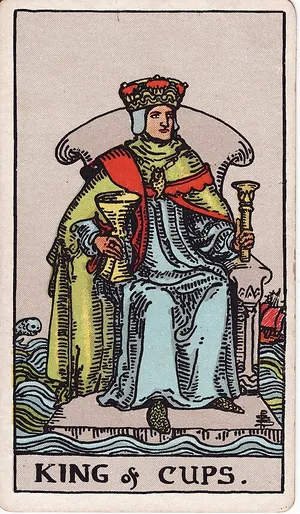

The King of Cups is one of the 56 Minor Arcana in the Rider–Waite–Smith tarot: the King, one of the four court cards in the suit of Cups, drawn by Pamela Colman Smith and published in London in 1909. It shows a crowned king on a stone throne set on the open sea, a great cup in one hand and a short sceptre in the other, with a ship on one side and a leaping fish on the other. Upright, it is usually read as calm, generous authority over feeling; reversed, as feelings held down until they leak out, or kindness used to manipulate.
Key facts
- Suit: Cups, one of the four suits of 14 cards. Today’s common pairing links Cups with water, and the suit with feelings and relationships; pairings differ between schools, as the 1909 Rider–Waite–Smith tarot article explains. This card’s entry is where Waite says the Sign of the Cup “naturally refers to water”.
- Rank: a court card, the King, the highest of the four court ranks, after the Queen of Cups. (Waite’s book takes each suit from the top, so his Cups section opens with this card.) The printed title at the bottom reads KING of CUPS.
- Upright in one line: emotional balance, wise counsel, steadiness under pressure.
- Reversed in one line: suppressed feeling, moodiness, or care used as leverage.
- Waite’s own key words (1910, shortened): “responsible, disposed to oblige the Querent”; “equity, art and science”; “creative intelligence”; reversed, “Dishonest, double-dealing man”.
What the picture shows
The background is a flat grey. The king sits facing us on a pale stone throne with scroll-like curves at the sides of its back. The throne stands on a square stone slab, and all around the slab is sea: rows of blue and green waves fill the bottom of the card and rise up both sides.
He holds a large gold cup in his right hand and a short gold sceptre in his left, both just as Waite describes: “He holds a short sceptre in his left hand and a great cup in his right”. On his head is a red and gold crown over a pale blue-grey cap that covers his ears. In “The Suit of Wands: King”, Waite says each King wears, “like his three correspondences in the remaining suits, what is called a cap of maintenance beneath his crown”, and that is the cap shown here. He wears a long pale blue robe, a yellow-green cloak with a red collar over his shoulders, and a small gold pendant shaped like a fish, hung on a chain at his chest. His shoes are a dotted gold-green.
On the right, partly hidden by the throne, a ship with red sails and an orange hull rides the waves. On the left, the grey-blue head of a large fish, with a round eye, arches out of a wave; Waite calls it a dolphin: “on one side a ship is riding and on the other a dolphin is leaping”. Smith’s monogram is on the slab at the lower right, and the title KING of CUPS runs along the bottom.
Waite adds one sentence of explanation: “The implicit is that the Sign of the Cup naturally refers to water, which appears in all the court cards.” In context he means the four court cards of Cups.
Waite’s meanings in 1910
In Part III, §2 of The Pictorial Key to the Tarot, Waite gives the divinatory meanings:
“Fair man, man of business, law, or divinity; responsible, disposed to oblige the Querent; also equity, art and science, including those who profess science, law and art; creative intelligence. Reversed: Dishonest, double-dealing man; roguery, exaction, injustice, vice, scandal, pillage, considerable loss.”
The upright list again starts with a type of person: a “Fair man” who works in business, law or “divinity”, which here means theology or the Church. The qualities that follow are about fairness and making: “equity”, “art and science”, “creative intelligence”. The reversed list is long and severe, from a “double-dealing man” to “considerable loss”.
Part III, §4, “Some Additional Meanings of the Lesser Arcana”, is a further set of meanings Waite lists for each card. For the King it pulls against the upright meaning: “Beware of ill-will on the part of a man of position, and of hypocrisy pretending to help. Reversed: Loss.” These are period fortune-telling formulas, kept here as history; they are not a warning about anyone the reader knows. Waite notes after the list that these additional meanings “are very often in disagreement with those previously given”, and this card shows it plainly.
How the card is usually read today
One common modern reading takes the King of Cups as emotional maturity in a position of responsibility: someone who feels fully but stays calm enough to help others, a counsellor, a carer, a steady head in a crisis. In that reading the sea around him is real and the throne stands firm in it. It is a description to reflect on, not a forecast about a person who will help you.
Upright. Readers often connect it with diplomacy, compassion with boundaries, sound advice, patience, or creative and caring work done with experience. Waite’s “creative intelligence” and “equity” fit this reading: fairness and imagination together.
Reversed. Waite gives “Dishonest, double-dealing man” and a long list of wrongs. Later readings more often take the reversed King as the calm turned brittle: feelings bottled up until they burst, moodiness, coldness passed off as control, or warmth used to manipulate. Some echo the §4 line about “hypocrisy pretending to help”.
Questions people often take from the card:
- How do I stay steady when feelings, mine or other people’s, run high?
- Am I calm, or only keeping a lid on things?
- Where could I offer help that is honest about its own limits?
Upright and reversed at a glance
| Upright | Reversed | |
|---|---|---|
| Waite, 1910 | Fair man of business, law or divinity; responsible, obliging; equity, art and science; creative intelligence | Dishonest, double-dealing man; roguery, injustice, scandal, considerable loss |
| Common reading today | Emotional balance; wise counsel; calm authority | Suppressed feeling; moodiness; manipulation |
| A question to ask | How can I stay calm and still feel? | What am I holding down? |
The King of Cups in a spread
Each position gives the card a slightly different question.
- Three cards (Past, Present, Future). In the Past position, it can recall someone whose steadiness or advice still guides you. In the Present, it asks how you are holding your feelings in a situation that stirs them. In the Future position, readers usually take it as an invitation to think about what calm, caring authority would look like for you, not as someone who will arrive.
- Celtic cross. In the Crown position, it may point to the kind of maturity you are working towards. In the Challenge position, it can ask whether composure has become a way of not feeling. In the Outcome position, many readers look at the cards beside it, such as the Queen of Cups or a King from another suit, and read them together as different ways of holding responsibility.
The positions of both spreads and the names of all 78 cards are in the tarot glossary; where the deck and its pictures come from is in the 1909 Rider–Waite–Smith tarot.
Cards often read next to the King of Cups
- Queen of Cups, the card before it: a queen at the water’s edge who, in Waite’s Part III, §2 entry for the Queen of Cups, “sees, but she also acts”. The King sits further out, in the sea itself.
- Ace of Cups: the suit’s opening card, a single cup over water, whose meanings in Waite’s Part III, §2 entry include “House of the true heart”.
- King of Wands: the entry where Waite describes the cap of maintenance all four Kings wear; his King is “ardent” and “impassioned”.
- King of Swords: in Waite’s Part III, §2 entry for the King of Swords, a king who “sits in judgment”, the same rank ruled by thought rather than feeling.
In HeyFate, each card you draw is turned upright or reversed at random with even odds, and an AI model writes the reading. This page is the reference behind the card, not a reading of your own question.
Sources
- A. E. Waite, The Pictorial Key to the Tarot, Part III, §2, “The Suit of Cups: King”, with lines from “The Suit of Cups: Queen”, “The Suit of Cups: Ace”, “The Suit of Wands: King” and “The Suit of Swords: King” (Wikisource, from the 1922 reprint)
- A. E. Waite, The Pictorial Key to the Tarot, Part III, §4, “Some Additional Meanings of the Lesser Arcana” (Wikisource, from the 1922 reprint)
- Wikimedia Commons: Cups14.jpg (Pam-A scan, public domain)
AI-generated content, for reference only; not medical, legal, financial or psychological advice. These methods come from cultural traditions, and HeyFate offers them for cultural interest, entertainment and self-reflection.