King of Swords Tarot Card Meaning: Upright, Reversed and Symbolism
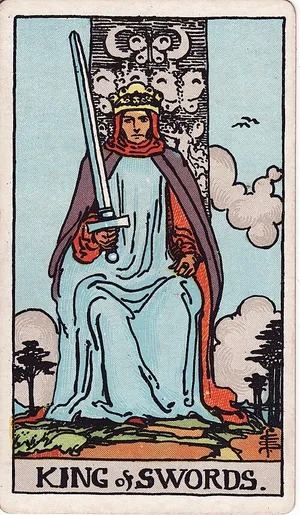

The King of Swords is the highest-ranking of the four court cards in the suit of Swords, one of the four suits of 14 cards that make up the 56 Minor Arcana of the Rider–Waite–Smith tarot, drawn by Pamela Colman Smith and published in London in 1909. It shows a crowned king seated on a tall stone throne, facing straight out of the card, with a drawn sword held upright in his right hand. Upright, it is usually read as clear thinking, fairness and authority grounded in reason; reversed, as that authority turned rigid, cold or cruel.
Key facts
- Suit: Swords, a suit usually linked with thought, words, conflict and hard decisions. Swords go with Air in today’s common pairing, a convention that is not universal (Papus paired them with Earth); see the 1909 Rider–Waite–Smith tarot.
- Rank and place: a court card, the King, printed KING of SWORDS at the bottom. In the usual order he closes the suit, after the Queen of Swords; Waite’s own list of the suit begins with him.
- Upright in one line: judgement, clear reasoning, fair and firm decisions.
- Reversed in one line: power used harshly, rigid rules, cold or manipulative thinking.
- Waite’s own key words (1910, selected): judgment, power, command, authority, “militant intelligence”, law.
What the picture shows
Unlike the Queen, who is shown in profile, the King faces us directly. He wears a gold crown over a red hood that frames his face closely, and his expression is level and unsmiling. A pale blue robe falls in long folds from his shoulders to the ground, with red-orange sleeves at the wrists, and a dark purple cloak lined in red hangs behind his shoulders. His right hand grips a long sword by the hilt and holds it up beside him, the blade leaning slightly to his right, towards the left edge of the card. His left hand rests in his lap.
The throne rises behind him to the top of the card, a tall grey panel carved with butterflies; the topmost butterfly is flanked by two crescent shapes. On either side the sky is pale blue, with low grey-white clouds and, at the upper right, two small birds. Dark trees stand at both lower corners, and the ground at his feet is patchy green and orange. The title is at the bottom and Smith’s monogram is at the lower right.
Waite’s note is about office more than appearance: “He sits in judgment, holding the unsheathed sign of his suit. He recalls, of course, the conventional Symbol of Justice in the Trumps Major, and he may represent this virtue, but he is rather the power of life and death, in virtue of his office.” The red hood under the crown may be what Waite, in his entry for the King of Wands, calls “a cap of maintenance”, worn by that King “like his three correspondences in the remaining suits”. Waite does not explain the butterflies in this entry.
Waite’s meanings in 1910
Waite opens Part III, §2 by saying that for the Minor Arcana “a harmony of their meanings will be provided from all sources”. For the King of Swords:
“Whatsoever arises out of the idea of judgment and all its connexions—power, command, authority, militant intelligence, law, offices of the crown, and so forth. Reversed: Cruelty, perversity, barbarity, perfidy, evil intention.”
The upright meaning grows out of the picture note: a man who “sits in judgment” stands for “the idea of judgment and all its connexions”. Waite does not explain the phrase “militant intelligence”; this page takes it loosely as the mind in active service. “Offices of the crown” are posts held under the Crown. The reversed list is the same power turned to harm: “Cruelty, perversity, barbarity, perfidy”. Perfidy is betrayal of trust.
In §4, “Some Additional Meanings of the Lesser Arcana”, Waite lists a further set of meanings, which he says are “very often in disagreement with those previously given”: “A lawyer, senator, doctor. Reversed: A bad man; also a caution to put an end to a ruinous lawsuit.” These belong to period cartomancy, which matched court cards to professions and to kinds of trouble. They are kept here as history, not as advice about anyone’s legal or medical affairs.
How the card is usually read today
One common modern reading takes the King of Swords as mastery of the suit: clear thinking that has become steady, responsible judgement. Court cards are often read as a person in the situation, or as a quality you are asked to bring to it. Read it as a prompt for reflection, not as a forecast.
Upright. Readers often connect it with fairness, logic, expertise, ethical decisions, plain truth-telling, or a person whose authority rests on knowledge. The frontal pose is sometimes read as looking the matter straight in the face.
Reversed. Waite’s reversed meanings, cruelty to “evil intention”, are close to how later readers describe it: authority without compassion, rules applied without regard for people, cleverness used to control, or a cold refusal to hear another side.
Questions to sit with:
- What would a fair, clear-headed judgement look like here?
- Am I using reason to understand this, or to win?
- Whose expertise could I ask for, and would I listen to it?
Upright and reversed at a glance
| Upright | Reversed | |
|---|---|---|
| Waite, 1910 | Judgment, power, command, authority, militant intelligence, law | Cruelty, perversity, barbarity, perfidy, evil intention |
| Common reading today | Clear reasoning, fairness, grounded authority | Harshness, rigidity, cold or controlling thought |
| A question to ask | What would a fair decision be? | Where has firmness turned into coldness? |
The King of Swords in a spread
As the senior card of the suit, he often marks where a decision rests.
- Three cards (Past, Present, Future). In the Past position, it can invite a look at a firm decision, or a firm person, that set the terms you live with now. In the Present, it asks what a clear and fair judgement would be. In the Future position, readers usually take it as a prompt to think through what principles you want to decide by, not as a fixed event.
- Celtic cross. In the Crown position, it may point to an aim of acting with clarity and integrity. In the Environment position, it can stand for an expert, an official or an authority figure in the matter. In the Outcome position, many readers look at the Challenge card to see what such a judgement would have to weigh.
The positions of both spreads and the names of all 78 cards are in the tarot glossary; where the deck and its pictures come from is in the 1909 Rider–Waite–Smith tarot.
Cards often read next to the King of Swords
- Queen of Swords, the court card before him: the same upright sword, seen in profile; clarity shaped by experience rather than by office.
- Justice (XI): the “conventional Symbol of Justice in the Trumps Major” that Waite says the King recalls; the King is often read as that principle carried by a person.
- King of Cups: Waite’s King whose “throne is set upon the sea”; feeling kept in balance, set against the King of Swords’ reasoning.
- King of Wands: Waite’s King who “uplifts a flowering wand”; leadership by drive and vision rather than by judgement.
In HeyFate, each card you draw is turned upright or reversed at random with even odds, and an AI model writes the reading. This page is the reference behind the card, not a reading of your own question.
Sources
- A. E. Waite, The Pictorial Key to the Tarot, Part III, §2, “The Suit of Swords: King”, also citing the King of Wands and King of Cups (Wikisource, from the 1922 reprint)
- A. E. Waite, The Pictorial Key to the Tarot, Part III, §4, “Some Additional Meanings of the Lesser Arcana” (Wikisource, from the 1922 reprint)
- Wikimedia Commons: Swords14.jpg (Pam-A scan, public domain)
AI-generated content, for reference only; not medical, legal, financial or psychological advice. These methods come from cultural traditions, and HeyFate offers them for cultural interest, entertainment and self-reflection.