Justice Tarot Card Meaning: Upright, Reversed and Symbolism
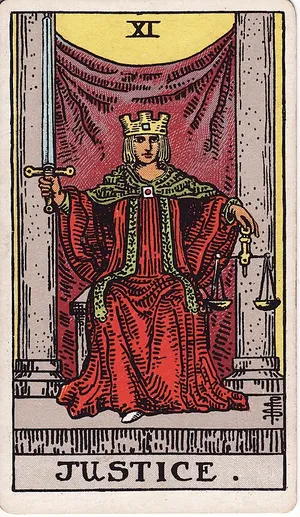

Justice is card XI (11) of the 22 Major Arcana in the Rider–Waite–Smith tarot. It shows a crowned figure in red seated between two grey pillars, holding an upright sword in one hand and a pair of scales in the other. Upright, it is read as fairness, honest weighing and accepting the consequences of one’s choices; reversed, as imbalance, bias or avoiding responsibility.
Key facts
- Number and place: XI, between Wheel of Fortune (X) and The Hanged Man (XII). Many older decks number Justice VIII; in RWS it is XI. In Part II, “VIII. Strength, or Fortitude”, Waite explains that he interchanged Strength with Justice, “which is usually numbered eight”.
- Other names: none in Waite; the printed title is JUSTICE.
- Upright in one line: fairness, clear judgement, cause and effect, accountability.
- Reversed in one line: unfairness, bias, dodging responsibility, or judging too harshly.
- Waite’s own key words (1910): equity, rightness, probity, executive; “triumph of the deserving side in law”.
What the picture shows
The figure sits facing straight out of the card, on a stone seat raised on a grey step. On each side stands a plain grey pillar, and between the pillars hangs a purple curtain; above it shows a band of yellow. The figure wears a red robe that falls to the floor, a green cape fastened at the throat with a square clasp set with a red stone, and a gold crown with three square turrets and a square jewel at the front. The face is calm and level, the hair cut straight at the shoulders.
The right hand raises a straight sword, point upward, its hilt gold. The left hand holds a set of gold scales by a short handle, the two pans hanging below. At the hem of the robe, a white shoe shows on the step; later commentators often read it as a foot about to move, judgement leading to action, though Waite does not mention it. Smith’s monogram is at the bottom right, beside the step.
Compared with the Tower or the Wheel, there is very little movement here. The card is almost symmetrical: two pillars, one sword, one balance, a figure set squarely in the middle.
Waite’s meanings in 1910
In Part III of The Pictorial Key to the Tarot, Waite gives the meaning of Justice as:
“Equity, rightness, probity, executive; triumph of the deserving side in law. Reversed: Law in all its departments, legal complications, bigotry, bias, excessive severity.”
The legal wording belongs to the fortune-telling tradition of his day and is quoted here as history. In Part II, Waite says little, because the card “follows the traditional symbolism and carries above all its obvious meanings”. He refers readers back to Part I for the rest.
What he does add is a contrast. The figure is “seated between pillars, like the High Priestess”, and so he separates two kinds of justice. One is “the moral principle which deals unto every man according to his works”. The other is “the spiritual justice which is involved in the idea of election”, which he likens to “the breathing of the Spirit where it wills” and to the gifts of a poet: “we have them or have not, and their presence is as much a mystery as their absence.” He treats the card as the first kind, and says of the second that “we have no canon of criticism or ground of explanation concerning it”. His last sentence sums it up: “the pillars of Justice open into one world and the pillars of the High Priestess into another.”
How the card is usually read today
One common modern reading treats Justice as honest weighing: looking at the facts, including one’s own part, and accepting that actions have consequences. The sword stands for the decision and the scales for the care taken before it. Treat it as a prompt for reflection, not as a ruling on what will happen.
Upright. Readers often speak of fairness, taking responsibility, a clear-headed decision, or balancing what one owes others with what one owes oneself. Some point to Waite’s “according to his works” and read the card as a reminder that choices add up.
Reversed. Waite’s reversed list moves from law into “bigotry, bias, excessive severity”. Later readings keep that sense of judgement gone wrong: being unfair to someone, shifting blame, refusing to look at one’s own part, or being so hard on oneself that nothing can be put right.
Questions the card often raises:
- Have I looked at this situation from every side, including the side that does not suit me?
- What is my own share of responsibility here?
- Am I being fair, or only being strict?
Upright and reversed at a glance
| Upright | Reversed | |
|---|---|---|
| Waite, 1910 | Equity, rightness, probity, executive; triumph of the deserving side in law | Law in all its departments, legal complications, bigotry, bias, excessive severity |
| Common reading today | Fairness; honest weighing; accountability; a clear decision | Bias; shifting blame; judging too harshly; imbalance |
| A question to ask | What would a fair view of this look like? | Where am I tilting the scales? |
Justice in a spread
Where Justice lands in a spread changes what it asks of you.
- Three cards (Past, Present, Future). As Past, it can point to a decision whose consequences are still being worked through. As Present, it asks whether you are weighing the situation honestly. As Future, readers usually treat it as an invitation to decide carefully and own the choice, not as a verdict about any dispute.
- Celtic cross. In the Challenge position, it can invite reflection on where fairness or responsibility is being tested. In the Self position, many readers ask how you judge yourself and others; beside the Hanged Man, the pair is often read as the pull between deciding now and waiting to see differently.
The positions of both spreads and the names of all 78 cards are in the tarot glossary; where the deck and its pictures come from is in the 1909 Rider–Waite–Smith tarot.
Cards often read next to Justice
- Wheel of Fortune (X), the card before it: circumstances that turn, where Justice asks what one does with them.
- The Hanged Man (XII), the card after it: suspended judgement, a different view before the next step.
- The High Priestess (II): the other figure seated between pillars, whom Waite sets against Justice.
- Strength (VIII): the card Justice changed places with in Waite’s numbering.
In HeyFate, each card you draw is turned upright or reversed at random with even odds, and an AI model writes the reading. This page is the reference behind the card, not a reading of your own question.
Sources
- A. E. Waite, The Pictorial Key to the Tarot, Part II, “XI. Justice” (Wikisource, from the 1922 reprint)
- A. E. Waite, The Pictorial Key to the Tarot, Part III, §3, the divinatory meanings of the Greater Arcana (Wikisource, from the 1922 reprint)
- Wikimedia Commons: RWS Tarot 11 Justice.jpg (Pam-A scan, public domain)
AI-generated content, for reference only; not medical, legal, financial or psychological advice. These methods come from cultural traditions, and HeyFate offers them for cultural interest, entertainment and self-reflection.