Wheel of Fortune Tarot Card Meaning: Upright, Reversed and Symbolism
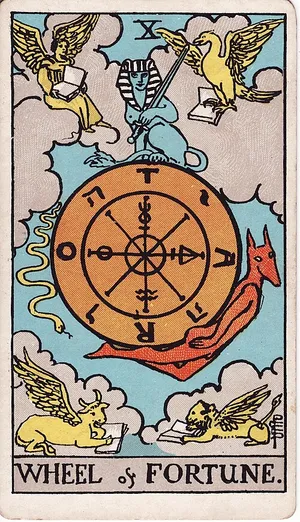

Wheel of Fortune is card X (10) of the 22 Major Arcana in the Rider–Waite–Smith tarot. It shows a great orange wheel lettered T-A-R-O, floating among clouds, with a sphinx on top, a serpent going down one side and a red jackal-headed figure rising on the other, and a winged creature in each corner. Upright, it is read as a turn in circumstances and the cycles life moves through; reversed, as a turn that feels like a setback, or resistance to change that is already moving.
Key facts
- Number and place: X, between The Hermit (IX) and Justice (XI).
- Other names: often shortened to “the Wheel”; the card prints its title as WHEEL of FORTUNE.
- Upright in one line: change, cycles, a turning point, things in motion.
- Reversed in one line: a downturn in the cycle, delay, holding on against change.
- Waite’s own key words (1910): destiny, fortune, success, elevation, luck, felicity.
What the picture shows
The wheel fills the centre of the card. It is drawn in orange with two black rings and eight spokes meeting at a small hub. On the outer ring, the Latin letters T, A, R and O stand at the top, right, bottom and left, so that they read TARO going clockwise from the top. Between them sit four Hebrew letters. Four of the spokes end in small signs; later commentators often read these as alchemical symbols, but Waite does not discuss them in his entry.
On top of the wheel sits a blue sphinx in a striped headdress, holding a sword angled upwards to the right. A yellow serpent winds down the left side of the wheel, head downward. On the right, a red figure with a jackal’s head and long pointed ears rises along the rim beneath the wheel. Waite leaves it unnamed in Part II, but in Part I, describing the reconstruction he followed (Part II credits it to Éliphas Lévi), he lists “a Hermanubis rising with the wheel”: Hermanubis is a Greek-Egyptian blend of Hermes and the jackal-headed god Anubis.
In each corner, resting on grey clouds against a blue sky, is a winged creature with an open book: a winged human figure at top left, an eagle at top right, a bull at bottom left and a lion at bottom right. Smith’s monogram stands in the lower right corner, by the lion.
Waite’s meanings in 1910
In Part III of The Pictorial Key to the Tarot, Waite’s divinatory entry for the card is brief:
“Destiny, fortune, success, elevation, luck, felicity. Reversed: Increase, abundance, superfluity.”
The reversed meanings are close to the upright ones, which modern readers often find puzzling. In Part II, Waite says he followed Éliphas Lévi’s reconstruction, and that Egyptian symbolism is fair to use “provided that no theory of origin is implied therein”. He “presented Typhon in his serpent form”, and “the four Living Creatures of Ezekiel occupy the angles of the card”. The picture, he says, “stands for the perpetual motion of a fluidic universe and for the flux of human life. The Sphinx is the equilibrium therein.”
He explains the lettering: “The transliteration of Taro as Rota is inscribed on the wheel, counterchanged with the letters of the Divine Name—to shew that Providence is implied through all.” He objects to versions in which the sphinx sits on a separate pedestal, because that spoils “the essential idea of stability amidst movement”; on this card it sits on the wheel itself. And he draws a conclusion that runs against the card’s popular image: behind the symbol “there lies the denial of chance”.
How the card is usually read today
One common modern reading takes the Wheel as a reminder that circumstances turn: what is up can come down, and what is down can rise again. The sphinx on top is often read as the steady point in the middle of that motion. Use it as a prompt for reflection, not as a statement about what will happen.
Upright. Readers often speak of a turning point, a change of season in some part of life, or a moment when things begin to move after a long pause. Some take Waite’s “denial of chance” seriously and treat the card as a question about patterns: what keeps coming round, and why.
Reversed. Waite’s own reversed words, “Increase, abundance, superfluity”, are not a simple reversal of the upright ones. Many later readings give the card a darker turn reversed: a slower phase, plans that stall, or clinging to how things were when the situation has already changed.
Some questions people take from the card:
- What in my life is turning right now, and which part of it can I influence?
- Is there a pattern that keeps coming back round to me?
- Where is my steady point when things move?
Upright and reversed at a glance
| Upright | Reversed | |
|---|---|---|
| Waite, 1910 | Destiny, fortune, success, elevation, luck, felicity | Increase, abundance, superfluity |
| Common reading today | A turning point; cycles; change getting under way | A slower phase; delay; resisting a change already in motion |
| A question to ask | What is turning, and what is mine to steer? | What am I holding still that wants to move? |
The Wheel of Fortune in a spread
How the Wheel is read depends on the position it falls in.
- Three cards (Past, Present, Future). In the Past, it can mark a turning point that set the current situation in motion. In the Present, it asks what is shifting now and how you are meeting it. In the Future position, readers usually treat it as a reminder that situations change, and an invitation to think about how you want to respond, not as a fixed event.
- Celtic cross. In the Past position, it can point to a recent change whose effects are still unfolding. In the Outcome position, many readers look at its neighbours, such as Justice or the Hermit, to ask what you can bring to a situation that keeps moving.
The positions of both spreads and the names of all 78 cards are in the tarot glossary; where the deck and its pictures come from is in the 1909 Rider–Waite–Smith tarot.
Cards often read next to the Wheel
- The Hermit (IX), the card before it: stillness on the mountain, before the world turns again.
- Justice (XI), the card after it: from turning circumstance to weighing and consequence.
- The World (XXI): the same four creatures, shown as heads among clouds, watch from its corners around an oval wreath.
- The Tower (XVI): change from outside too, but as a single strike rather than a cycle.
In HeyFate, each card you draw is turned upright or reversed at random with even odds, and an AI model writes the reading. This page is the reference behind the card, not a reading of your own question.
Sources
- A. E. Waite, The Pictorial Key to the Tarot, Part I, §2 “Trumps Major”, “10. The Wheel of Fortune” (Wikisource, from the 1922 reprint)
- A. E. Waite, The Pictorial Key to the Tarot, Part II, “X. Wheel of Fortune” (Wikisource, from the 1922 reprint)
- A. E. Waite, The Pictorial Key to the Tarot, Part III, §3, the divinatory meanings of the Greater Arcana (Wikisource, from the 1922 reprint)
- Wikimedia Commons: RWS Tarot 10 Wheel of Fortune.jpg (Pam-A scan, public domain)
AI-generated content, for reference only; not medical, legal, financial or psychological advice. These methods come from cultural traditions, and HeyFate offers them for cultural interest, entertainment and self-reflection.