The Tower Tarot Card Meaning: Upright, Reversed and Symbolism
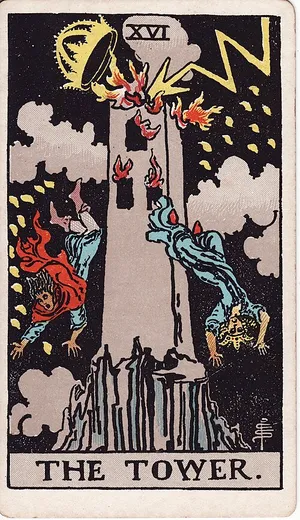

The Tower is card XVI (16) of the 22 Major Arcana in the Rider–Waite–Smith tarot, drawn by Pamela Colman Smith and published in London in 1909. It shows a tower struck by lightning, its crown blown off and two people falling from it. Upright, it is read as a sudden upheaval that brings down something built on a false footing; reversed, as the same shock in a milder, delayed or resisted form.
Key facts
- Number and place: XVI, between The Devil (XV) and The Star (XVII).
- Other names: older French decks call it La Maison Dieu, “the House of God”; in Part II, §1, Waite calls it “the Tower or Maison Dieu”.
- Upright in one line: an abrupt break, a revelation, a structure that could not stand.
- Reversed in one line: the upheaval held off, felt inside, or met with resistance.
- Waite’s own key words (1910): misery, distress, adversity, calamity, deception, ruin; “a card in particular of unforeseen catastrophe”.
What the picture shows
The scan above is a Pam-A printing that Wikimedia Commons dates to 1910; the deck itself was first published in 1909. Look at it before reading any meaning into it. Smith drew a tall grey tower standing on a jagged peak against a black sky. A zigzag of lightning comes in from the upper right and strikes the top of the tower, and the golden crown that capped it is knocked loose and tipping over. Flames burst from the top and from the windows.
Two people fall headfirst, one on each side. The one on the left wears a red cloak over blue clothing; the one on the right wears a flowing blue garment and a gold crown. Small yellow flame-shaped drops fall through the air around them; later commentators often read these as the Hebrew letter yod, though Waite does not explain them in his entry for the card. Grey clouds roll past. Smith’s monogram sits in the lower right corner.
Waite’s meanings in 1910
In Part III of The Pictorial Key to the Tarot, Waite lists the divinatory meanings. For the Tower:
“Misery, distress, indigence, adversity, calamity, disgrace, deception, ruin. It is a card in particular of unforeseen catastrophe. Reversed: According to one account, the same in a lesser degree; also oppression, imprisonment, tyranny.”
In Part II he gives his own symbolic reading. He calls the card “the ruin of the House of Life, when evil has prevailed therein”, and above all “the rending of a House of Doctrine”, which he takes to mean a house of falsehood. He quotes Psalm 127:1, “except the Lord build the house, they labour in vain that build it”.
Two points help when reading these words a century later. First, earlier in Part II Waite warned that the common divinatory meanings were “largely arbitrary attributions” and belonged to the cards “on a lower plane”. Second, his symbolic discussion is about the collapse of false ideas or doctrines rather than misfortune as such.
How the card is usually read today
One common modern reading centres on sudden disruption: something that seemed solid no longer holds. In that reading the card is less about the damage than about what becomes visible when the walls come down. Read it as a prompt for reflection, not as a forecast.
Upright. Common readings are a sudden change of plans, a truth coming out, a belief or arrangement that no longer holds, or pressure that finally breaks. Many readers point out the relief that can follow: once the false crown is off, you can see the ground again.
Reversed. Waite gives “the same in a lesser degree”, which some readers take as a smaller upheaval. Later readings add an inward version, a change felt mainly within, or resistance: holding a cracked structure together, or putting off a change that is already under way.
Questions people often take from the card:
- What in my situation rests on an assumption I have not checked?
- If this arrangement fell apart, what would I learn about it?
- Am I holding up something that would be easier to rebuild than to keep propping up?
Upright and reversed at a glance
| Upright | Reversed | |
|---|---|---|
| Waite, 1910 | Misery, adversity, deception, ruin; unforeseen catastrophe | The same in a lesser degree; oppression, imprisonment, tyranny |
| Common reading today | Sudden change; a false structure collapses; a revelation | A smaller or delayed upheaval; resisting a change already under way |
| A question to ask | What was built on a false footing? | What am I propping up, and why? |
The Tower in a spread
Position changes how the card is read.
- Three cards (Past, Present, Future). In the Past position, it invites a look back at a change that still shapes things. In the Present, it asks whether the current arrangement still holds. In the Future position, readers usually take it as a prompt to examine assumptions before deciding on the next step, not as a fixed event.
- Celtic cross. In the Challenge position, the Tower can invite reflection on a disruption that needs attention. In the Outcome position, many readers look at the cards beside it, especially The Star or an Ace, and read them together as room to rebuild.
The positions of both spreads and the names of all 78 cards are in the tarot glossary; where the deck and its pictures come from is in the 1909 Rider–Waite–Smith tarot.
Cards often read next to the Tower
- The Devil (XV), the card before it: being bound to something. The Tower is often read as the bond breaking, by force.
- The Star (XVII), the card after it: the quiet after the storm. Readers often pair the two as loss followed by hope.
- Death (XIII): often read as endings and transition; the Tower puts more weight on abrupt disruption.
- Wheel of Fortune (X): change from outside, but as a turning cycle rather than a single strike.
In HeyFate, each card you draw is turned upright or reversed at random with even odds, and an AI model writes the reading. This page is the reference behind the card, not a reading of your own question.
Sources
- A. E. Waite, The Pictorial Key to the Tarot, Part II, “XVI. The Tower” (Wikisource, from the 1922 reprint)
- A. E. Waite, The Pictorial Key to the Tarot, Part III, §3, the divinatory meanings of the Greater Arcana (Wikisource, from the 1922 reprint)
- Wikimedia Commons: RWS Tarot 16 Tower.jpg (Pam-A scan, public domain)
AI-generated content, for reference only; not medical, legal, financial or psychological advice. These methods come from cultural traditions, and HeyFate offers them for cultural interest, entertainment and self-reflection.