The Devil Tarot Card Meaning: Upright, Reversed and Symbolism
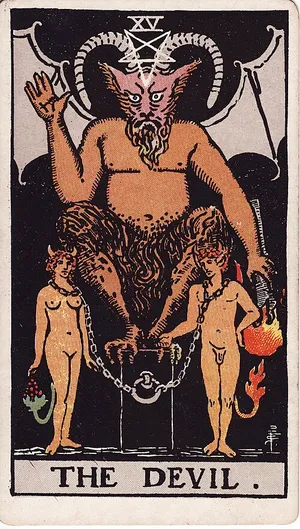

The Devil is card XV (15) of the 22 Major Arcana in the Rider–Waite–Smith tarot, drawn by Pamela Colman Smith and published in London in 1909. It shows a horned, bat-winged figure crouching on a dark block, with a naked man and woman chained to it by the neck. Upright, it is read as being bound: to a habit, a craving or an arrangement that holds you more than you hold it; reversed, as that hold loosening, or as a closer look at what keeps it in place.
Key facts
- Number and place: XV, between Temperance (XIV) and The Tower (XVI).
- Other names: Waite’s description of the figure begins “The Horned Goat of Mendes”, and he mentions Éliphas Lévi’s “Baphometic figure”; the card itself is simply THE DEVIL.
- Upright in one line: attachment, compulsion, the pull of the material side of life.
- Reversed in one line: chains loosening, or a clearer view of how they work.
- Waite’s own key words (1910): ravage, violence, vehemence, extraordinary efforts, force, fatality.
What the picture shows
Most of the card is black. At the top, a large figure crouches on a black half-block with goat’s horns curling out from its head and grey wings like a bat’s spread behind its shoulders. Its face is pink and goat-like, with staring white eyes and a pointed beard, and a white pentagram stands point-down between the horns; Waite writes, “A reversed pentagram is on the forehead.” The body is orange and heavy; the legs are covered in dark hair and end in bird-like claws that grip the top of the block.
The figure’s right hand (on your left) is raised with the palm turned outwards and the fingers spread. Waite reads this gesture as “the reverse of that benediction which is given by the Hierophant in the fifth card”. In its left hand it holds a large torch pointing down towards the ground. Waite also places “the sign of Mercury” at the pit of the stomach; in this small scan that mark is hard to make out.
A ring is set into the front of the block, and two chains run from it to the necks of two naked figures, a woman on the left and a man on the right. Both have small horns and both have tails: hers ends in a cluster of red fruit, which later commentators often read as grapes; his ends in a flame, close to the Devil’s lowered torch. The loops round their necks are loose. Later commentators often point out that they look loose enough to lift off; Waite does not say this. Smith’s monogram is at the lower right.
Waite’s meanings in 1910
The divinatory line Waite gives the card in Part III of The Pictorial Key to the Tarot reads:
“Ravage, violence, vehemence, extraordinary efforts, force, fatality; that which is predestined but is not for this reason evil. Reversed: Evil fatality, weakness, pettiness, blindness.”
The second clause matters: even in this old list, the “fatality” of the upright card “is not for this reason evil”. It is the reversed line that begins “Evil fatality”.
In Part II he says the two chained figures are “analogous with those of the fifth card, as if Adam and Eve after the Fall”, and gives the core of his reading in one line: “Hereof is the chain and fatality of the material life.” The tails “signify the animal nature, but there is human intelligence in the faces”. He adds that the one enthroned above them “is not to be their master for ever”, and is himself “a bondsman, sustained by the evil that is in him and blind to the liberty of service”. He reports, with some scorn, Éliphas Lévi’s claim that the figure is occult science and magic, rejects another commentator’s claim that “in the Divine world it signifies predestination”, and ends with his own image: “the Dweller on the Threshold without the Mystical Garden”, standing outside the garden once those who have “eaten the forbidden fruit” are driven out.
How the card is usually read today
One common modern reading treats the Devil as a picture of attachment: something you feel unable to put down, even when you can see what it costs you. The point many readers stress is the one the picture makes: the chains are loose, which can invite a question about how an attachment is kept in place. It describes a pattern worth looking at, not something that will happen to you, and it is not a judgement on you.
Upright. Readers often connect it with habits, cravings, overwork, a fixation on status or possessions, or an arrangement that has become a cage. Some read it more widely as the “shadow” side: wants or fears you would rather not look at, which grow stronger for being ignored.
Reversed. Waite’s reversed line, “Evil fatality, weakness, pettiness, blindness”, is darker than the upright one. Later readings usually turn this round: the reversed Devil is read as the hold weakening, a decision to step away, or honesty about a pattern. Some readers add that it can show the same bond held more tightly, so the cards around it are read closely.
Some questions to sit with:
- What do I keep returning to, even though it no longer serves me?
- What would I have to give up, or face, to take this chain off?
- Which part of this hold comes from outside me, and which part do I keep in place myself?
Upright and reversed at a glance
| Upright | Reversed | |
|---|---|---|
| Waite, 1910 | Ravage, violence, vehemence, force, fatality; predestined but not for this reason evil | Evil fatality, weakness, pettiness, blindness |
| Common reading today | Attachment, compulsion, material pull; the shadow side | Loosening the hold; seeing the pattern; sometimes a tighter grip |
| A question to ask | What holds me more than I hold it? | What would it take to lift the chain off? |
The Devil in a spread
The card reads differently in each position.
- Three cards (Past, Present, Future). In the Past, it can point to an old habit or dependency whose effects are still felt. In the Present, it asks what currently has a grip on your time or attention. In the Future position, readers usually treat it as a prompt to notice a pattern while it is still small, not as a fixed outcome.
- Celtic cross. In the Challenge position, the Devil can invite reflection on what holds you back that you have stopped noticing. In the Self position, it may ask how you see your own wants. In the Outcome position, many readers read it together with the cards beside it, especially The Tower or The Star, to see whether the story moves towards release.
The positions of both spreads and the names of all 78 cards are in the tarot glossary; where the deck and its pictures come from is in the 1909 Rider–Waite–Smith tarot.
Cards often read next to the Devil
- The Hierophant (V): Waite himself sets the Devil’s raised hand against the Hierophant’s blessing and compares their two pairs of figures.
- The Lovers (VI): later commentators often compare the Lovers’ man and woman under an angel with the chained pair under the Devil.
- Temperance (XIV), the card before it: measure and balance, set against the Devil’s excess.
- The Tower (XVI), the card after it: often read as the hold broken, suddenly, from outside.
In HeyFate, each card you draw is turned upright or reversed at random with even odds, and an AI model writes the reading. This page is the reference behind the card, not a reading of your own question.
Sources
- A. E. Waite, The Pictorial Key to the Tarot, Part II, “XV. The Devil” (Wikisource, from the 1922 reprint)
- A. E. Waite, The Pictorial Key to the Tarot, Part III, §3, the divinatory meanings of the Greater Arcana (Wikisource, from the 1922 reprint)
- Wikimedia Commons: RWS Tarot 15 Devil.jpg (Pam-A scan, public domain)
AI-generated content, for reference only; not medical, legal, financial or psychological advice. These methods come from cultural traditions, and HeyFate offers them for cultural interest, entertainment and self-reflection.