The Hierophant Tarot Card Meaning: Upright, Reversed and Symbolism
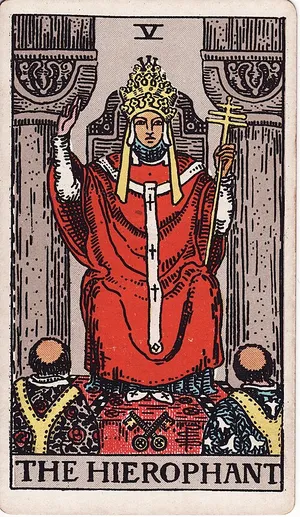

The Hierophant is card V (5) of the 22 Major Arcana in the Rider–Waite–Smith tarot, drawn by Pamela Colman Smith and published in London in 1909. It shows a churchman in a red robe and a triple crown, seated between two grey pillars, one hand raised in blessing, with two kneeling figures and a pair of crossed keys before him. Upright, it is read as tradition, teaching and shared belief; reversed, as questioning those rules, or holding to them too rigidly.
Key facts
- Number and place: V, between The Emperor (IV) and The Lovers (VI).
- Other names: older French decks call it Le Pape, the Pope. Hierophant is a Greek word for the priest who revealed the sacred objects in the ancient mysteries. Waite notes: “He has been usually called the Pope”, which he treats as one instance of a wider office.
- Upright in one line: tradition, a teacher or institution, learning a shared way of doing things.
- Reversed in one line: breaking with convention, or dogma held too tightly.
- Waite’s own key words (1910, a selection): marriage, alliance, captivity, servitude, mercy, goodness, inspiration; reversed, society, concord, over-kindness, weakness.
What the picture shows
Look at the card before reading any meaning into it. The numeral V sits at the top of a grey background. Two heavy grey pillars stand on either side, their capitals carved with curling shapes, and the back of a grey throne rises behind him. He faces us, wearing a red robe and a tall gold crown in three tiers, with blue at his throat and a long white band running down the front of the robe, marked with small black crosses.
His right hand, on the viewer’s left, is raised with two fingers up. His left hand, on the viewer’s right, holds a gold staff topped with a cross of three bars. His white shoes rest on a red patterned dais, and in front of it lie two crossed gold keys. In the foreground two men with shaven crowns kneel with their backs to us. The one on the left wears a dark robe patterned with red roses; the one on the right a blue robe scattered with white flowers that look like lilies. Both have yellow bands in a Y shape over their shoulders.
Waite’s description gives the main items: “the triple crown”, two pillars “not those of the Temple which is guarded by the High Priestess”, “a sceptre terminating in the triple cross”, and “the crossed keys”. He calls the raised hand “the well-known ecclesiastical sign which is called that of esotericism, distinguishing between the manifest and concealed part of doctrine”. Waite describes the two ministers as “in albs”, the white liturgical robes of clergy; the scan shows patterned outer vestments, one with roses and one with lilies. Later commentators often link those flowers to the roses and lilies of the Magician.
Waite’s meanings in 1910
Waite’s divinatory meanings are listed in Part III of The Pictorial Key to the Tarot. His entry for the Hierophant reads:
“Marriage, alliance, captivity, servitude; by another account, mercy and goodness; inspiration; the man to whom the Querent has recourse. Reversed: Society, good understanding, concord, over-kindness, weakness.”
The phrase “the man to whom the Querent has recourse” means the person you turn to for help or advice. Note too that the upright line gives “inspiration”, while in Part II Waite says outright that the Hierophant “is not inspiration”. His two lists do not always agree.
Part II is his longer reading. The Hierophant is “the ruling power of external religion, as the High Priestess is the prevailing genius of the esoteric, withdrawn power”. He agrees with Grand Orient that the card shows “the power of the keys, exoteric orthodox doctrine”, and calls the figure “the summa totius theologiæ”, the sum of all theology, “when it has passed into the utmost rigidity of expression”. He is also “the channel of grace belonging to the world of institution as distinct from that of Nature”. And Waite adds a warning built into the card: “it may so happen that the pontiff forgets the significance of this his symbolic state and acts as if he contained within his proper measures all that his sign signifies”. He ends: “he is not religion, although he is a mode of its expression.”
How the card is usually read today
One common modern reading sees the Hierophant as the knowledge that comes through a tradition: a school, a faith, a profession, a family’s way of doing things, and the people who pass it on. In that reading the kneeling pair matter as much as the crown, because the card is about handing something down. Take it as a prompt for reflection; it is not a forecast.
Upright. Common readings are learning from a mentor, joining or relying on an institution, following an established method, ceremony, or shared values. Waite’s “marriage” and “alliance” sit in this line too, as formal bonds; this page treats them as history, not as news about anyone’s relationships.
Reversed. Waite’s reversed words, society, concord, over-kindness, weakness, are mild. Later readings usually go elsewhere: questioning a convention, finding one’s own path outside a group, or the opposite risk Waite himself names, a rule kept so rigidly that it forgets its purpose.
Questions the card hands to the reader:
- Whose teaching am I following here, and do I still agree with it?
- Is there a tradition that could help me, if I asked?
- Which rule am I keeping out of habit rather than conviction?
Upright and reversed at a glance
| Upright | Reversed | |
|---|---|---|
| Waite, 1910 | Marriage, alliance, captivity, servitude; mercy and goodness; inspiration | Society, good understanding, concord, over-kindness, weakness |
| Common reading today | Tradition; a teacher; shared belief | Breaking with convention; rigid dogma |
| A question to ask | What can I learn from those before me? | Which rule has outlived its reason? |
The Hierophant in a spread
Each position turns his blessing into a different question.
- Three cards (Past, Present, Future). In the Past position, it can recall an upbringing, a schooling or a set of beliefs that framed the question. In the Present, it asks whose guidance you are relying on, and whether to seek some. In the Future position, readers usually take it as a prompt to consider which commitments or customs you want to keep, not as a fixed event.
- Celtic cross. In the Challenge position, the Hierophant can invite reflection on pressure to conform, or on a rule that no longer fits. In the Environment position, some readers look at the institutions and groups around the question.
The positions of both spreads and the names of all 78 cards are in the tarot glossary; where the deck and its pictures come from is in the 1909 Rider–Waite–Smith tarot.
Cards often read next to the Hierophant
- The Emperor (IV), the card before it: worldly rule beside the Hierophant’s spiritual and teaching authority.
- The Lovers (VI), the card after it: two figures again, but choosing for themselves rather than kneeling to receive.
- The High Priestess (II): Waite’s own pair for this card, the hidden teaching against the public one; “the High Priestess makes no sign”.
- The Devil (XV): in Part II, “XV. The Devil”, Waite describes its raised hand as “the reverse of that benediction which is given by the Hierophant”.
In HeyFate, each card you draw is turned upright or reversed at random with even odds, and an AI model writes the reading. This page is the reference behind the card, not a reading of your own question.
Sources
- A. E. Waite, The Pictorial Key to the Tarot, Part II, “V. The Hierophant” (Wikisource, from the 1922 reprint)
- A. E. Waite, The Pictorial Key to the Tarot, Part III, §3, the divinatory meanings of the Greater Arcana (Wikisource, from the 1922 reprint)
- Wikimedia Commons: RWS Tarot 05 Hierophant.jpg (Pam-A scan, public domain)
AI-generated content, for reference only; not medical, legal, financial or psychological advice. These methods come from cultural traditions, and HeyFate offers them for cultural interest, entertainment and self-reflection.