The Emperor Tarot Card Meaning: Upright, Reversed and Symbolism
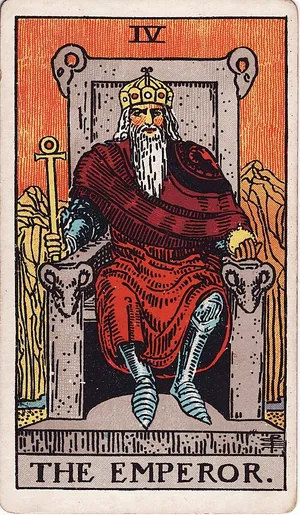

The Emperor is card IV (4) of the 22 Major Arcana in the Rider–Waite–Smith tarot, drawn by Pamela Colman Smith and published in London in 1909. It shows a white-bearded king on a square stone throne carved with rams’ heads, holding a sceptre and an orb against a red sky and bare mountains. Upright, it is read as structure, authority and steady responsibility; reversed, as that order gone rigid, or missing where it is needed.
Key facts
- Number and place: IV, between The Empress (III) and The Hierophant (V).
- Other names: older French decks call it L’Empereur.
- Upright in one line: order, leadership, boundaries, a plan made solid.
- Reversed in one line: control turned rigid, or a lack of structure and follow-through.
- Waite’s own key words (1910, a selection): stability, power, protection, realization, reason, authority, will; reversed, benevolence, compassion, obstruction, immaturity.
What the picture shows
Look at the card before reading any meaning into it. The numeral IV sits at the top of a sky washed in red and orange. The king sits square to us on a heavy grey stone throne. Rams’ heads are carved at its two upper corners and again on the fronts of both armrests, and a round emblem on his cape, at the viewer’s right shoulder, seems to carry another.
He is old, with long white hair and a long white beard, and wears a gold crown set with red stones. Over a red robe he has a deep red cape, and beneath it the pale blue of armour shows at his forearms and on both legs, down to pointed steel shoes. In his right hand, on the viewer’s left, he holds a tall gold sceptre shaped like an ankh, a cross with a loop at the top; in his left hand, a gold orb. Behind the throne rise steep, bare orange and yellow mountains, with no plant in sight, and at the foot of the cliffs on the left a thin strip of blue that some readers take for a stream. Smith’s monogram is on the throne’s base, lower right.
Waite’s description is brief: “He has a form of the Crux ansata for his sceptre and a globe in his left hand. He is a crowned monarch—commanding, stately, seated on a throne, the arms of which are fronted by rams’ heads.” Crux ansata is the Latin name for the ankh, the Egyptian sign of life. Waite says nothing about the armour or the mountains; later commentators often read the armour as readiness to defend what he has built, and the bare peaks as a hard-won, unyielding kind of rule.
Waite’s meanings in 1910
Waite’s divinatory meanings are listed in Part III of The Pictorial Key to the Tarot. His entry for the Emperor reads:
“Stability, power, protection, realization; a great person; aid, reason, conviction; also authority and will. Reversed: Benevolence, compassion, credit; also confusion to enemies, obstruction, immaturity.”
The reversed line is softer than many readers now expect. Benevolence and compassion sit alongside obstruction and immaturity, as if the king’s hard edge had turned to mildness, for good or ill.
In Part II, Waite calls the Emperor “executive and realization, the power of this world, here clothed with the highest of its natural attributes”. He pairs him with the card before: he is “the virile power, to which the Empress responds”, though he adds that the two cards “do not precisely represent the condition of married life, though this state is implied”. Above worldly rule there is “the higher kingship, occupying the intellectual throne”, “the lordship of thought rather than of the animal world”. Of two earlier readings he reports, he says that “will in its embodied form” is “only one of its applications”, and dismisses the other, the Emperor as “an expression of virtualities contained in the Absolute Being”, with “but this is fantasy”.
How the card is usually read today
One common modern reading sees the Emperor as the part of life that needs form: rules, plans, boundaries and someone willing to take responsibility for them. In that reading the stone throne matters as much as the crown. Take it as a prompt for reflection; it is not a forecast.
Upright. Common readings are leadership, discipline, a clear framework, protecting what has been built, or dealing with an authority such as an employer or an institution. Readers often note that the throne is square and steady: this is order that lasts, not a burst of energy.
Reversed. Waite’s benevolence and compassion stand apart from modern habit. Later readings usually take the reversal in one of two directions: control that has hardened into rigidity or domination, or the opposite, a lack of structure, follow-through or self-discipline.
Questions the Emperor puts on the table:
- Where would a clear rule or boundary make things easier for everyone?
- Is the order I am keeping still serving its purpose?
- What am I willing to take responsibility for, and what am I trying to control?
Upright and reversed at a glance
| Upright | Reversed | |
|---|---|---|
| Waite, 1910 | Stability, power, protection, realization; reason, conviction, authority, will | Benevolence, compassion, credit; confusion to enemies, obstruction, immaturity |
| Common reading today | Structure; leadership; responsibility | Rigid control; or a missing framework |
| A question to ask | What needs a firm shape? | Am I holding the reins too tightly, or not at all? |
The Emperor in a spread
The throne carries a different weight in each position.
- Three cards (Past, Present, Future). In the Past position, it can point to a rule, a routine or an authority figure that shaped the situation. In the Present, it asks whether things need more structure or less. In the Future position, readers usually take it as a prompt to think about what kind of order a next step would need, not as a fixed event.
- Celtic cross. In the Challenge position, the Emperor can invite reflection on friction with an authority, or on one’s own need for control. In the Crown position, some readers see an aim for stability or mastery, and ask what it would cost.
The positions of both spreads and the names of all 78 cards are in the tarot glossary; where the deck and its pictures come from is in the 1909 Rider–Waite–Smith tarot.
Cards often read next to the Emperor
- The Empress (III), the card before it: growth and care, set against his order and rule; Waite writes of them as a pair.
- The Hierophant (V), the card after it: authority again, but of teaching and tradition rather than of the state.
- The Chariot (VII): another armoured ruler, this time standing in a chariot; often read as will in action where the Emperor is will made steady.
- Justice (XI): also seated and facing forward; read as fairness and law where the Emperor is read as command.
In HeyFate, each card you draw is turned upright or reversed at random with even odds, and an AI model writes the reading. This page is the reference behind the card, not a reading of your own question.
Sources
- A. E. Waite, The Pictorial Key to the Tarot, Part II, “IV. The Emperor” (Wikisource, from the 1922 reprint)
- A. E. Waite, The Pictorial Key to the Tarot, Part III, §3, the divinatory meanings of the Greater Arcana (Wikisource, from the 1922 reprint)
- Wikimedia Commons: RWS Tarot 04 Emperor.jpg (Pam-A scan, public domain)
AI-generated content, for reference only; not medical, legal, financial or psychological advice. These methods come from cultural traditions, and HeyFate offers them for cultural interest, entertainment and self-reflection.