The Empress Tarot Card Meaning: Upright, Reversed and Symbolism
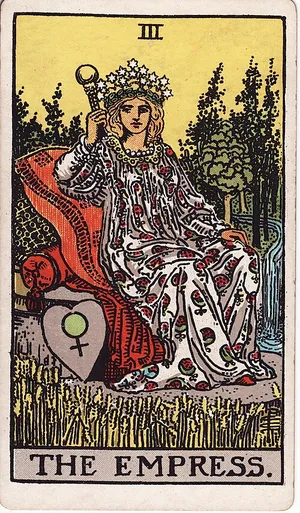

The Empress is card III (3) of the 22 Major Arcana in the Rider–Waite–Smith tarot, drawn by Pamela Colman Smith and published in London in 1909. It shows a crowned woman at ease on red cushions in a garden, with ripe grain at her feet, trees and a waterfall behind her, and a heart-shaped shield bearing the sign of Venus. Upright, it is read as abundance, care and things growing; reversed, as that growth stalled, smothered or neglected.
Key facts
- Number and place: III, between The High Priestess (II) and The Emperor (IV).
- Other names: older French decks call it L’Impératrice. Waite gathers several titles for her, among them “the Earthly Paradise” and refugium peccatorum, “refuge of sinners”.
- Upright in one line: fertility in the wide sense, nurture, comfort, creative work.
- Reversed in one line: growth blocked, care turned to smothering, self-neglect.
- Waite’s own key words (1910, a selection): fruitfulness, action, initiative, length of days; also difficulty, doubt; reversed, light, truth, “public rejoicings”.
What the picture shows
Look at the card before reading any meaning into it. The numeral III sits at the top of a yellow sky. Tall dark green trees crowd the right side and the far left, and on the right a narrow stream of blue water falls down from among them. Across the whole bottom of the card stands a field of ripe yellow grain.
The woman sits leaning back on a deep red couch heaped with cushions. She has long fair hair, a green wreath and, above it, a crown of white six-pointed stars; Waite says there are twelve. She wears a string of beads at her throat and a loose white gown printed all over with red fruit, often taken for pomegranates. Her right hand, on the viewer’s left, holds up a sceptre topped with a round globe; her left rests in her lap. Propped against the couch in the lower left is a grey heart-shaped shield marked with the sign of Venus, a circle above a cross.
Waite’s description matches the picture. It opens: “A stately figure, seated, having rich vestments and royal aspect, as of a daughter of heaven and earth.” He notes that her “diadem is of twelve stars, gathered in a cluster” and places the Venus symbol “on the shield which rests near her”. Then: “A field of corn is ripening in front of her, and beyond there is a fall of water.” Corn here means grain, in British usage. The sceptre, he says, “is surmounted by the globe of this world”. Unlike the High Priestess before her, she sits outdoors among growing things; later commentators often contrast the two as a closed temple and an open garden.
Waite’s meanings in 1910
Waite’s divinatory meanings are listed in Part III of The Pictorial Key to the Tarot. His entry for the Empress reads:
“Fruitfulness, action, initiative, length of days; the unknown, clandestine; also difficulty, doubt, ignorance. Reversed: Light, truth, the unravelling of involved matters, public rejoicings; according to another reading, vacillation.”
This list is less tidy than the picture. The upright line turns, halfway through, to the unknown and to doubt, and the reversed line is mostly bright: light, truth, things untangled. Anyone reading reversals as simply bad will find this card an exception in Waite’s own text.
In Part II he calls her “the inferior Garden of Eden, the Earthly Paradise, all that is symbolized by the visible house of man”, and “the fruitful mother of thousands”. She is “above all things universal fecundity and the outer sense of the Word”. He gives her a place in a pair: she is “the door or gate by which an entrance is obtained into this life”, while the way out “is the secret known to the High Priestess”. He also says plainly: “Most old attributions of this card are completely wrong on the symbolism”.
How the card is usually read today
One common modern reading sees the Empress as the conditions in which things grow: time, care, comfort and the senses, rather than effort and control. In that reading the ripening grain says more than the crown. Take it as a prompt for reflection; it is not a forecast.
Upright. Common readings are nurture, creative work, pleasure in the body and in nature, a home or project being tended, or generosity. Some readers link it to family; this page treats that as a theme to think about, not as news about anyone’s relationships or body.
Reversed. Waite’s reversed line, light, truth, vacillation, is far from the modern habit. Later readings usually take the reversal as growth that has stalled, care that has turned into smothering or dependence, or the carer forgetting to look after themselves.
Questions the card leaves open:
- What in my life is growing, and what does it need from me now?
- Am I tending something, or holding it too tightly?
- When did I last give myself the kind of care I give others?
Upright and reversed at a glance
| Upright | Reversed | |
|---|---|---|
| Waite, 1910 | Fruitfulness, action, initiative, length of days; also the unknown, doubt | Light, truth, the unravelling of involved matters, public rejoicings; vacillation |
| Common reading today | Nurture; creativity; abundance | Stalled growth; smothering care; self-neglect |
| A question to ask | What am I helping to grow? | What needs room rather than more attention? |
The Empress in a spread
The garden reads differently depending on where it falls.
- Three cards (Past, Present, Future). In the Past position, it can recall a season of care or ease that still feeds the present. In the Present, it asks what needs patience and tending rather than pushing. In the Future position, readers usually take it as a prompt to think about what you would like to cultivate, not as a promise of plenty.
- Celtic cross. In the Challenge position, the Empress can invite reflection on comfort that has become a trap, or on care given everywhere except to oneself. In the Environment position, some readers look at the people and surroundings that support the question, or crowd it.
The positions of both spreads and the names of all 78 cards are in the tarot glossary; where the deck and its pictures come from is in the 1909 Rider–Waite–Smith tarot.
Cards often read next to the Empress
- The High Priestess (II), the card before it: the inner, veiled temple beside the Empress’s open garden.
- The Emperor (IV), the card after it: in Part II, “IV. The Emperor”, Waite treats the two as a pair, calling him “the virile power, to which the Empress responds”; readers often contrast her growth with his order and rule.
- The Star (XVII): another woman among water and open land; often read as hope and renewal where the Empress is read as abundance.
- The Lovers (VI): a garden again, this time with a man and a woman whom Waite, in Part II, “VI. The Lovers”, likens to Adam and Eve. It is read as choice and union rather than plenty.
In HeyFate, each card you draw is turned upright or reversed at random with even odds, and an AI model writes the reading. This page is the reference behind the card, not a reading of your own question.
Sources
- A. E. Waite, The Pictorial Key to the Tarot, Part II, “III. The Empress” (Wikisource, from the 1922 reprint)
- A. E. Waite, The Pictorial Key to the Tarot, Part III, §3, the divinatory meanings of the Greater Arcana (Wikisource, from the 1922 reprint)
- Wikimedia Commons: RWS Tarot 03 Empress.jpg (Pam-A scan, public domain)
AI-generated content, for reference only; not medical, legal, financial or psychological advice. These methods come from cultural traditions, and HeyFate offers them for cultural interest, entertainment and self-reflection.