The Lovers Tarot Card Meaning: Upright, Reversed and Symbolism
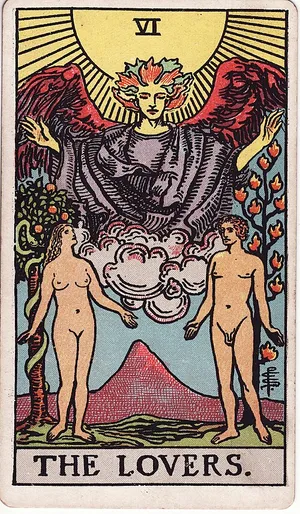

The Lovers is card VI (6) of the 22 Major Arcana in the Rider–Waite–Smith tarot, drawn by Pamela Colman Smith and published in London in 1909. It shows a naked man and woman standing in a garden beneath a winged figure and a blazing sun, a fruit tree with a serpent behind her and a tree of flames behind him. Upright, it is read as love, attraction and a choice made from one’s values; reversed, as imbalance, mismatch or a choice avoided.
Key facts
- Number and place: VI, between The Hierophant (V) and The Chariot (VII).
- Other names: older French decks call it L’Amoureux, “the lover”, and show a young man between two women with Cupid above. Waite says his design “replaces” that older picture.
- Upright in one line: connection, attraction, harmony, choosing in line with what you value.
- Reversed in one line: imbalance, values at odds, a decision put off.
- Waite’s own key words (1910, a selection): attraction, love, beauty, trials overcome; reversed, failure, foolish designs.
What the picture shows
Look at the card before reading any meaning into it. A large yellow sun with black rays fills the top of the card, with the numeral VI inside it. Below the sun, rising from a white cloud, is a winged figure with spreading red wings, hair like red and green flames, and a loose purple robe. Its arms are stretched wide, palms open, over the two people below.
The woman stands on the viewer’s left, the man on the right, both naked on green ground against a pale blue sky. She looks up towards the winged figure; he looks across at her. Behind her grows a tree hung with round red fruit, and a green snake winds up its trunk. Behind him stands a tree whose branches end in small flames. Between the two, in the distance, rises a single steep red mountain. Smith’s monogram sits low on the right, beside the man’s tree.
Waite’s description is close to the picture. “The sun shines in the zenith, and beneath is a great winged figure with arms extended, pouring down influences.” The pair are “unveiled before each other, as if Adam and Eve when they first occupied the paradise of the earthly body”. “Behind the man is the Tree of Life, bearing twelve fruits, and the Tree of the Knowledge of Good and Evil is behind the woman; the serpent is twining round it.” Smith drew the man’s tree with flames rather than fruit, and later commentators often count twelve of them. Many later writers also name the winged figure as the archangel Raphael; Waite does not name it.
Waite’s meanings in 1910
Waite’s divinatory meanings are listed in Part III of The Pictorial Key to the Tarot. His entry for the Lovers reads:
“Attraction, love, beauty, trials overcome. Reversed: Failure, foolish designs. Another account speaks of marriage frustrated and contrarieties of all kinds.”
The word “contrarieties” here means things going against you: oppositions and setbacks. And “designs” means plans. These are Waite’s century-old divinatory words, quoted as history, not statements about anyone’s relationship.
In Part II he reads the card more widely. The figures “suggest youth, virginity, innocence and love before it is contaminated by gross material desire”. “This is in all simplicity the card of human love, here exhibited as part of the way, the truth and the life.” He is explicit that his design is new: it “replaces, by recourse to first principles, the old card of marriage” and “the later follies which depicted man between vice and virtue”. On the woman, he keeps the idea of the Fall but presents her as “rather the working of a Secret Law of Providence than a willing and conscious temptress”, and adds that “only by her can he complete himself”. He also argues that the older pictures and meanings fall away together.
How the card is usually read today
One common modern reading sees the Lovers as more than romance: it is about a bond, and about the choice that bond asks for, made in line with one’s own values. In that reading the older picture of a man between two women still echoes, as the theme of choosing. Take it as a prompt for reflection; it is not a forecast.
Upright. Common readings are closeness, attraction, trust, a partnership of any kind, or a decision taken wholeheartedly. Some readers stress the openness of the picture: the two stand “unveiled”, with nothing hidden from each other.
Reversed. Waite’s reversed words, failure and foolish designs, are blunt. Later readings tend to be gentler: a relationship or agreement out of balance, a choice that pulls against one’s values, or a decision left hanging because each option costs something.
Questions to take away from the card:
- What do I value most in this situation, and does my choice reflect it?
- Where am I being open with someone, and where am I holding back?
- Is there a decision I keep circling instead of making?
Upright and reversed at a glance
| Upright | Reversed | |
|---|---|---|
| Waite, 1910 | Attraction, love, beauty, trials overcome | Failure, foolish designs; marriage frustrated, contrarieties of all kinds |
| Common reading today | Connection; harmony; a choice made from one’s values | Imbalance; values at odds; a choice avoided |
| A question to ask | What am I choosing, and why? | Where do my actions and my values part ways? |
The Lovers in a spread
The card’s choice looks different from each position.
- Three cards (Past, Present, Future). In the Past position, it can recall a bond or a decision that set the course of the question. In the Present, it asks what you are choosing between, and what each option means to you. In the Future position, readers usually take it as a prompt to think about which values should guide a next step, not as a promise about any relationship.
- Celtic cross. In the Challenge position, the Lovers can invite reflection on a divided loyalty, or on two things you want that do not fit together. In the Hopes position, some readers see a wish for closeness or agreement, and ask what it would take from you.
The positions of both spreads and the names of all 78 cards are in the tarot glossary; where the deck and its pictures come from is in the 1909 Rider–Waite–Smith tarot.
Cards often read next to the Lovers
- The Hierophant (V), the card before it: two figures kneel to receive a teaching; here two stand and choose.
- The Chariot (VII), the card after it: a choice made, now driven forward by will.
- The Devil (XV): the same layout of a man, a woman and a winged figure above them, but chained; readers often pair the two as free union and bondage.
- The Empress (III): another garden; read as abundance where the Lovers are read as union and choice.
In HeyFate, each card you draw is turned upright or reversed at random with even odds, and an AI model writes the reading. This page is the reference behind the card, not a reading of your own question.
Sources
- A. E. Waite, The Pictorial Key to the Tarot, Part II, “VI. The Lovers” (Wikisource, from the 1922 reprint)
- A. E. Waite, The Pictorial Key to the Tarot, Part III, §3, the divinatory meanings of the Greater Arcana (Wikisource, from the 1922 reprint)
- Wikimedia Commons: RWS Tarot 06 Lovers.jpg (Pam-A scan, public domain)
AI-generated content, for reference only; not medical, legal, financial or psychological advice. These methods come from cultural traditions, and HeyFate offers them for cultural interest, entertainment and self-reflection.