The Chariot Tarot Card Meaning: Upright, Reversed and Symbolism
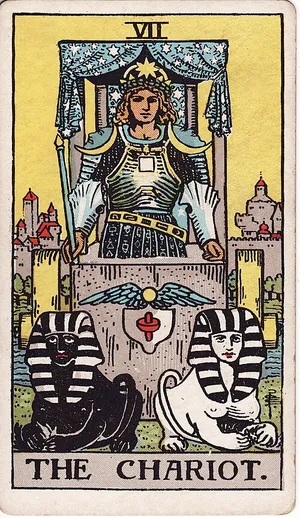

The Chariot is card VII (7) of the 22 Major Arcana in the Rider–Waite–Smith tarot. It shows an armoured young man standing in a square grey chariot under a starry canopy, with a black sphinx and a white sphinx lying in front of it and a walled town behind. Upright, it is read as drive and self-command that carry a person forward; reversed, as that drive scattered, stalled or turned into conflict.
Key facts
- Number and place: VII, between The Lovers (VI) and Strength (VIII).
- Other names: the printed title is THE CHARIOT; Waite calls the figure “the victorious hero” and “the charioteer”.
- Upright in one line: willpower, direction, holding opposing forces on one course.
- Reversed in one line: losing the reins, pulling in two directions, force that becomes a quarrel.
- Waite’s own key words (1910): succour, providence; also war, triumph, presumption, vengeance, trouble.
What the picture shows
Smith set the scene against a flat yellow sky. The charioteer stands upright inside a square grey block that serves as the body of the chariot. Above him hangs a blue canopy scattered with white stars, held up on posts. He wears a crown topped with a gold star and a wreath, and a breastplate with a white square on the chest. On each shoulder sits a yellow crescent moon. His belt and the skirt of his tunic carry small signs; later commentators often read them as astrological and planetary glyphs.
In his right hand he holds a long light-blue wand or sceptre with a gold tip, resting it on the rim of the chariot; his left hand rests on the rim with nothing in it. Waite’s text describes him “carrying a drawn sword”, but the scan shows a wand, not a sword. On the front of the chariot is a winged disc in blue and gold, and below it a shield with a red emblem that later commentators often read as a union of opposites.
The two sphinxes lie in front, one black and one white, both in striped headdresses. Neither is harnessed, and no reins can be seen. Behind the chariot a river runs past a town of grey walls and red roofs, with a few trees on the bank.
Waite’s meanings in 1910
In Part III of The Pictorial Key to the Tarot, Waite gives the divinatory meaning of the Chariot as:
“Succour, providence; also war, triumph, presumption, vengeance, trouble. Reversed: Riot, quarrel, dispute, litigation, defeat.”
His Part II reading is more ambitious. It opens with “An erect and princely figure”, a hero who “has led captivity captive” and is “conquest on all planes—in the mind, in science, in progress, in certain trials of initiation”. He says “two sphinxes thus draw his chariot”, a detail he took from Éliphas Lévi, and that the hero has “replied to the sphinx”. On the figure’s shoulders “are supposed to be the Urim and Thummim”, objects placed in the Hebrew high priest’s breastpiece (Exodus 28:30); what Smith actually drew there are the two crescent moons.
Waite also sets limits on the victory. The hero “is above all things triumph in the mind”, but his conquests are “manifest or external and not within himself”, and his freedom “may leave himself in the bondage of the logical understanding”. If he stood before the High Priestess, Waite says, “he could not open the scroll called Tora”. He ends: “He is not hereditary royalty and he is not priesthood.” The Chariot, in his account, is a real but outward triumph, short of inner wisdom.
How the card is usually read today
One common modern reading treats the Chariot as directed will: choosing a course and keeping two pulling forces, the black and the white sphinx, on it without reins. On this reading the point is less winning than steering. It works as a prompt for reflection, not a statement about what lies ahead.
Upright. Readers often talk about focus, discipline and momentum: a goal that is clear enough to organise effort around, or the self-control needed to hold mixed feelings together long enough to act. Some point to Waite’s own caveat and add that an outward win does not settle everything inside.
Reversed. Waite’s reversed words, “Riot, quarrel, dispute, litigation, defeat”, describe the chariot losing its order. Later readings soften this into drift or scattered energy, pushing hard without a clear direction, or the opposite: holding the reins so tightly that nothing moves.
Questions people often draw from the card:
- Where am I heading, and have I actually chosen it?
- Which two parts of me pull in different directions, and can they still move together?
- Is the victory I want an outward one, and what would it leave unanswered?
Upright and reversed at a glance
| Upright | Reversed | |
|---|---|---|
| Waite, 1910 | Succour, providence; war, triumph, presumption, vengeance, trouble | Riot, quarrel, dispute, litigation, defeat |
| Common reading today | Willpower; a chosen direction; opposing forces held on one course | Scattered effort; losing control; conflict instead of progress |
| A question to ask | What am I steering towards? | Where has my effort turned into a fight? |
The Chariot in a spread
What the card points to depends on where it lands.
- Three cards (Past, Present, Future). As Past, it can recall a push or a decision that set things moving. As Present, it asks whether your energy has a clear direction right now. As Future, it can be taken as a question about which course you want to commit to, rather than a promise of success.
- Celtic cross. In the Challenge position, readers often look at competing demands that are hard to drive together. In the Crown position, it can stand for a goal you are steering by; next to the Hermit or the Hanged Man, many readers ask whether pressing on or pausing fits the question better.
The positions of both spreads and the names of all 78 cards are in the tarot glossary; where the deck and its pictures come from is in the 1909 Rider–Waite–Smith tarot.
Cards often read next to the Chariot
- The Lovers (VI), the card before it: a choice. The Chariot is often read as setting off once the choice is made.
- Strength (VIII), the card after it: another form of mastery, by patience rather than command.
- The High Priestess (II): Waite himself sets the charioteer before her pillars and says that if she questioned him he could not answer.
- The Hermit (IX): the inward road the Chariot’s outward triumph does not cover.
In HeyFate, each card you draw is turned upright or reversed at random with even odds, and an AI model writes the reading. This page is the reference behind the card, not a reading of your own question.
Sources
- A. E. Waite, The Pictorial Key to the Tarot, Part II, “VII. The Chariot” (Wikisource, from the 1922 reprint)
- A. E. Waite, The Pictorial Key to the Tarot, Part III, §3, the divinatory meanings of the Greater Arcana (Wikisource, from the 1922 reprint)
- Wikimedia Commons: RWS Tarot 07 Chariot.jpg (Pam-A scan, public domain)
AI-generated content, for reference only; not medical, legal, financial or psychological advice. These methods come from cultural traditions, and HeyFate offers them for cultural interest, entertainment and self-reflection.