The Hermit Tarot Card Meaning: Upright, Reversed and Symbolism
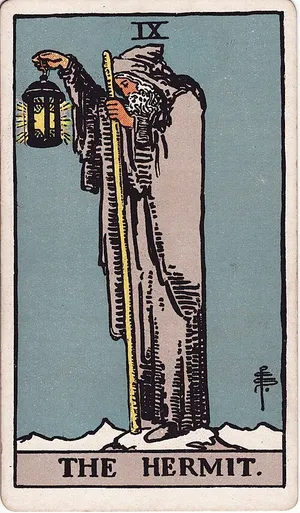

The Hermit is card IX (9) of the 22 Major Arcana in the Rider–Waite–Smith tarot. It shows an old man in a grey hooded cloak standing alone on a snowy height, holding up a lantern in one hand and a long staff in the other. Upright, it is read as withdrawal, reflection and searching for one’s own light; reversed, as isolation that has gone too far, or a refusal to look inward at all.
Key facts
- Number and place: IX, between Strength (VIII) and Wheel of Fortune (X).
- Other names: the printed title is THE HERMIT; in Chinese the card is 隐者, also rendered 隐士 (hermit, recluse).
- Upright in one line: solitude by choice, careful thought, a light held up for the way ahead.
- Reversed in one line: loneliness, hiding, or caution that has turned into fear.
- Waite’s own key words (1910): prudence, circumspection; “also and especially treason, dissimulation, roguery, corruption”.
What the picture shows
The Hermit is one of the sparest pictures in the deck. The background is a flat blue-grey, with no sun, moon or stars. A tall figure in a long grey cloak and hood stands in profile, facing left, on a strip of white, jagged ground that reads as snow on a mountain top. His long white beard spills out of the hood, and his head is bowed, his eyes lowered.
In one hand, raised to about head height, he holds a black-framed lantern by its ring. Yellow light glows through its bars, and short rays spread out around it. Waite says: “It is a star which shines in the lantern.” In this scan you can see a bright yellow shape behind the bars, though at this size its points are hard to count. Later commentators usually describe it as a six-pointed star. In the other hand he holds a long yellow staff that reaches from the ground to about head height, its top beside his hood. Smith’s monogram is on the right, at about the height of his knee.
There is nothing else in the scene: no path, no building, no other person. Everything depends on the one figure and the one light.
Waite’s meanings in 1910
In Part III of The Pictorial Key to the Tarot, Waite’s entry for the Hermit reads:
“Prudence, circumspection; also and especially treason, dissimulation, roguery, corruption. Reversed: Concealment, disguise, policy, fear, unreasoned caution.”
The list is surprising next to the picture: half of it names vices. His Part II reading points somewhere else entirely. The one change from older designs, he says, is that the lamp “is not enveloped partially in the mantle of its bearer”, who “blends the idea of the Ancient of Days with the Light of the World”. He calls it “a card of attainment” and says the figure holds “his beacon on an eminence”, so that the light says: “where I am, you also may be.”
He then rejects three earlier explanations. The Hermit is not, as Court de Gébelin had it, “a wise man in search of truth and justice”, nor “an especial example of experience”. And it is “understood quite incorrectly” when tied to “occult isolation”, which he calls “one of the frivolous renderings which we owe to Éliphas Lévi”. What the card shows, in his words, is “the truth that the Divine Mysteries secure their own protection from those who are unprepared”. For Waite, then, the Hermit is not a seeker but someone who has arrived and holds up a light for others.
How the card is usually read today
One common modern reading of the Hermit is time apart: stepping back from noise to think something through, and trusting a small light enough to walk by it. It is often treated as an invitation rather than a state to stay in. Take it as something to reflect on, not as a verdict on what is coming.
Upright. Readers often mention solitude chosen for a reason, study, a pause before a decision, or advice from someone older or more experienced. Some follow Waite’s own emphasis and read the lantern as the experience a person can offer others once they have found their footing.
Reversed. Waite’s reversed words, “Concealment, disguise, policy, fear, unreasoned caution”, lean towards hiding. Later readings describe withdrawal that has become isolation, avoiding people or questions, or the reverse: never allowing oneself any time alone to think.
Questions the card often brings up:
- What would I see more clearly with some quiet and distance?
- Is my withdrawal giving me room to think, or helping me avoid something?
- What have I learned that might light the way for someone else?
Upright and reversed at a glance
| Upright | Reversed | |
|---|---|---|
| Waite, 1910 | Prudence, circumspection; especially treason, dissimulation, roguery, corruption | Concealment, disguise, policy, fear, unreasoned caution |
| Common reading today | Chosen solitude; reflection; inner guidance; a mentor | Isolation; hiding; caution driven by fear; no time to reflect |
| A question to ask | What do I need quiet to understand? | What am I hiding from? |
The Hermit in a spread
The card’s place in the layout shapes the question it raises.
- Three cards (Past, Present, Future). In the Past, it can point back to a period of withdrawal or study that still informs you. In the Present, it asks whether you need time apart before going on. In the Future position, readers often take it as a suggestion to leave space for reflection, not as a forecast of being alone.
- Celtic cross. In the Environment position, it may prompt thought about someone in your circle whose experience you could draw on. In the Hopes position, it can name a wish for quiet or clarity; beside the Chariot, readers often weigh the pull between pressing on and stepping back.
The positions of both spreads and the names of all 78 cards are in the tarot glossary; where the deck and its pictures come from is in the 1909 Rider–Waite–Smith tarot.
Cards often read next to the Hermit
- Strength (VIII), the card before it: inner steadiness, which the Hermit carries into solitude.
- Wheel of Fortune (X), the card after it: the quiet of the mountain top gives way to a turning world.
- The High Priestess (II): another card of hidden knowledge; she guards it, the Hermit holds a light to it.
- The Star (XVII): another card where a star is the light to steer by, this time a large star high in an open sky.
In HeyFate, each card you draw is turned upright or reversed at random with even odds, and an AI model writes the reading. This page is the reference behind the card, not a reading of your own question.
Sources
- A. E. Waite, The Pictorial Key to the Tarot, Part II, “IX. The Hermit” (Wikisource, from the 1922 reprint)
- A. E. Waite, The Pictorial Key to the Tarot, Part III, §3, the divinatory meanings of the Greater Arcana (Wikisource, from the 1922 reprint)
- Wikimedia Commons: RWS Tarot 09 Hermit.jpg (Pam-A scan, public domain)
AI-generated content, for reference only; not medical, legal, financial or psychological advice. These methods come from cultural traditions, and HeyFate offers them for cultural interest, entertainment and self-reflection.