The High Priestess Tarot Card Meaning: Upright, Reversed and Symbolism
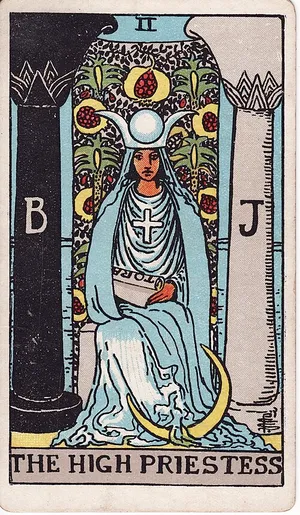

The High Priestess is card II (2) of the 22 Major Arcana in the Rider–Waite–Smith tarot, drawn by Pamela Colman Smith and published in London in 1909. It shows a woman in blue seated between a black pillar and a white one, a half-hidden scroll in her lap and a crescent moon at her feet. Upright, it is read as quiet knowledge, intuition and what is not yet said; reversed, as that inner sense ignored, or knowledge kept on the surface.
Key facts
- Number and place: II, between The Magician (I) and The Empress (III).
- Other names: older French decks call it La Papesse, the Female Pope; Waite notes that she “has been called Occult Science on the threshold of the Sanctuary of Isis”.
- Upright in one line: intuition, silence, a secret, knowing more than is shown.
- Reversed in one line: an inner voice overridden, hidden matters, shallow knowledge.
- Waite’s own key words (1910, a selection): secrets, mystery, “the future as yet unrevealed”, silence, tenacity, wisdom; reversed, passion, conceit, surface knowledge.
What the picture shows
Look at the card before reading any meaning into it. The numeral II sits at the top. A woman sits very still, facing us, on a grey stone seat. On the left stands a black pillar with a white letter B; on the right a pale grey pillar with a black letter J. Both are topped with pointed, flower-like capitals. Behind her hangs a veil stretched between the pillars, patterned with green palm leaves and round yellow pomegranates split open to show red seeds. Pale blue shows above and around the veil.
She wears a horned crown with a white globe set between the horns, a pale blue mantle over a white gown, and on her breast a white cross. In her lap she holds a scroll; the letters TORA can be read on it, and the rest is tucked under her mantle. A yellow crescent moon lies at her feet, and the hem of her gown pours over the floor in folds. Smith’s monogram is in the lower right, at the foot of the J pillar.
Waite’s description follows the picture closely: “the lunar crescent at her feet, a horned diadem on her head, with a globe in the middle place, and a large solar cross on her breast”. He names the pillars “J. and B.” of “the mystic Temple”; in the Bible the two pillars of Solomon’s Temple are called Jachin and Boaz (1 Kings 7:21). The scroll’s partial cover is deliberate, he says, “to shew that some things are implied and some spoken”. Later commentators often read the flowing gown as water and the blue behind the veil as a sea; Waite says only that her vestments are “flowing and gauzy”.
Waite’s meanings in 1910
Waite’s divinatory meanings are listed in Part III of The Pictorial Key to the Tarot. His entry for the High Priestess reads:
“Secrets, mystery, the future as yet unrevealed; the woman who interests the Querent, if male; the Querent herself, if female; silence, tenacity; mystery, wisdom, science. Reversed: Passion, moral or physical ardour, conceit, surface knowledge.”
“Science” here keeps its older sense of learning or knowledge in general. The reversed line is a neat contrast: where the upright card is silent and deep, the reversed one is heated and shallow.
Part II is where Waite says most. He rejects the “Occult Science” label: she is “really the Secret Church, the House which is of God and man”. She is “the Queen of the borrowed light, but this is the light of all”, and her truest name, he says, is Shekinah, “the co-habiting glory”, a Hebrew term for the divine presence dwelling among people. He adds that “when he reads the Law she gives the Divine meaning”, and he ends with a strong claim: “There are some respects in which this card is the highest and holiest of the Greater Arcana.”
How the card is usually read today
One common modern reading treats the High Priestess as the part of you that knows before it can explain: a hunch, a sense of something unspoken, the value of waiting before acting. In that reading the half-covered scroll matters more than the crown. Take it as a prompt for reflection; it is not a forecast.
Upright. Common readings are intuition, a pause to listen, a matter not yet in the open, study, or keeping one’s own counsel. Readers often contrast her stillness with the busy Magician before her: nothing is being done here, and that is the point.
Reversed. Waite’s reversed words, passion, ardour, conceit, surface knowledge, describe a turn from depth to heat. Later readings usually add an inner voice drowned out by noise or other people’s views, secrets that weigh on someone, or a withdrawal that has gone on too long.
Questions worth sitting with:
- What do I already sense about this that I have not put into words?
- Is my silence here patience, or avoidance?
- Which part of the scroll am I trying to read too soon?
Upright and reversed at a glance
| Upright | Reversed | |
|---|---|---|
| Waite, 1910 | Secrets, mystery, the future unrevealed; silence, tenacity, wisdom | Passion, moral or physical ardour, conceit, surface knowledge |
| Common reading today | Intuition; waiting; what is not yet said | Inner voice ignored; hidden strain; shallow knowing |
| A question to ask | What do I know without being told? | What am I refusing to listen to? |
The High Priestess in a spread
Her quiet takes on a different weight in each position.
- Three cards (Past, Present, Future). In the Past position, it can point to something learnt slowly or kept private that still shapes the question. In the Present, it asks whether this is a time to gather understanding rather than to act. In the Future position, readers usually take it as a prompt to leave room for what is not yet clear, not as a fixed event.
- Celtic cross. In the Challenge position, the High Priestess can invite reflection on what is unknown or unspoken in the situation. In the Hopes position, some readers see a wish for clarity, or for privacy, and ask which one it really is.
The positions of both spreads and the names of all 78 cards are in the tarot glossary; where the deck and its pictures come from is in the 1909 Rider–Waite–Smith tarot.
Cards often read next to the High Priestess
- The Magician (I), the card before it: outward will and skill, set against her inward knowing.
- The Empress (III), the card after it: in Part II, “III. The Empress”, Waite says that the way out of her garden “is the secret known to the High Priestess”.
- The Hierophant (V): another figure between pillars, but teaching in public; in Part II, “V. The Hierophant”, Waite notes that “the High Priestess makes no sign”.
- The Moon (XVIII): the crescent at her feet becomes a whole card; often read as uncertainty where she is read as calm insight.
In HeyFate, each card you draw is turned upright or reversed at random with even odds, and an AI model writes the reading. This page is the reference behind the card, not a reading of your own question.
Sources
- A. E. Waite, The Pictorial Key to the Tarot, Part II, “II. The High Priestess” (Wikisource, from the 1922 reprint)
- A. E. Waite, The Pictorial Key to the Tarot, Part III, §3, the divinatory meanings of the Greater Arcana (Wikisource, from the 1922 reprint)
- Wikimedia Commons: RWS Tarot 02 High Priestess.jpg (Pam-A scan, public domain)
AI-generated content, for reference only; not medical, legal, financial or psychological advice. These methods come from cultural traditions, and HeyFate offers them for cultural interest, entertainment and self-reflection.