The Magician Tarot Card Meaning: Upright, Reversed and Symbolism
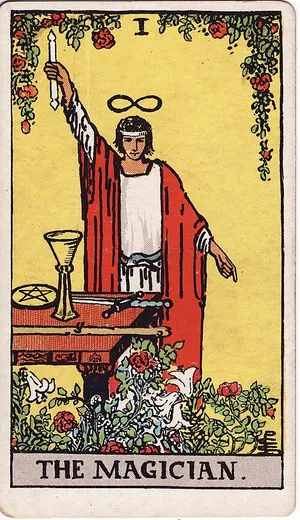

The Magician is card I (1) of the 22 Major Arcana in the Rider–Waite–Smith tarot, drawn by Pamela Colman Smith and published in London in 1909. It shows a young man in a red cloak behind a table, one hand raising a white wand to the sky and the other pointing to the ground, with a cup, a coin, a sword and a wand laid out in front of him. Upright, it is read as skill and will put to work; reversed, as talent left idle, scattered or used to mislead.
Key facts
- Number and place: I, between The Fool (0) and The High Priestess (II).
- Other names: older French decks call it Le Bateleur, the street conjuror or juggler; in RWS he has become a magician at work rather than a showman.
- Upright in one line: resources at hand, focus, an idea turned into action.
- Reversed in one line: ability unused or misdirected, scattered effort, sleight of hand.
- Waite’s own key words (1910, a selection): skill, diplomacy, address, subtlety, self-confidence, will; but also sickness, loss and “snares of enemies”.
What the picture shows
Look at the card before reading any meaning into it. The background is plain yellow, with the Roman numeral I at the top. A garland of red roses and green leaves hangs across the top edge and trails down both sides, and more red roses and white lilies grow thickly in the foreground below the table. Smith’s monogram is tucked into the bottom right corner.
The young man stands facing us, dark-haired, with a white band round his head. Above it floats a black horizontal figure of eight. He wears a white tunic under a long red cloak, with a blue-grey band at the waist. His right arm, on the viewer’s left, is raised straight up and holds a short white wand; his left arm, on the viewer’s right, points down, the index finger aimed at the ground.
On the red table in front of him lie the four suit signs of the Minor Arcana: a tall golden cup, a round disc marked with a five-pointed star, a sword laid flat with its blue hilt, and a plain wooden wand along the front edge. The table is drawn side-on, so the objects are spread out like tools on a workbench.
Waite’s description is close to the picture. He gives the figure “the countenance of divine Apollo, with smile of confidence and shining eyes”, calls the figure of eight “the sign of life, like an endless cord”, and says the belt is “a serpent-cincture, the serpent appearing to devour its own tail”. In this scan the belt shows only as a blue-grey band, and a snake is hard to make out at this size. Waite does not mention the roses hanging above the figure, only the flowers “beneath”.
Waite’s meanings in 1910
Waite’s divinatory meanings are listed in Part III of The Pictorial Key to the Tarot. His entry for the Magician reads:
“Skill, diplomacy, address, subtlety; sickness, pain, loss, disaster, snares of enemies; self-confidence, will; the Querent, if male. Reversed: Physician, Magus, mental disease, disgrace, disquiet.”
The word “address” here has its old sense: deftness, tact in handling people. It is worth seeing that his upright list is not all bright. Skill and will sit beside sickness and disaster, and the reversed list mixes a person (a physician, a magus) with troubles.
Part II reads the card on another level. The raised wand and the pointing hand are a “dual sign” that “shews the descent of grace, virtue and light, drawn from things above and derived to things below”. The four objects on the table “lie like counters before the adept, and he adapts them as he wills”. The roses and lilies have been “changed into garden flowers, to shew the culture of aspiration”. In sum, he writes, the card “signifies the divine motive in man, reflecting God, the will in the liberation of its union with that which is above”. Later commentators often compress the gesture into the phrase “as above, so below”; that wording is theirs, not Waite’s in this entry.
How the card is usually read today
One common modern reading sees the Magician as the moment when you have what you need and choose to use it: the tools are on the table, and what matters is attention and intent. Take it as a prompt for reflection; it is not a forecast.
Upright. Common readings are focus, initiative, a skill coming into its own, clear communication, or the sense that the pieces of a plan are finally in reach. Many readers point out that the four objects stand for different kinds of means, so the card can ask which of them you are actually using.
Reversed. Waite’s reversed list, a physician, a magus, disquiet, disgrace, does not map neatly onto modern use. Later readings usually take the reversal as ability not put to work, energy split across too many tasks, or the shadow side of the showman: persuasion that slides into trickery, by others or by oneself.
Questions the Magician can open up:
- What do I already have on the table that I have not yet picked up?
- Is my attention on one thing, or spread across all four?
- Where might I be talking myself, or someone else, into something?
Upright and reversed at a glance
| Upright | Reversed | |
|---|---|---|
| Waite, 1910 | Skill, diplomacy, subtlety, self-confidence, will; also sickness, loss, snares of enemies | Physician, Magus, mental disease, disgrace, disquiet |
| Common reading today | Focus; skill in use; means at hand | Talent left idle; scattered effort; manipulation |
| A question to ask | What can I do with what is already here? | What am I not using, or using to mislead? |
The Magician in a spread
The same raised wand reads differently from one position to the next.
- Three cards (Past, Present, Future). In the Past position, it can recall a time you acted with confidence, and what you learned you could do. In the Present, it asks what is within reach right now and whether you are using it. In the Future position, readers usually take it as a prompt to think about which skills a next step would need, not as a promise of success.
- Celtic cross. In the Challenge position, the Magician can invite reflection on whether the trouble is too many options rather than too few, or a gap between words and action. In the Root position, some readers look at the abilities and habits that underlie the whole question.
The positions of both spreads and the names of all 78 cards are in the tarot glossary; where the deck and its pictures come from is in the 1909 Rider–Waite–Smith tarot.
Cards often read next to the Magician
- The Fool (0), the card before it: a traveller setting out with a rose, a staff and a small bag; the Magician gathers the means.
- The High Priestess (II), the card after it: the Magician acts and shows; the High Priestess keeps silent and knows. Readers often pair them as outer will and inner knowing.
- The Chariot (VII): will again, but driving forward rather than working at a table.
- Strength (VIII): the same horizontal figure of eight appears above the woman’s head; readers often contrast his skill with her patience.
In HeyFate, each card you draw is turned upright or reversed at random with even odds, and an AI model writes the reading. This page is the reference behind the card, not a reading of your own question.
Sources
- A. E. Waite, The Pictorial Key to the Tarot, Part II, “I. The Magician” (Wikisource, from the 1922 reprint)
- A. E. Waite, The Pictorial Key to the Tarot, Part III, §3, the divinatory meanings of the Greater Arcana (Wikisource, from the 1922 reprint)
- Wikimedia Commons: RWS Tarot 01 Magician.jpg (Pam-A scan, public domain)
AI-generated content, for reference only; not medical, legal, financial or psychological advice. These methods come from cultural traditions, and HeyFate offers them for cultural interest, entertainment and self-reflection.