The Fool Tarot Card Meaning: Upright, Reversed and Symbolism
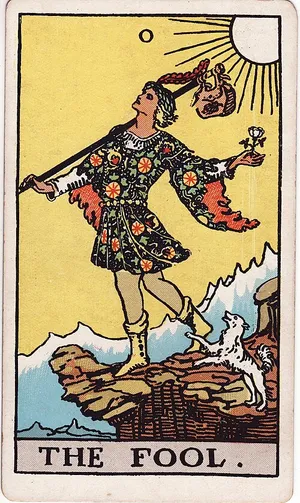

The Fool is card 0 of the 22 Major Arcana in the Rider–Waite–Smith tarot, drawn by Pamela Colman Smith and published in London in 1909. It shows a young traveller in a bright tunic stepping out at the edge of a cliff, a white rose in one hand and a small white dog at his heels. Upright, it is read as a fresh start made with open curiosity; reversed, as that openness turned careless, distracted or held back.
Key facts
- Number and place: printed 0 on the card. In the usual RWS order it stands before The Magician (I). Waite himself discusses it between The Last Judgment (XX, printed JUDGEMENT on the card) and The World (XXI) in Parts II and III of The Pictorial Key to the Tarot, and in the conclusion to the Greater Keys (Part II, §3) he remarks that wherever it ought to be put, “the Zero is an unnumbered card”.
- Other names: older French decks call it Le Mat; Waite notes that one old by-name for it was “the alchemist”.
- Upright in one line: a beginning, a leap of trust, curiosity without a fixed plan.
- Reversed in one line: carelessness, drift, or a first step put off.
- Waite’s own key words (1910, a selection): folly, mania, extravagance, intoxication, frenzy; reversed, negligence, carelessness, apathy, vanity.
What the picture shows
Look at the card before reading any meaning into it. A small 0 sits at the top of a bright yellow sky, and a white sun with long black rays fills the upper right corner. Below it a young man stands on a brown rocky ledge, his front foot planted on the rock and his back foot lifted behind him, caught in mid-stride. His face is tipped up towards the sky, not down at the drop in front of him.
He wears a dark tunic patterned with green leaves and round red-and-yellow rosettes shaped like little wheels, with a belt at the waist, wide sleeves lined in red, pale hose and yellow boots. A green wreath circles his head, with a red feather standing up from it. Over one shoulder he carries a long black staff, and from its far end, up near the sun, hangs a small patterned bag. In his other hand, held out lightly, is a single white rose.
A small white dog jumps up beside him on the right, front paws off the ground, its head turned towards him. Behind them rise white, snow-capped peaks shaded in pale blue, and much lower, in the bottom left corner, a line of distant grey mountains. The edge of the cliff is just ahead of his front foot; the picture stops before he steps over it.
Waite’s description matches most of this. It opens “With light step”, and goes on to a young man who “pauses at the brink of a precipice”, whose dog “is still bounding”, with “a rose in one hand and in the other a costly wand”, from which hangs “a wallet curiously embroidered”. He says the young man “surveys the blue distance before him—its expanse of sky rather than the prospect below”. Later commentators often read the white rose as innocence and the dog as instinct, or as a warning bark; Waite gives neither meaning.
Waite’s meanings in 1910
Waite’s divinatory meanings are listed in Part III of The Pictorial Key to the Tarot. His entry for the Fool reads:
“Folly, mania, extravagance, intoxication, delirium, frenzy, bewrayment. Reversed: Negligence, absence, distribution, carelessness, apathy, nullity, vanity.”
The last word, “bewrayment”, is an old word for betrayal or disclosure: letting a secret out.
His Part II reading points almost the other way. There the young man is “a prince of the other world on his travels through this one” and “the spirit in search of experience”. The cliff edge “has no terror; it is as if angels were waiting to uphold him, if it came about that he leaped from the height”. The sun behind him “knows whence he came, whither he is going, and how he will return by another path after many days”.
Waite is openly cool about the older view. He reports: “The conventional explanations say that the Fool signifies the flesh, the sensitive life”; and he uses the card to argue that the Trumps Major “had no place originally in the arts of psychic gambling”. So on this card the gap between his two lists is wide: Part III gives a row of disorders, while Part II gives a spirit setting out on a journey.
How the card is usually read today
One common modern reading treats the Fool as the start of a journey: the moment before the first step, when you know little and are open to a great deal. Some readers go further and follow the cards from 0 to XXI as stages of that journey, with the Fool as the traveller who passes through them all. Take it as a prompt for reflection; it is not a forecast.
Upright. Common readings are a new beginning, trying something unfamiliar, acting on curiosity, a trip, or a willingness to look a little foolish while learning. Readers often point to the lightness of the picture: he carries almost nothing and looks up, not down.
Reversed. Waite’s reversed list, negligence, carelessness, apathy, names a different problem: not too much daring but too little attention. Later readings add two opposite versions. One is recklessness, stepping off without looking at the ground. The other is a start held back, staying at the edge because the drop feels too large.
Some questions the card can raise:
- What would I try if I did not need to know how it ends?
- Where am I being open, and where am I simply not paying attention?
- What am I carrying that I could set down before I begin?
Upright and reversed at a glance
| Upright | Reversed | |
|---|---|---|
| Waite, 1910 | Folly, mania, extravagance, intoxication, frenzy | Negligence, absence, carelessness, apathy, nullity, vanity |
| Common reading today | A new start; curiosity; a leap of trust | Carelessness; a step taken without looking; a start held back |
| A question to ask | What would I begin with an open mind? | Am I watching where I put my feet? |
The Fool in a spread
Where the Fool lands changes the question it asks.
- Three cards (Past, Present, Future). In the Past position, it can point back to a time you set out without much of a map, and what that start set going. In the Present, it asks what you would try now if you let yourself be a beginner. In the Future position, readers usually take it as a prompt to think about what kind of start you want, not as an event that is bound to come.
- Celtic cross. In the Challenge position, the Fool can invite reflection on whether eagerness is skipping over details, or whether caution is keeping you at the edge too long. In the Self position, some readers see the attitude you bring to the question: open, unguarded, perhaps not yet sure of the ground.
The positions of both spreads and the names of all 78 cards are in the tarot glossary; where the deck and its pictures come from is in the 1909 Rider–Waite–Smith tarot.
Cards often read next to the Fool
- The Magician (I), the card after it: the Fool sets out with almost nothing; the Magician has his tools laid out on the table and puts them to work.
- The World (XXI): the end of the sequence. Readers often pair the two as the start and the close of one cycle, and Waite himself places the Fool just before it.
- The Hermit (IX): another lone figure on a height, but one who lowers his gaze and holds up a lantern rather than looking towards the sky.
- The Sun (XIX): open sky and a figure unafraid; often read as plain joy where the Fool is read as setting out.
In HeyFate, each card you draw is turned upright or reversed at random with even odds, and an AI model writes the reading. This page is the reference behind the card, not a reading of your own question.
Sources
- A. E. Waite, The Pictorial Key to the Tarot, Part II, “Zero. The Fool” (Wikisource, from the 1922 reprint)
- A. E. Waite, The Pictorial Key to the Tarot, Part III, §3, the divinatory meanings of the Greater Arcana (Wikisource, from the 1922 reprint)
- Wikimedia Commons: RWS Tarot 00 Fool.jpg (Pam-A scan, public domain)
AI-generated content, for reference only; not medical, legal, financial or psychological advice. These methods come from cultural traditions, and HeyFate offers them for cultural interest, entertainment and self-reflection.