Strength Tarot Card Meaning: Upright, Reversed and Symbolism
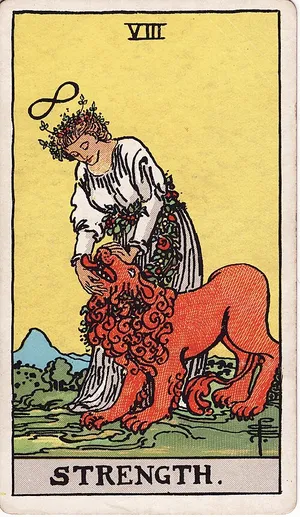

Strength is card VIII (8) of the 22 Major Arcana in the Rider–Waite–Smith tarot. It shows a woman in white bending over a red lion and holding its jaws, a figure-of-eight sign floating above her head. Upright, it is read as courage and steady inner strength that tames rather than forces; reversed, as that strength faltering, or turning into force and control.
Key facts
- Number and place: VIII, between The Chariot (VII) and The Hermit (IX). Older decks often number Strength XI and Justice VIII; Waite swapped them.
- Other names: Waite heads the card “Strength, or Fortitude” and lists it simply as “Fortitude” in his divinatory meanings. The printed card says STRENGTH.
- Upright in one line: gentle courage, patience, mastery of impulse without violence.
- Reversed in one line: self-doubt, or the opposite, strength used as domination.
- Waite’s own key words (1910): power, energy, action, courage, magnanimity; also complete success and honours.
What the picture shows
The background is a plain yellow sky. A woman in a long white gown stands on green ground, leaning forward over a lion. One hand rests on its upper jaw and the other on its lower jaw, so that she seems to be closing its mouth; the lion’s red tongue is still showing. Her face is calm, her eyes lowered. The lion is drawn in red-orange with a heavy curled mane, its head raised towards her and its tail tucked between its hind legs.
Above her head floats a black figure-of-eight sign, the lemniscate. She wears a wreath of leaves and small flowers in her hair, and a garland of red flowers and leaves wraps round her waist and trails down towards the lion. On the left, behind her, a blue mountain rises above a line of green trees. Smith’s monogram stands in the lower right corner.
In the 1922 reprint used here, Waite says the sign over her head is “the same symbol of life which we have seen in the card of the Hierophant”. In the deck itself, the same figure-of-eight floats over the head of the Magician (I); the Hierophant (V) does not have it. Read his sentence with the picture of the Magician in mind.
Waite’s meanings in 1910
In Part III of The Pictorial Key to the Tarot, Waite lists this card under the name Fortitude:
“Power, energy, action, courage, magnanimity; also complete success and honours. Reversed: Despotism, abuse of power, weakness, discord, sometimes even disgrace.”
In Part II, he says the only change from older designs is “that her beneficent fortitude has already subdued the lion, which is being led by a chain of flowers”. He also explains the number, briefly: “For reasons which satisfy myself, this card has been interchanged with that of Justice, which is usually numbered eight.” He gives no further reason.
His symbolic reading turns away from ordinary confidence. The card “has nothing to do with self-confidence in the ordinary sense”, he writes, but with “the confidence of those whose strength is God”. The chain of flowers stands for “the sweet yoke and the light burden of Divine Law, when it has been taken into the heart of hearts”. In one aspect, “the lion signifies the passions, and she who is called Strength is the higher nature in its liberation”. He is careful to add that these higher meanings “are, however, matters of inference” and not “transparent on the surface of the card”.
How the card is usually read today
One common modern reading takes Strength as quiet courage: the ability to meet something wild, in oneself or outside, with patience instead of force. The lion is held, not beaten. Treat it as a prompt for reflection, not a judgement on how things will go.
Upright. Readers often speak of composure under pressure, compassion, and the kind of self-control that comes from understanding an impulse rather than suppressing it. Some note that the woman does not look strained, and take that as the point: strength that does not need to show itself.
Reversed. Waite’s reversed list, “Despotism, abuse of power, weakness, discord”, runs in two directions, too much force and too little. Later readings keep both: self-doubt and feeling overwhelmed by one’s own reactions, or trying to win through pressure and control.
Some questions the card can raise:
- What feeling or habit am I trying to overpower, when it might respond better to patience?
- Where would a gentler approach take more courage than a forceful one?
- Am I confusing being in control with being strong?
Upright and reversed at a glance
| Upright | Reversed | |
|---|---|---|
| Waite, 1910 | Power, energy, action, courage, magnanimity; complete success and honours | Despotism, abuse of power, weakness, discord, sometimes disgrace |
| Common reading today | Gentle courage; patience; impulse understood and steadied | Self-doubt; being swept by reactions; strength turned into control |
| A question to ask | What would patience do here? | Am I pushing, or giving way, when neither helps? |
Strength in a spread
Each position puts a different question to the card.
- Three cards (Past, Present, Future). In the Past position it can recall a time you stayed steady when it was hard. In the Present, it asks how you are handling a strong feeling right now. In the Future position, readers tend to treat it as an invitation to choose patience over force, not as a forecast of how something turns out.
- Celtic cross. In the Root position, it can point to resilience the situation already rests on. In the Self position, many readers ask how you relate to your own temper and drive; beside the Chariot, the pair is often read as two ways of mastering, command and gentleness.
The positions of both spreads and the names of all 78 cards are in the tarot glossary; where the deck and its pictures come from is in the 1909 Rider–Waite–Smith tarot.
Cards often read next to Strength
- The Chariot (VII), the card before it: mastery by will and direction, where Strength masters by patience.
- The Hermit (IX), the card after it: strength turned inward into solitude and reflection.
- Justice (XI): the card Waite swapped it with; in many older decks Justice is VIII.
- The Magician (I): the other card with the figure-of-eight over the head, often read as will meeting skill.
In HeyFate, each card you draw is turned upright or reversed at random with even odds, and an AI model writes the reading. This page is the reference behind the card, not a reading of your own question.
Sources
- A. E. Waite, The Pictorial Key to the Tarot, Part II, “VIII. Strength, or Fortitude” (Wikisource, from the 1922 reprint)
- A. E. Waite, The Pictorial Key to the Tarot, Part III, §3, the divinatory meanings of the Greater Arcana (Wikisource, from the 1922 reprint)
- Wikimedia Commons: RWS Tarot 08 Strength.jpg (Pam-A scan, public domain)
AI-generated content, for reference only; not medical, legal, financial or psychological advice. These methods come from cultural traditions, and HeyFate offers them for cultural interest, entertainment and self-reflection.