The Star Tarot Card Meaning: Upright, Reversed and Symbolism
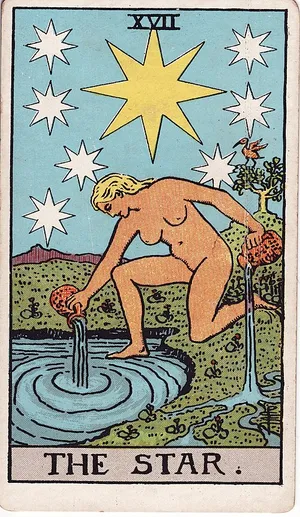

The Star is card XVII (17) of the 22 Major Arcana in the Rider–Waite–Smith tarot, drawn by Pamela Colman Smith and published in London in 1909. It shows a naked woman kneeling at the edge of a pool under one large star and seven smaller ones, pouring water from two jugs onto the water and the land. Upright, it is usually read as hope, renewal and quiet confidence after a hard time; reversed, as that hope dimmed, with discouragement or a loss of faith in yourself.
Key facts
- Number and place: XVII, between The Tower (XVI) and The Moon (XVIII).
- Other names: in Part I, Waite heads it “The Star, Dog-Star, or Sirius, also called fantastically the Star of the Magi”; in Part II he calls the great star l’étoile flamboyante, “the blazing star” of Masonic symbolism.
- Upright in one line: hope, healing, a calm and open outlook.
- Reversed in one line: hope dimmed, doubt, feeling cut off from what used to sustain you.
- Waite’s own key words (1910): loss, theft, privation, abandonment; or, by “another reading”, hope and bright prospects.
What the picture shows
A large yellow star with eight points fills the top of the card. Around it are seven smaller white stars, four down the left side and three on the right, each also with eight points, just as Waite describes: “A great, radiant, star of eight rays, surrounded by seven lesser stars”. The sky is a pale, even blue.
Below, a woman with fair hair kneels on a grassy bank. She is, in Waite’s words, “entirely naked”. One knee rests on the grass and the other foot stands on the surface of the pool; Waite specifies: “Her left knee is on the land and her right foot upon the water.” She holds a red-brown jug in each hand. From the one on your left, water pours into the pool and spreads in rings of ripples. From the one on your right, water falls onto the grass and runs off across it in thin, winding streams. Waite says she pours “Water of Life” from “two great ewers, irrigating sea and land”.
Behind her the ground rises to a small tree on the right, and a red bird with a long beak perches on top of it. Waite calls it simply “a bird” and does not name the species; some later readings link it to the ibis and the Egyptian god Thoth. A low line of purple hills runs along the horizon on the left, and the grass is dotted with small red-budded plants. Smith’s monogram is at the lower right.
Waite’s meanings in 1910
Waite’s divinatory meaning, from Part III of The Pictorial Key to the Tarot, is short and a little surprising:
“Loss, theft, privation, abandonment; another reading says—hope and bright prospects, Reversed: Arrogance, haughtiness, impotence.”
This is one of the cards where the old list and the modern reading point in almost opposite directions. Waite puts loss first, and gives hope only as an alternative.
His Part II reading is more generous, though he is impatient with the simple version. He dismisses the “card of hope” idea in one line: “The summary of several tawdry explanations says that it is a card of hope.” Then: “On other planes it has been certified as immortality and interior light.” He does accept one older view, introduced with “It has been said truly”: that the card’s mottoes are “Waters of Life freely” and “Gifts of the Spirit”. He says the figure “expresses eternal youth and beauty”. For “the majority of prepared minds”, he writes, she will appear as “the type of Truth unveiled”. His own view goes further into Kabbalah: she is “in reality the Great Mother in the Kabalistic Sephira Binah”, supernal Understanding, who passes her influence down “in the measure that they can receive” it.
How the card is usually read today
One common modern reading takes the Star as the card of hope that follows a loss: after the shock of the Tower, a still night, a clear sky and water poured out freely. In that reading the card is less about a specific good outcome than about being open and unguarded again. Use it to reflect on your own situation; it does not foretell one.
Upright. Readers often connect it with recovery, a sense of direction returning, generosity, inspiration, or being able to trust again. The two jugs are sometimes read as giving to both the inner and outer sides of life, the pool and the land.
Reversed. Waite gives “Arrogance, haughtiness, impotence”. Later readings more often take the reversed Star as hope that has worn thin: discouragement, self-doubt, or feeling disconnected from the things that once renewed you. Some read it as a reminder that hope may need small, practical steps rather than waiting for a sign.
Some questions to sit with:
- What still gives me hope here, even if it is small?
- What am I pouring out, and is any of it coming back to replenish me?
- Where have I stopped trusting myself, and since when?
Upright and reversed at a glance
| Upright | Reversed | |
|---|---|---|
| Waite, 1910 | Loss, theft, privation, abandonment; or hope and bright prospects | Arrogance, haughtiness, impotence |
| Common reading today | Hope, healing, renewal; calm after hardship | Discouragement, self-doubt, feeling cut off |
| A question to ask | What is worth hoping for here? | What would help my hope recover? |
The Star in a spread
Each position gives the card a slightly different question.
- Three cards (Past, Present, Future). In the Past position, it can point to a time of recovery or encouragement that still supports you. In the Present, it asks what is helping you heal or keep going. As the Future, readers usually take it as an invitation to name what you hope for and what would nourish it, not as a promise.
- Celtic cross. In the Hopes position, the Star asks you to look plainly at what you want, and how much of your energy it is drawing on. In the Challenge position, it may point to hope that is hard to hold onto. In the Outcome position, many readers look at The Tower or other hard cards earlier in the spread, and read the Star as the space for repair that comes after them.
The positions of both spreads and the names of all 78 cards are in the tarot glossary; where the deck and its pictures come from is in the 1909 Rider–Waite–Smith tarot.
Cards often read next to the Star
- The Tower (XVI), the card before it: sudden collapse. The two are often read together as loss followed by hope.
- The Moon (XVIII), the card after it: another night sky, but uncertain and shifting rather than clear.
- Temperance (XIV): another figure with water, one foot on land and one on water; read as balance rather than hope.
- The World (XXI): in Part II, “XXI. The World”, Waite notes that the World’s figure “has been said to stand for Truth, which is, however, more properly allocated to the seventeenth card”.
In HeyFate, each card you draw is turned upright or reversed at random with even odds, and an AI model writes the reading. This page is the reference behind the card, not a reading of your own question.
Sources
- A. E. Waite, The Pictorial Key to the Tarot, Part I, §2 “Trumps Major”, “17. The Star” (Wikisource, from the 1922 reprint)
- A. E. Waite, The Pictorial Key to the Tarot, Part II, “XVII. The Star” (Wikisource, from the 1922 reprint)
- A. E. Waite, The Pictorial Key to the Tarot, Part III, §3, the divinatory meanings of the Greater Arcana (Wikisource, from the 1922 reprint)
- Wikimedia Commons: RWS Tarot 17 Star.jpg (Pam-A scan, public domain)
AI-generated content, for reference only; not medical, legal, financial or psychological advice. These methods come from cultural traditions, and HeyFate offers them for cultural interest, entertainment and self-reflection.