Temperance Tarot Card Meaning: Upright, Reversed and Symbolism
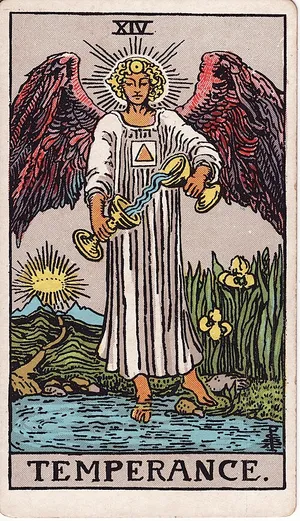

Temperance is card XIV (14) of the 22 Major Arcana in the Rider–Waite–Smith tarot, drawn by Pamela Colman Smith and published in London in 1909. It shows a winged angel pouring water from one cup into another, with one foot in a pool and the other on the bank. Upright, it is read as balance, patience and the careful mixing of things that pull in different directions; reversed, as that balance lost, with excess, friction or interests that will not combine.
Key facts
- Number and place: XIV, between Death (XIII) and The Devil (XV).
- Other names: none in common use. Waite says the card is “called Temperance fantastically”, after what it does: it tempers and combines.
- Upright in one line: moderation, a steady hand, combining opposites into something workable.
- Reversed in one line: imbalance, overdoing it, or parts of a life that pull against each other.
- Waite’s own key words (1910): economy, moderation, frugality, management, accommodation.
What the picture shows
A tall figure in a long white robe stands at the centre with large red-and-purple wings spread behind. Its curly golden hair is ringed by fine rays of light, and a small gold disc sits on its forehead; Waite calls this “the sign of the sun”. On the breast of the robe is a white square with an orange triangle inside it, which Waite reads as “the square and triangle of the septenary” (four plus three, seven). Just above the square, at the neckline, are a few small Hebrew letters; later commentators often read them as the divine name YHVH, though Waite’s entry does not mention them.
Waite writes that he speaks of the angel “in the masculine sense, but the figure is neither male nor female”. The angel holds two gold cups, one higher than the other, and a stream of blue water runs diagonally from the higher cup into the lower one. Its right foot (on your left) stands in the pool; its left foot rests on a stone at the edge of the grass. Waite says this “one foot upon the earth and one upon waters” shows the nature of the essences being poured.
On the left, a path leaves the water and winds up between green hills to two blue peaks, where a bright light shines. Waite says a crown is “seen vaguely” in that light; in this scan it reads mostly as a glowing disc, with a ring of dots inside. On the right, tall green leaves rise from the bank with two yellow irises. Waite says nothing about them. Smith’s monogram is at the lower right, just above the title.
Waite’s meanings in 1910
Waite’s Part III of The Pictorial Key to the Tarot gives the card’s divinatory meaning in a single entry:
“Economy, moderation, frugality, management, accommodation. Reversed: Things connected with churches, religions, sects, the priesthood, sometimes even the priest who will marry the Querent; also disunion, unfortunate combinations, competing interests.”
The reversed line is a good reminder of how much these old lists reflect their period: the reversed meanings jump from careful housekeeping to churches and clergy, and only then to “disunion” and “competing interests”.
His symbolic reading in Part II is very different in tone. He says the angel “is held to be pouring the essences of life from chalice to chalice”, and that the path up to the light holds “some part of the Secret of Eternal Life, as it is possible to man in his incarnation”. He rejects the older explanations of the card, “changes in the seasons, perpetual movement of life and even the combination of ideas”, and denies that the angel is the genius of the sun. His own explanation of the name is the key line: when its rule holds in our consciousness, “it tempers, combines and harmonises the psychic and material natures”.
How the card is usually read today
One common modern reading treats Temperance as the art of finding the right measure: not giving up something, but blending it with its opposite until both can work together. The pouring between cups becomes an image of patience, adjustment and testing a mixture a little at a time. Treat it as a question to sit with, not a forecast.
Upright. Readers often take it as a call to pace yourself, to bring work and rest, or reason and feeling, back into proportion, or to find a middle path between two positions. Some see it as healing after the ending shown in Death, the card before it: a slow return to balance rather than a dramatic turn.
Reversed. Waite’s “disunion, unfortunate combinations, competing interests” is the part many later readings keep. Later readings add excess or impatience: too much of one thing, rushing a process that needs time, or trying to combine elements that do not mix. Some also read it as a sign that the inner and outer sides of life have drifted apart.
Some questions to sit with:
- Where am I using too much, or too little, of something?
- What two parts of my situation could be blended rather than set against each other?
- Am I giving this process the time it actually needs?
Upright and reversed at a glance
| Upright | Reversed | |
|---|---|---|
| Waite, 1910 | Economy, moderation, frugality, management, accommodation | Churches, sects, the priesthood; disunion, unfortunate combinations, competing interests |
| Common reading today | Balance, patience, the middle way; blending opposites | Imbalance, excess, impatience; parts that will not combine |
| A question to ask | What needs a steadier, more measured hand? | Where has the mixture gone out of proportion? |
Temperance in a spread
Where the card sits shapes what it asks.
- Three cards (Past, Present, Future). As the Past, it can point back to a period of adjustment or recovery that set the current balance. In the Present, it asks whether you are pacing yourself or forcing things. As the Future, readers usually take it as a prompt to keep blending and adjusting, not as a promise that things will settle on their own.
- Celtic cross. In the Challenge position, Temperance can invite reflection on patience itself: the difficulty may be that a slow process cannot be hurried. In the Root position, it may point to a long habit of compromise worth looking at. In the Outcome position, many readers look at the cards around it to see which elements are being brought together.
The positions of both spreads and the names of all 78 cards are in the tarot glossary; where the deck and its pictures come from is in the 1909 Rider–Waite–Smith tarot.
Cards often read next to Temperance
- Death (XIII), the card before it: an ending and transition. Temperance is often read as the slow mending that follows.
- The Devil (XV), the card after it: excess and bondage, the reverse of measure. The two are often contrasted.
- Judgement (XX): in Part II, “XX. The Last Judgment”, Waite says that card “has been called truly in the past a card of eternal life, and for this reason it may be compared with that which passes under the name of Temperance”.
- The Star (XVII): another figure pouring water with a foot on land and on water, read as hope rather than balance.
In HeyFate, each card you draw is turned upright or reversed at random with even odds, and an AI model writes the reading. This page is the reference behind the card, not a reading of your own question.
Sources
- A. E. Waite, The Pictorial Key to the Tarot, Part II, “XIV. Temperance” (Wikisource, from the 1922 reprint)
- A. E. Waite, The Pictorial Key to the Tarot, Part III, §3, the divinatory meanings of the Greater Arcana (Wikisource, from the 1922 reprint)
- Wikimedia Commons: RWS Tarot 14 Temperance.jpg (Pam-A scan, public domain)
AI-generated content, for reference only; not medical, legal, financial or psychological advice. These methods come from cultural traditions, and HeyFate offers them for cultural interest, entertainment and self-reflection.