Death Tarot Card Meaning: Upright, Reversed and Symbolism
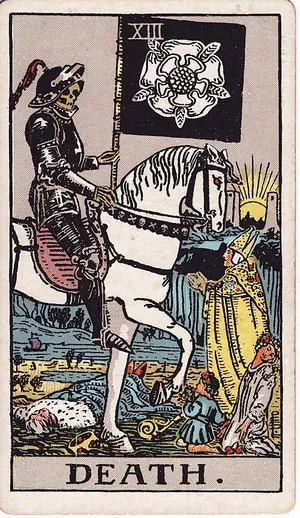

Death is card XIII (13) of the 22 Major Arcana in the Rider–Waite–Smith tarot. It shows a skeleton in black armour riding a white horse and carrying a black banner with a white rose, while a king lies fallen and a bishop, a girl and a child meet him on the ground. Upright, it is read as an ending that makes way for change; reversed, as change resisted, delayed or stuck halfway. Drawing it is not a forecast that anyone will die.
Key facts
- Number and place: XIII, between The Hanged Man (XII) and Temperance (XIV).
- Other names: in many Tarot de Marseille decks the card carries only its number, with no title; the RWS card prints DEATH.
- Upright in one line: an ending, a closing chapter, transformation.
- Reversed in one line: holding on, stagnation, a change that will not complete.
- Waite’s own key words (1910, abridged): end, mortality, destruction, corruption; reversed, “Inertia, sleep, lethargy”.
What the picture shows
The rider fills the left half of the card. Under a black helmet with a red plume, the face is a bare skull; the rest of the body is covered by black plate armour. He sits on a white horse that walks to the right, its bridle and breast band decorated with small skulls and crossed bones. In his hand he holds a pole with a black banner, on which a white five-petalled rose is drawn. He carries no sword or scythe.
Four people are on the ground around the horse. A king in an ermine-trimmed robe lies on his back on the ground at lower left, his crown fallen by the horse’s hoof. A bishop in a tall yellow mitre and gold robe faces the rider with his hands raised together, and a yellow crook-shaped staff lies on the ground nearby. Below him a small child in blue kneels and looks up, flowers in its hair, and beside the child a young woman with a wreath of flowers kneels and turns her head away.
Behind them a river runs across the card, with a boat under a red sail and a few trees on the bank. On the horizon at the right, a yellow sun sits half above the land between two tall towers, rays spreading upward. Waite calls these “two pillars on the verge of the horizon” and the light “the sun of immortality”; later commentators disagree about whether it is rising or setting.
Waite’s meanings in 1910
In Part III of The Pictorial Key to the Tarot, Waite gives the old divinatory meaning in full:
“End, mortality, destruction, corruption; also, for a man, the loss of a benefactor; for a woman, many contrarieties; for a maid, failure of marriage projects. Reversed: Inertia, sleep, lethargy, petrifaction, somnambulism; hope destroyed.”
These are the stock meanings of fortune-telling in his day, sorted by who was asking. They are quoted here as history; they say nothing about anyone’s life now. Waite himself had warned earlier in Part II that such meanings were “largely arbitrary attributions”.
His Part II reading is very different in tone. He opens: “The veil or mask of life is perpetuated in change, transformation and passage from lower to higher”, and says this is better shown by “one of the apocalyptic visions than by the crude notion of the reaping skeleton”. That is why Smith drew a slow horseman instead of a figure with a scythe. “Behind it lies the whole world of ascent in the spirit.” The rose on the banner “signifies life”.
Waite does not turn the card into pure metaphor. He says the death hinted at in the previous card, the Hanged Man, is meant mystically, “but this is not the case in the present instance”. Of this card he writes: “The natural transit of man to the next stage of his being either is or may be one form of his progress”; and he sets it apart from the “mystical death” some reach “while still in this life”: “a change in the form of consciousness”, to which “ordinary death is neither the path nor gate”. He closes by saying that the occult explanations of this card are “better than usual”: “rebirth, creation, destination, renewal, and the rest”.
How the card is usually read today
One common modern reading treats Death as the card of endings and transition: something finishes so that something else can begin. Many reading guides stress that it is about change, not physical death. Waite, too, reports the occult explanations “rebirth, creation, destination, renewal” as better than usual, though his own discussion covers both ordinary death and mystical change. Read it as a prompt for reflection, never as a forecast about anyone’s life or health.
Upright. Readers often speak of a chapter closing, a habit or role that has run its course, or the clear break that lets new things grow. Some point to the white rose on the banner and the sun between the towers: the scene is not only about loss.
Reversed. Waite’s reversed words, “Inertia, sleep, lethargy, petrifaction”, describe being frozen in place. Later readings carry this into change that is resisted, held off or only half made: staying in something that has already ended, or fearing what comes after.
Some questions to sit with:
- What in my life has already ended, even if I have not admitted it yet?
- What am I keeping alive out of habit or fear?
- If this chapter closed, what might have room to begin?
Upright and reversed at a glance
| Upright | Reversed | |
|---|---|---|
| Waite, 1910 | End, mortality, destruction, corruption; old omens sorted by man, woman and maid | Inertia, sleep, lethargy, petrifaction, somnambulism; hope destroyed |
| Common reading today | An ending that clears the way; transition; renewal | Resisting change; stagnation; a change left halfway |
| A question to ask | What is ready to end? | What am I holding on to that has already gone? |
Death in a spread
The position frames what kind of ending the card asks you to think about.
- Three cards (Past, Present, Future). In the Past, it can mark an ending that still shapes the present. In the Present, it asks whether something has run its course. In the Future position, readers usually treat it as a question about what you are ready to let go of, never as a fixed event or a statement about health.
- Celtic cross. In the Challenge position, it can point to a change that is hard to accept. In the Outcome position, many readers look at the cards around it, such as Temperance or the Star, and read the pair as an ending followed by a slower rebuilding.
The positions of both spreads and the names of all 78 cards are in the tarot glossary; where the deck and its pictures come from is in the 1909 Rider–Waite–Smith tarot.
Cards often read next to Death
- The Hanged Man (XII), the card before it: the pause before the ending; in Part II, “XII. The Hanged Man”, Waite writes of “the sacred Mystery of Death” and “a glorious Mystery of Resurrection”.
- Temperance (XIV), the card after it: blending and balance once the old has passed.
- The Tower (XVI): also read as an ending, but sudden and from outside, where Death’s rider moves at a walk.
- Judgement (XX): often read as rising again, the renewal in the explanations Waite reports for this card. Waite calls it “The Last Judgment”; the printed card says JUDGEMENT.
In HeyFate, each card you draw is turned upright or reversed at random with even odds, and an AI model writes the reading. This page is the reference behind the card, not a reading of your own question.
Sources
- A. E. Waite, The Pictorial Key to the Tarot, Part II, “XIII. Death” (Wikisource, from the 1922 reprint)
- A. E. Waite, The Pictorial Key to the Tarot, Part III, §3, the divinatory meanings of the Greater Arcana (Wikisource, from the 1922 reprint)
- Wikimedia Commons: RWS Tarot 13 Death.jpg (Pam-A scan, public domain)
AI-generated content, for reference only; not medical, legal, financial or psychological advice. These methods come from cultural traditions, and HeyFate offers them for cultural interest, entertainment and self-reflection.