Judgement Tarot Card Meaning: Upright, Reversed and Symbolism
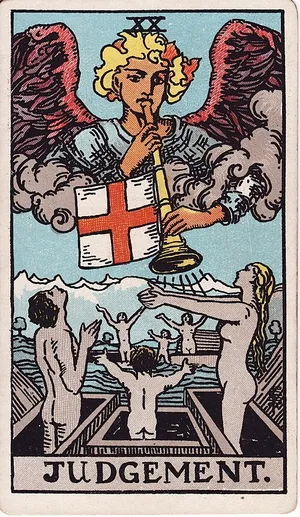

Judgement is card XX (20) of the 22 Major Arcana in the Rider–Waite–Smith tarot, drawn by Pamela Colman Smith and published in London in 1909. It shows an angel in the clouds blowing a trumpet hung with a cross banner, while naked figures rise from open tombs below with their arms raised. Upright, it is read as a call, an awakening, or taking stock of the past to begin again; reversed, as hesitation to answer that call, or a judgement of yourself that is too harsh.
Key facts
- Number and place: XX, between The Sun (XIX) and The World (XXI).
- Other names: the card is printed JUDGEMENT, but Waite’s own text calls it “The Last Judgment”. The name is also often spelt “Judgment”.
- Upright in one line: awakening, renewal, a reckoning that frees you to move on.
- Reversed in one line: doubt, delay, not trusting the call, or being hard on yourself.
- Waite’s own key words (1910): change of position, renewal, outcome.
What the picture shows
An angel fills the top half of the card, wrapped from the waist down in grey clouds. The wings are a deep red and purple, the hair golden and curling, with a tuft of red at one side like a small flame. The angel holds a long golden trumpet to the lips with both hands; short lines spread down from its bell, as if marking the sound. From the trumpet hangs a square white banner with a red cross. Waite notes simply that “the cross as usual is displayed on the banner”.
Below is a sea, and behind it a range of white, snow-covered mountains. Open tombs, drawn like long boxes, float on the water. In the foreground three figures stand up out of them, all pale grey: a man on the left, seen from behind and side, looking up with his hands lifted; a woman on the right with long golden hair, stretching her arms up towards the angel; and between them a child with its back to us, both arms raised. This is the grouping Waite describes: “a woman on the right, a man on the left hand, and between them their child, whose back is turned”. Further back, three more distant figures rise from the tombs with their arms open.
Waite remarks on that second group: “in this card there are more than three who are restored”, a change he says was made on purpose to show “the insufficiency of current explanations”. He also asks the reader to notice that “all the figures are as one in the wonder, adoration and ecstacy expressed by their attitudes”.
Waite’s meanings in 1910
Waite’s Part III of The Pictorial Key to the Tarot lists the card under the name the Last Judgment:
“Change of position, renewal, outcome. Another account specifies total loss though lawsuit. Reversed: Weakness, pusillanimity, simplicity; also deliberation, decision, sentence.”
The word “though” in the second sentence appears to be a misprint for “through”: the sense is a total loss by way of a lawsuit. The reversed list mixes timidity (“pusillanimity”) with the vocabulary of a court: “deliberation, decision, sentence”.
In Part II he moves from the outward picture to an inward one. The card, he writes, “registers the accomplishment of the great work of transformation in answer to the summons of the Supernal—which summons is heard and answered from within”. He then asks: “What is that within us which does sound a trumpet and all that is lower in our nature rises in response—almost in a moment, almost in the twinkling of an eye?” For “those who can see no further”, the card may go on showing the Last Judgment and the bodily resurrection; but those “who have inward eyes” will see why it “has been called truly in the past a card of eternal life”.
How the card is usually read today
One common modern reading treats Judgement as a call that you hear from inside: a moment of honest review, after which you rise and take up something you had set aside. It is less about being judged by someone else than about answering for your own life and starting again. It invites a review of your own; it does not pronounce a verdict.
Upright. Readers often connect it with awakening to a vocation or a truth, making peace with the past, forgiving yourself or others, or a decision that has been coming for a long time. The open arms of the figures are often read as readiness: they do not cower, they respond.
Reversed. Waite’s “deliberation, decision, sentence” is still close to some modern readings of hesitation and weighing up. Later readings add self-doubt, ignoring an inner call, fear of being judged, or a harsh verdict on yourself that keeps you from moving on.
Some questions to sit with:
- What is calling me now, and what keeps me from answering it?
- What part of my past am I ready to review honestly, and then put down?
- Am I judging myself more harshly than I would judge someone else?
Upright and reversed at a glance
| Upright | Reversed | |
|---|---|---|
| Waite, 1910 | Change of position, renewal, outcome; or total loss through a lawsuit | Weakness, pusillanimity, simplicity; deliberation, decision, sentence |
| Common reading today | Awakening, renewal, honest review; answering a call | Hesitation, self-doubt, a harsh verdict on yourself |
| A question to ask | What am I being called to rise to? | What stops me from answering? |
Judgement in a spread
Its position decides which side of the card comes forward.
- Three cards (Past, Present, Future). In the Past position, it can point to a turning point or realisation that still shapes your choices. In the Present, it asks what you are reviewing or being asked to decide now. In the Future position, readers usually take it as an invitation to prepare for a decision or a fresh start, not as a verdict that is coming.
- Celtic cross. In the Self position, Judgement can invite reflection on how you weigh your own actions. In the Past position, it may point to a reckoning that has already happened. In the Outcome position, many readers look at the cards around it to see what is being reconsidered, and what might rise from it.
The positions of both spreads and the names of all 78 cards are in the tarot glossary; where the deck and its pictures come from is in the 1909 Rider–Waite–Smith tarot.
Cards often read next to Judgement
- The Sun (XIX), the card before it: clear daylight. Judgement turns that clarity into a summons.
- The World (XXI), the card after it: completion, the end of the Major Arcana’s sequence.
- Temperance (XIV): in this card’s Part II entry, Waite says it “has been called truly in the past a card of eternal life, and for this reason it may be compared with that which passes under the name of Temperance”.
- Death (XIII): an ending; Judgement is often read as the rising that answers it.
In HeyFate, each card you draw is turned upright or reversed at random with even odds, and an AI model writes the reading. This page is the reference behind the card, not a reading of your own question.
Sources
- A. E. Waite, The Pictorial Key to the Tarot, Part II, “XX. The Last Judgment” (Wikisource, from the 1922 reprint)
- A. E. Waite, The Pictorial Key to the Tarot, Part III, §3, the divinatory meanings of the Greater Arcana (Wikisource, from the 1922 reprint)
- Wikimedia Commons: RWS Tarot 20 Judgement.jpg (Pam-A scan, public domain)
AI-generated content, for reference only; not medical, legal, financial or psychological advice. These methods come from cultural traditions, and HeyFate offers them for cultural interest, entertainment and self-reflection.